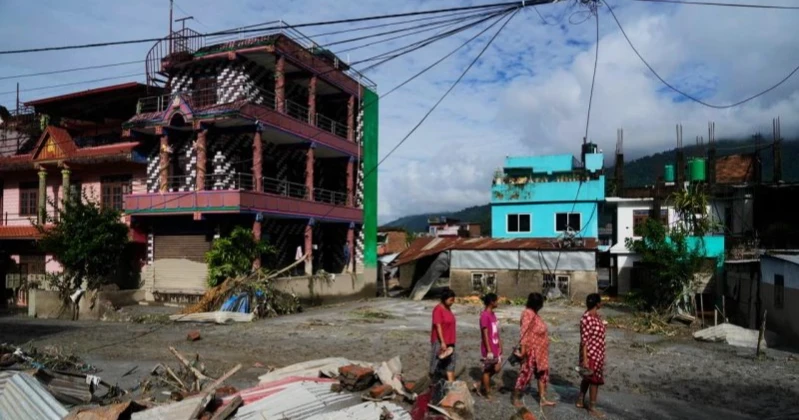
Rescue teams searched Thursday for hundreds of people missing along the Nepal-China border after a massive flood and mudslide swept through several communities following what experts believe was a glacier collapse.
At least 273 people were killed and more than 1,300 remained missing in Nepal and Tibet, including foreign nationals and pilgrims. Hundreds of people were also forced to leave their homes.
Videos showed floodwaters sweeping away people, buildings and bridges as residents tried to escape. Drone footage from Nepal on Thursday showed the extent of the devastation.
The steep valleys in the region serve as important transport routes and support local economies but are highly vulnerable to floods and landslides. In Nuwakot, mud covered what appeared to be the second floors of buildings. Vehicles were buried, debris hung from trees and power lines, and survivors were seen covered in mud.
Many people had little time to escape.
Soley village in Nuwakot, home to about 25 families, was almost completely destroyed, said Kathmandu-based journalist Nirajan Paudyal, whose parents and other relatives live there.
"There is no update till now. I fear there won't be any update," Paudyal said after travelling to the area Thursday in search of his family.
Warming climate puts Himalayan communities at greater risk
The Himalayan mountain range, home to some of the world's highest peaks and glaciers, stretches across several South Asian countries.
Its steep slopes and valleys are particularly vulnerable to floods, landslides and other extreme weather events. Scientists say rising temperatures caused by human-driven climate change are accelerating glacier melt.
Researchers in Kathmandu said earlier this year that glaciers across the Hindu Kush Himalaya region are melting faster, with the rate of ice loss doubling since 2000.
Helicopters deployed as damaged roads hamper rescue
Authorities said at least 270 people were killed and 826 remained missing in Nepal, while three people were killed and 558 were missing in Tibet.
Dozens of bridges were destroyed and nearly 40 kilometres (25 miles) of roads were damaged in Nepal, making rescue operations more difficult.
The Nepalese army rescued more than 100 people from flood-hit areas by helicopter Thursday morning, army spokesperson Brig. Gen. Raja Ram Basnet said.
At least eight foreign nationals were flown to Kathmandu, while army teams also evacuated people trapped at facilities linked to the Trishuli hydropower project.
Rescuers recovered bodies hundreds of kilometres downstream in Chitwan district. Dozens of injured people were taken to Kathmandu for advanced treatment.
Bishal Kumar Bhandari, chairman of the Nepal Red Cross Society, said the focus had shifted from rescue operations to large-scale relief work in the worst-hit districts. About 1,200 people from at least three villages had been displaced, he said.
In Tibet, a mudslide near the Gyirong Port border crossing left surrounding areas covered by an average of more than 1.5 metres (5 feet) of mud, with some roads buried under more than 2 metres (6 feet), Chinese state broadcaster CCTV reported.
Roads leading to the port were damaged, while authorities warned that further collapses and landslides were possible as rain continued.
China sent a large military transport aircraft carrying a rescue team to the area. Chinese Premier Li Qiang also arrived in Gyirong on Thursday to oversee rescue efforts.
Chinese authorities also warned that a barrier lake formed where the Tsogyal River meets the Purupqiangzangbu River was overflowing and could burst.
Hundreds of foreign nationals among the missing
Nepal's Tourism Board said 517 of those missing in the country were foreign nationals, including 178 Indians. Some of them were believed to be pilgrims travelling toward Mount Kailash in Tibet, a site considered sacred by Hindus.
More than 60 of the missing in Nepal were US nationals, while others came from about 30 countries, including Ukraine, the United Kingdom, South Africa and Japan, the Tourism Board said.
Indian spiritual leader and Isha Foundation founder Sadhguru Jaggi Vasudev said on X that 77 members of one of his Mount Kailash pilgrimage groups were caught in the flash floods at the Nepal-China border immigration office.
He said the group included people from several countries and that there was no official information about those at the immigration office, including 22 US nationals.
"Looking at the scale of destruction, it looks bad," Sadhguru said in a video. He added that the building where the group had completed immigration procedures a week earlier had been washed away.
China's Foreign Ministry spokesperson Lin Jian said nearly 100 Chinese citizens were missing on the Nepal side. Preliminary information showed that 260 of those missing in Tibet were foreign nationals, he said.
Glacier collapse blamed for devastating floods
The US Geological Survey initially reported a magnitude 4.4 earthquake early Wednesday about 66 kilometres (41 miles) north of Kathmandu near the border.
It later revised its assessment, saying the seismic event was caused by a magnitude 5.2 glacier collapse that sent huge amounts of debris downstream. The agency said its conclusion was based on data from nearby seismic stations, long-period seismic waves and satellite images. It said there had been no earthquake.
Climate experts at the Kathmandu-based International Centre for Integrated Mountain Development said an avalanche from a glacier likely triggered Wednesday's flash flood.
"Hydrological observations indicate the exceptional speed and magnitude of the flood wave," they said in an emailed statement.
Water levels in the Trishuli River rose by as much as 9 metres (27 feet) in just 30 minutes, they said. The Lhende Khola River, a tributary of the Bhotekoshi River, also experienced severe flooding.
Experts warned that the disaster was not an isolated incident. Increasing instability in Himalayan glaciers threatens communities, infrastructure and water supplies across one of the world's most densely populated regions.
A similar disaster struck the region in August 2025 when a glacial lake in Tibet overflowed following high temperatures. Nine people were killed and key infrastructure, including a bridge linking Nepal and China, was damaged.