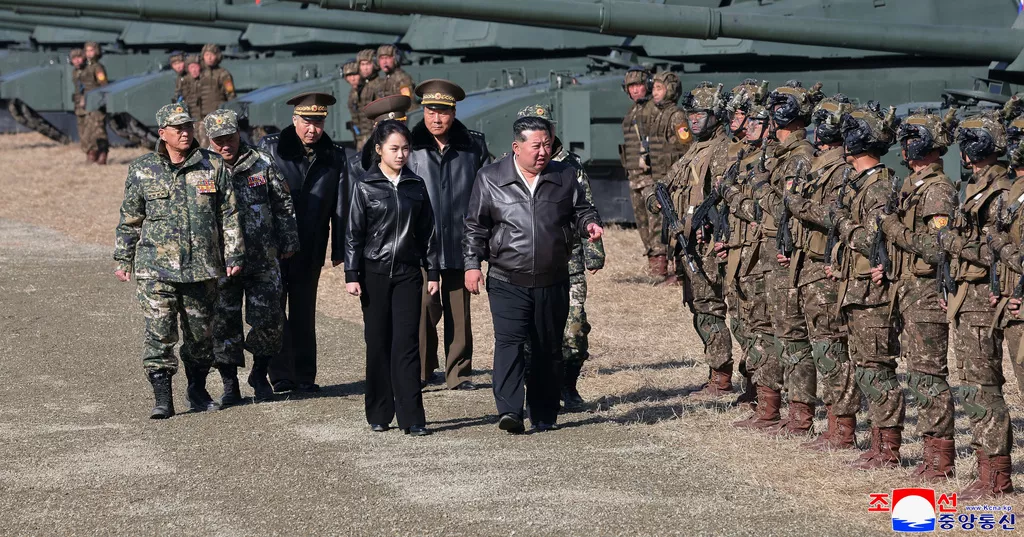
Many North Korean defectors believe leader Kim Jong Un is preparing his young daughter to succeed him, seeing her increasingly prominent appearances alongside her father as a sign that the country is moving towards a fourth generation of hereditary rule.
Kim Yumi, who fled North Korea with her family by boat three years ago, said she felt increasingly frustrated whenever state television showed Kim Jong Un appearing with his daughter, believing that the country was preparing for another dynastic transfer of power.
“My husband and I didn't want our children to live under a fourth-generation dictatorship. As parents, we thought the best thing we could do for our children was to give them freedom,” said Kim, 32, who now lives in Seoul.
North Korea, established in 1948, has been ruled by three successive generations of the Kim family, despite formally describing itself as a socialist republic. The first transfer of power took place in 1994, when state founder Kim Il Sung was succeeded by his son Kim Jong Il. In 2011, Kim Jong Un took over following his father's death.
There was no known public resistance during either transition, and observers believe another hereditary succession would likely face little opposition, at least publicly.
Kim Jong Un's repeated appearances with his daughter over the past four years have fuelled speculation that she is being prepared as his successor.
The issue has drawn attention because North Korea is a nuclear-armed but impoverished country of around 26 million people, where citizens have little political freedom and remain under strict state surveillance.
To understand how ordinary North Koreans might privately view another dynastic succession, The Associated Press spoke with nearly a dozen defectors who maintain contacts inside the country or witnessed earlier leadership transitions, along with several experts.
Most defectors believe daughter is heir apparent
Little is publicly known about Kim's daughter, reportedly named Kim Ju Ae and around 13 years old.
Since late 2022, she has appeared dozens of times alongside her father at major events, including weapons tests and military parades. State media have described her as Kim's “most beloved” and “respected” child.
Her apparent importance has also been highlighted through photographs showing senior military officials kneeling before her and images of her standing in front of her father.
South Korea's intelligence agency considers her the likely successor. Eight of the 11 defectors interviewed by the AP shared that assessment, while the others questioned whether a woman could lead the country given its deeply patriarchal culture.
Tae Yongho, a former minister at North Korea's Embassy in London who defected to South Korea in 2016, said the treatment of Kim Ju Ae by senior officials during visits to missile launch sites and factories reflected protocols normally reserved for a future leader.
He said the officials were treating her in much the same way they had treated Kim Jong Un when he accompanied his father as the designated successor.
Kang Mi-Jin, a defector who runs a company analysing North Korea's economy, said her contacts inside the country had told her through smuggled phones that they believed Kim Ju Ae was in line to succeed her father.
Jung Gwang-il, another defector who specialises in sending outside information into North Korea, said people he meets during visits to Chinese border towns also share that view.
Former NBA star Dennis Rodman first revealed the existence of Kim's daughter after holding her as a baby during a 2013 visit to Pyongyang.
Questions over a woman leading North Korea
Much of the uncertainty surrounding Kim Ju Ae's possible succession stems from her gender.
South Korean officials believe Kim Jong Un may have another younger child, although the sibling's gender has not been confirmed.
Women remain significantly underrepresented in North Korea's senior leadership. According to South Korea's Unification Ministry, only one of the 17 department directors of the ruling Workers' Party is a woman — Kim Jong Un's influential younger sister, Kim Yo Jong.
Kim Jeong-Ah, a former North Korean army officer who resettled in South Korea in 2009, said her contacts inside North Korea considered it unreasonable to regard the young girl as a future supreme leader.
Lee Si-young, a defector who heads the Seoul-based Free North Korea Radio station, said some older contacts inside North Korea were unhappy with the prospect of a woman taking power.
However, she noted that members of the Kim family were regarded as almost divine figures, making gender less important in determining their acceptance.
“Members of the Kim family are like gods reigning over humans so gender really doesn't matter,” she said.
Hereditary succession likely to face little resistance
Regardless of whether Kim Ju Ae eventually succeeds her father, who is 42, observers believe he is likely to designate one of his children to continue the family's rule.
South Korea's intelligence agency recently assessed that Kim is extremely obese and faces a high risk of cardiovascular disease, although it found no other signs of deteriorating health.
Ahn Chan-il, a defector and scholar who heads the World Institute for North Korean Studies in Seoul, said North Koreans would likely accept another hereditary transfer of power as something they had to follow.
The first succession in 1994 was relatively well prepared, as Kim Jong Il, then 52, had spent two decades serving as his father's designated successor and working alongside him in governing the country.
The second transition in 2011 was more uncertain, as Kim Jong Un was only 27 and considered inexperienced by outside observers.
He nevertheless consolidated his authority rapidly through high-profile executions and purges, including the 2013 execution of his powerful uncle Jang Song Thaek.
Oh Gyeong-seob, an analyst at the Korea Institute for National Unification in Seoul, said hereditary succession had become institutionalised in North Korea, with the ruling elite and ordinary citizens accepting it as a normal political process.
Choi Song-juk, who fled North Korea in 2015, said she had previously been so heavily influenced by state propaganda that she had not questioned the country's first two leadership transitions. She now describes the system as “nonsense”.
Another defector, Jeon Jae-hyun, said North Korea's extensive surveillance system prevented people from openly expressing dissatisfaction with the government and helped maintain political loyalty.
Kim Yumi said she had never heard of Kim Jong Un's daughter until the leader publicly introduced her at a long-range missile launch site in November 2022.
“Ordinary people know absolutely nothing about private lives of the Kim family,” said Kim, who now runs a YouTube channel focusing on North Korea.
She added that people generally avoided seeking information about the ruling family because doing so could put them in danger.