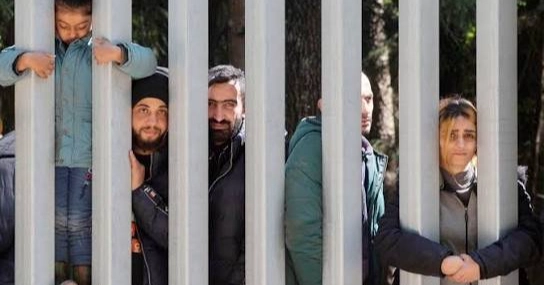
Poland suspended the registration of asylum applications from migrants entering from Belarus in March 2025, describing the move as a temporary emergency measure to counter what it said was an effort by Russia and its ally Belarus to destabilize the country by directing migrants toward the European Union.
The policy has remained in place for about 18 months. Poland is now calling on the European Union to allow member states to temporarily suspend asylum applications during situations involving what authorities describe as “instrumentalized” mass migration.
Rights groups, however, warn that such a policy could conflict with international law.
The Polish-Belarusian border stretches about 400 kilometres and forms part of the EU’s external frontier.
Since 2021, EU authorities have accused Belarusian President Alexander Lukashenko of using migrants as a political tool by encouraging people to travel to Belarus and seek entry into the EU, offering an alternative to more dangerous routes across the Mediterranean.
EU considers new emergency migration framework
The possibility of an EU-wide approach gained attention on Sept. 16 when European Commission President Ursula von der Leyen said the Commission would propose a new European emergency response framework for cases involving “engineered and weaponized” mass migration.
She said the framework would provide limited flexibility in applying normal migration procedures in specific emergency situations.
Von der Leyen did not specify which procedures could be changed. Details about the framework, including whether it would require approval from the European Parliament and EU leaders, remain unclear.
Poland’s Deputy Interior Minister Maciej Duszczyk, who oversees migration issues, welcomed the announcement as a sign that other EU countries were considering what he calls the “Polish solution.”
“We are happy that what we’ve been saying for a year, or a year and a half, is now becoming mainstream in the EU,” Duszczyk told The Associated Press.
He said a migration crisis in Ceuta in July, when more than 70,000 people crossed from Morocco into the Spanish enclave in North Africa, showed that other European countries could face border emergencies similar to Poland’s.
But Tineke Strik, a Dutch member of the European Parliament, said she was concerned that the proposed framework could lead to the Polish approach being adopted across the EU and make restrictions on asylum applications more widely accepted.
“If you normalize it, if you make it the default policy of all EU member states, you (the Poles) are not falling outside of the framework,” Strik said. “It simply has been legalized.”
She said such a move could weaken a central principle of European and international asylum law, under which people must have an opportunity to seek protection before they are returned.
Michael O’Flaherty, human rights commissioner for the Council of Europe, which is separate from the EU, also expressed concern that discussions about suspending asylum rights at the EU level could cross into violations of international law.
Critics say allowing countries to suspend asylum applications could undermine the principle of non-refoulement, which prevents governments from returning people to places where they could face persecution.
The principle became a key part of the international refugee protection system after World War II, following the experience of people fleeing Nazi persecution who were denied safe refuge.
Rights groups challenge Poland’s policy
Duszczyk said Poland’s suspension of asylum applications is consistent with international law. He said people considered especially vulnerable, including pregnant women, children and those facing persecution in Belarus, can still seek asylum.
“Each person who appears on the border has the right to speak to the Polish border guards and explain their situation,” Duszczyk said.
The Polish ombudsman and nongovernmental organizations working with migrants, however, dispute that account.
“Visibly pregnant women might stand a chance, but in the case of sick people or teenagers who are minors, their arguments are typically undermined,” said Karolina Czerwinska of the Association for Legal Intervention, a Polish NGO that provides legal assistance to migrants.
Duszczyk argued that conditions have changed since the 1950s, when countries emerging from World War II established much of the modern international system of refugee protection and human rights.
Czerwinska said Poland’s position on the frontline of Russia’s war against Ukraine makes respect for human rights particularly important.
“We Poles located on the front lines of the war in Ukraine should really make sure human rights are respected,” she said. “We may need to make use of them ourselves.”
Poland says EU migration pact is not enough
Human rights organizations said von der Leyen’s announcement was unexpected because the EU’s new Pact on Migration and Asylum, which took effect three months ago, already allows countries facing border emergencies to adjust some asylum procedures.
Those measures include extending deadlines for processing applications and allowing migrants to remain in detention for longer periods.
Duszczyk, however, said the European Commission’s proposal showed that the existing pact was “not enough.”
He said the EU needed a new legal mechanism that would allow member states to temporarily suspend normal procedures during a declared emergency.
According to Duszczyk, the European Commission is expected to provide more details about the proposed framework at a meeting of EU interior ministers on Oct. 1. Further discussions are expected at a European Council summit later in October.
The European Commission has said the proposed emergency mechanism would apply only under strictly defined conditions and would allow limited, time-bound flexibility in existing procedures while maintaining fundamental rights.