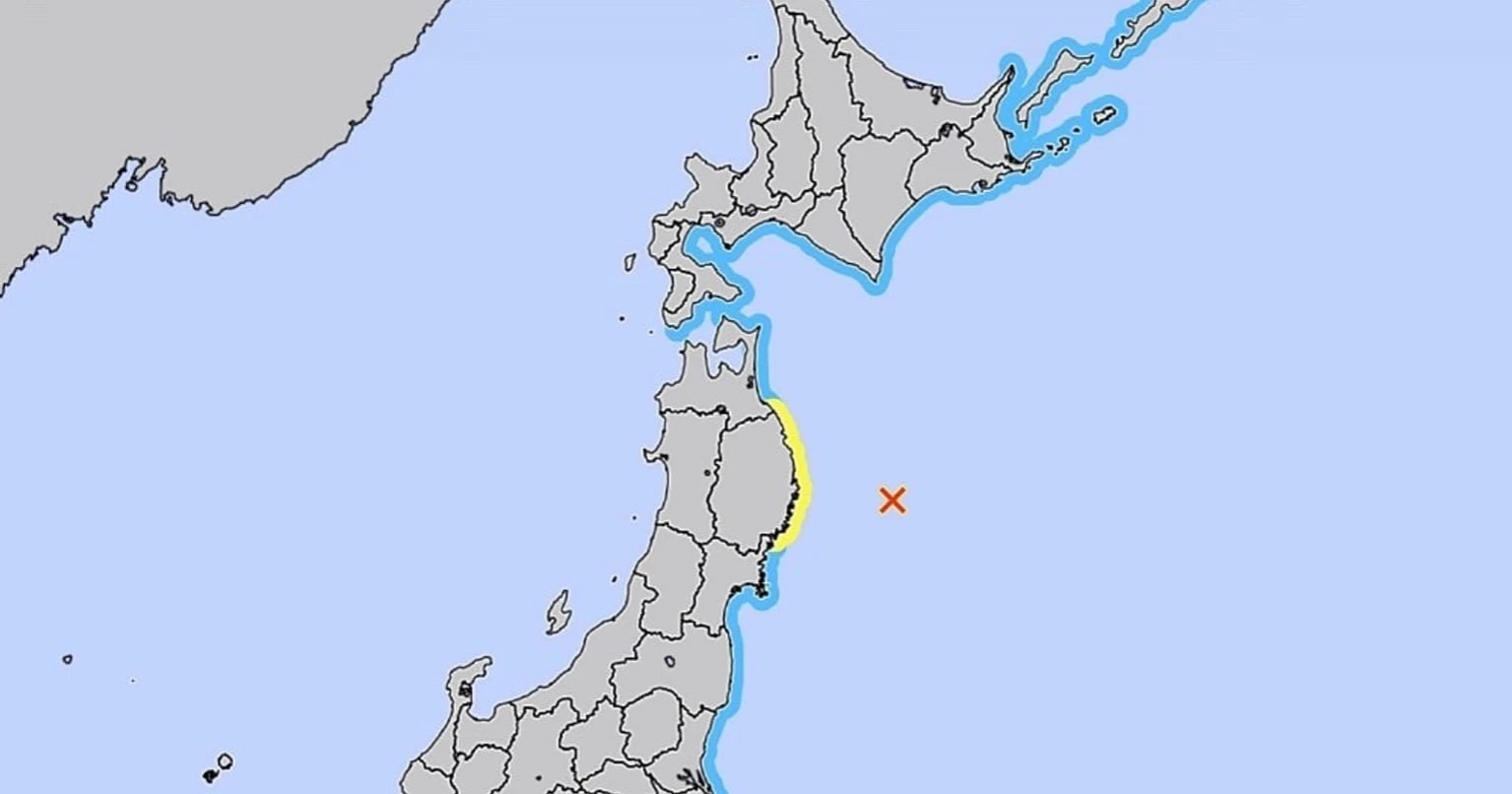
A powerful magnitude 6.9 earthquake struck off the coast of Iwate Prefecture in northern Japan on Sunday evening, prompting a tsunami advisory and warnings of possible aftershocks, the Japan Meteorological Agency (JMA) said.
The quake, which occurred at 5:03 p.m. local time at a depth of about 16 kilometers (10 miles), was followed by several smaller tremors. Authorities said there were no immediate reports of injuries or major damage, and no irregularities were detected at nearby nuclear power plants.
The JMA issued an advisory for tsunami waves up to 1 meter (3 feet) along northern coastal regions. Small tsunami waves — about 10 to 20 centimeters (4–8 inches) — were observed at Ofunato, Ominato, Miyako, Kamaishi, and Kuji. Officials warned residents to stay away from the coast, noting that waves could continue for several hours and grow stronger over time.
Public broadcaster NHK cautioned that aftershocks could follow, and the meteorological agency said the area faces an increased risk of strong earthquakes for about a week, especially in the next few days.
The quake caused temporary power shortages and delays to bullet train services, according to Kyodo News and railway operator JR East.
Japan’s northeast is one of the world’s most seismically active zones. The region was devastated in March 2011 by a massive earthquake and tsunami that killed nearly 20,000 people and triggered the Fukushima Daiichi nuclear disaster.
Officials said Sunday’s earthquake was not directly linked to the 2011 event, though the region remains highly prone to major quakes. Japan sits along the Pacific “Ring of Fire,” where many of the world’s strongest earthquakes occur.