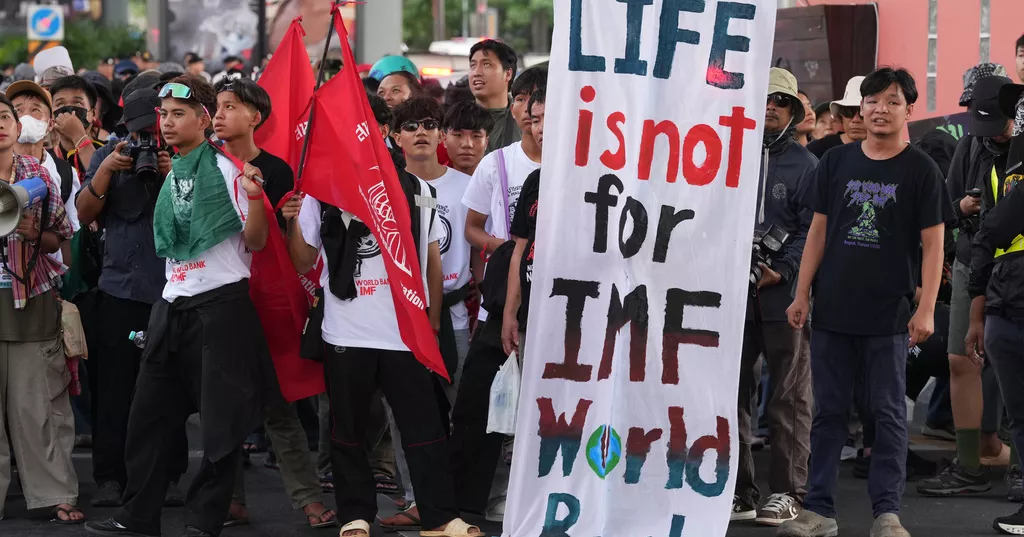
Dozens of protesters marched in Bangkok on Thursday, urging global financial leaders to address growing inequality, poverty, pollution and other social and environmental concerns as the International Monetary Fund (IMF) and World Bank held their annual meetings.
Some demonstrators wore masks depicting US President Donald Trump, IMF Managing Director Kristalina Georgieva and other leaders, while pulling a float shaped like a large pink pig with dollar signs for eyes towards the heavily guarded convention centre. The march briefly disrupted traffic near the venue, where more than 15,000 officials and experts had gathered for the IMF's autumn meeting.
The protesters also criticised international financial institutions and what they described as “vile abuses” by the Thai government and financial institutions.
In a written declaration, the People’s Network Against the World Bank and IMF said Thailand was grappling with a household debt crisis, declining living standards, environmental degradation and increasingly severe climate disasters.
Thailand has used the meetings to promote its capital as a host city, although Bangkok's luxury hotels and displays of wealth stand in stark contrast to its slums, polluted canals and people sleeping on the streets.
Recent severe flooding has destroyed crops and damaged millions of homes and businesses, further worsening the difficulties faced by many people across the country.
The demonstration remained largely peaceful, apart from a minor scuffle with police on a pedestrian bridge. The protesters marched from the nearby Khlong Toei slum towards the convention centre before dispersing.
Rising inequality, climate-related disasters and conflicts are among the major issues being discussed by global leaders during the weeklong meetings.
Thailand, like many low- and middle-income countries, particularly those dependent on imported energy, has faced economic pressure as the Iran war has kept oil prices above $100 a barrel for much of this year.
The World Bank identifies Thailand as the region's most income-unequal country.
In its latest economic outlook, the IMF warned that rising prices and mounting debt were aggravating inequality across many of its 191 member economies.
Economic growth in Asia is projected to slow to 4.8 percent this year, down from 5 percent in 2025, before declining further to 4.4 percent in 2027, according to IMF economists.
The slowdown reflects successive shocks from the Covid-19 pandemic, the war in Ukraine, the Iran war, higher tariffs and other trade barriers.
IMF chief Georgieva and other senior economic officials have stressed the importance of managing public debt, urging countries, including Thailand, to direct government spending towards targeted and temporary assistance for their most vulnerable populations.