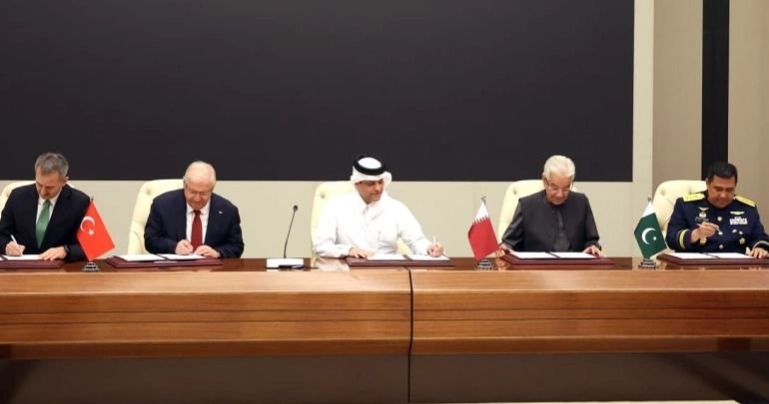
Qatar, Turkiye, Pakistan and Indonesia have agreed to expand cooperation in defence manufacturing, technology sharing and military research as regional conflicts and uncertainty push countries to strengthen their own security capabilities.
The four countries signed a memorandum of understanding in Doha on Wednesday, seeking to build on existing military partnerships through joint production, technology transfers and closer links between their defence supply chains.
The agreement comes amid the prolonged US-Israeli war with Iran and growing concerns over dependence on Washington for security. However, analysts say the initiative is intended to diversify defence partnerships rather than replace existing alliances.
Arda Mevlutoglu, a defence industry analyst and managing director of Mergen Analytical Strategies, said the initiative could help create a broader network of defence cooperation linking the Gulf with South and Southeast Asia.
The Qatari Defence Ministry said the agreement, named the “Badr” memorandum, aims to strengthen defence manufacturing, improve military capabilities and promote technical training, research and development among the four countries.
Under the arrangement, each country is expected to contribute its particular strengths. Turkiye would provide technological expertise and experience in defence manufacturing, while Pakistan and Indonesia could offer production facilities, skilled workers and domestic markets. Qatar would contribute investment and demand for military equipment.
Experts say the partnership could help the countries jointly develop, manufacture and maintain defence systems, potentially reducing costs and creating jobs.
Albert Vidal, a research associate at the International Institute for Strategic Studies, said Pakistan and Indonesia were interested in purchasing Turkish weapons and producing some of them domestically. Such arrangements could benefit Turkish manufacturers while supporting local industries in the two countries, with Qatar providing financial support.
The agreement builds on existing defence cooperation among the participants. Qatar and Turkiye signed a bilateral defence industry agreement in October 2025, while Pakistan and Turkiye have a joint naval shipbuilding project involving four vessels, two to be built in Istanbul and two at Karachi Shipyard.
Indonesia and Turkiye are also jointly developing a tank.
Burcu Ozcelik, a senior research fellow at the Royal United Services Institute, said the latest initiative could bring separate defence projects under a more coordinated and reliable framework.
Regional security concerns have increased amid the war involving Iran, attacks by Yemen's Houthi rebels and reports of shortages in US weapons supplies. Analysts say these developments have encouraged countries to diversify suppliers and strengthen domestic production.
Mevlutoglu, however, cautioned against viewing the agreement as a move away from the United States. Qatar is unlikely to abandon its strategic ties with Washington, while Turkiye seeks greater technological independence within NATO, he said.
Bader Mousa Al-Saif, an associate fellow at Chatham House's Middle East and North Africa Programme and an assistant professor at Kuwait University, said the initiative reflected growing interest among Gulf countries in cooperation with countries in the Global South and other Muslim-majority nations.
The Doha agreement also follows a separate regional defence initiative. Saudi Arabia, Pakistan and Turkiye signed the Mecca Joint Defence Agreement in August, establishing a mutual defence commitment. Ankara submitted the agreement to its parliament for ratification on Wednesday.
Unlike that agreement, which focuses on collective defence, the Doha memorandum centres on industrial and technological cooperation. Mevlutoglu said the two initiatives could complement each other by combining military cooperation with stronger regional defence production capabilities.
Source: Al Jazeera