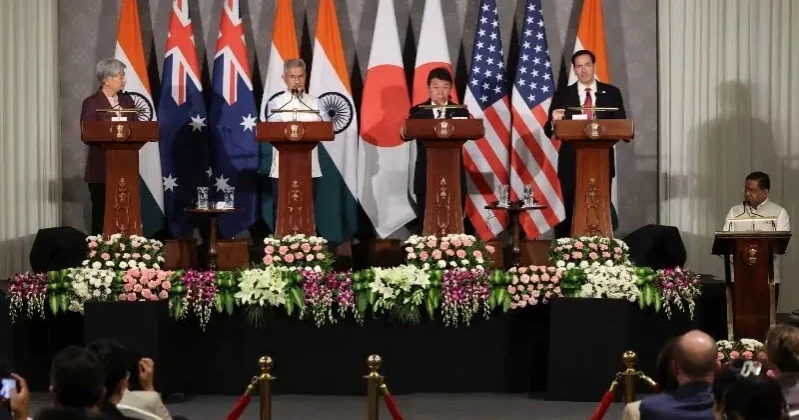
Quad, a diplomatic partnership between the United States, Australia, India, and Japan committed to fostering a free and open Indo-Pacific, has highlighted the importance of regional initiatives to strengthen energy resilience.
In a statement released by the governments of Australia, India, Japan, and the United States of America on Tuesday on the occasion of the Quad Foreign Ministers’ Meeting in New Delhi, they also mentioned important regional initiatives such as India’s support to energy security in South Asia, Japan’s Partnership on Wide Energy and Resources Resilience (POWERR Asia).
The countries highlighted Australia’s support to energy security in Southeast Asia and the Pacific, including through the $2 billion Southeast Asia Investment Financing Facility, Australian Development Investments and support for the ASEAN Power Grid, as well as financial assistance to Pacific island countries (including AUD30 million in budget support to Fiji).
The United States, Australia, India, and Japan are united by a common vision for a free and open Indo-Pacific, underpinned by robust economic and energy systems.
Recognizing shifts in the global energy landscape and escalating geopolitical complexities, the countries are accelerating collaboration to ensure energy stability and security.
"We recognize impacts of disruptions to global markets, particularly in relation to oil, gas, and petrochemical products as well as essential goods and critical downstream derivatives such as fertilizers, fall heavily on the Indo-Pacific region. Our leaders have expressed a clear collective intent to cooperate on energy security and resilience," said the countries in a joint statement.
They reiterated their strong commitment to ensure well-functioning, stable, transparent, secure and resilient energy markets.
The countries reaffirmed the importance of resilient and diversified supply chains, including energy products and other downstream commodities.
They reinforced the importance of secure and uninterrupted trade flows, including the safety of navigation and the protection of critical maritime routes and infrastructure, as essential to global economic stability and energy security.
The countries reiterated the importance of ensuring unimpeded freedom of navigation and uninterrupted flow of global commerce, including in the Strait of Hormuz, and opposing any restrictive measures hampering the flow of commercial vessels.
They recognized their shared commitment to maintain open trade flows of energy products.
To this end, the United States, Australia, India, and Japan will work to identify areas of cooperation for the Quad Initiative on Indo-Pacific Energy Security in technology, management, policy, international market analysis, and emergency response exercises through an engagement plan.
This group effort would aim to recognize and leverage the unique resources and capabilities of each country’s energy sector, including to strengthen their respective strategic petroleum systems.
"We will work with our partners in the Indo-Pacific to help strengthen regional energy resilience," they said in a joint statement shared by the US Department of State.
To achieve this, the Quad will convene a Quad Fuel Security Forum to coordinate high-level discussions and facilitate cooperation.
Foreign ministers from Australia, India, Japan and the United States announced new initiatives on Tuesday on maritime security, port infrastructure and energy to boost cooperation in the Indo-Pacific to counter concerns about China’s growing influence, reports AP.
The announcements by the group of nations known as the Quad came after talks in New Delhi between India’s Foreign Minister Subrahmanyam Jaishankar, U.S. Secretary of State Marco Rubio, Japanese Foreign Minister Toshimitsu Motegi and Australian Foreign Minister Penny Wong.
Speaking after the meeting, Rubio announced a new Indo-Pacific maritime surveillance initiative to integrate the four countries’ surveillance capabilities and strengthen real-time information sharing across the region. He said the Quad would work with Fiji to upgrade port infrastructure in the Pacific islands, marking its first joint regional infrastructure project.
The ministers also launched an Indo-Pacific energy security initiative aimed at strengthening regional fuel and energy supply chains, with the U.S. set to host a Quad fuel security forum later this year, Rubio said.
“We are deeply committed to this partnership. It is a linchpin in a cornerstone of our global strategy as a nation,” he said.
Separately, India and the U.S. signed a deal to strengthen cooperation on critical minerals as global concerns grow over reliance on China-dominated supplies.