Russians who have fought in Ukraine are playing a prominent role in this week's parliamentary election, appearing on party tickets, in campaign videos and in televised debates.
Election officials say nearly 200 candidates have served in Ukraine. The Kremlin has promoted the veterans as part of what it calls Russia's “true elite,” seeking to portray them as people who will receive an honored place in civilian life after the war.
However, analysts say few of the veterans are likely to gain significant influence among Russia's ruling elite. They view the campaign as partly an effort to encourage more men to join the military.
Independent Russian media have frequently reported cases involving returning veterans in assaults, drunken fights and killings. Some of those involved were recruited into the military from prison.
The election for the State Duma, the lower house of parliament, begins Friday. It is the first parliamentary vote since Russia launched its full-scale invasion of Ukraine and will also include areas of Ukraine that Russia seized and illegally annexed.
The Kremlin is closely controlling the election as it seeks to demonstrate public support for the war and strengthen the legitimacy of its actions.
Most Kremlin-aligned parties allowed to participate have candidates identified as participants in the so-called “special military operation” in Ukraine.
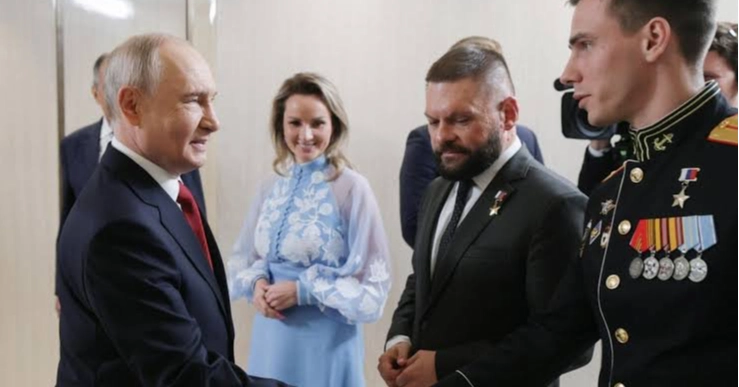
One of the prominent candidates is Vladislav Golovin, 29, of the ruling United Russia party. He fought in the battle for the Ukrainian port city of Mariupol and lost part of his leg. President Vladimir Putin has appeared with Golovin at events and awarded him the Hero of Russia title, the country's highest honor.
Golovin participated in Putin's “Time of Heroes” program in 2024, which prepares war veterans for careers in government. He now leads the Young Army, a military and patriotic youth organization. He has also been placed on Western sanctions lists.
United Russia has several dozen candidates with backgrounds in the Ukraine war. Another prominent candidate is Yevgeny Poddubny, a state television war correspondent with close ties to the authorities who was wounded by a Ukrainian drone.
The ultranationalist Liberal Democratic Party's leading candidate, Alexei Vereshchagin, is described as having joined Moscow-backed separatists in eastern Ukraine in 2014 and later led a volunteer brigade.
“We are the ones our homeland has called upon to fight for the ‘Russian World,’ and we will fight,” Vereshchagin, who was born in Kyiv, says in a campaign video, referring to a term promoted by Putin, particularly since Russia's 2014 annexation of Crimea.
Ukrainian police said in March that they were investigating Vereshchagin over alleged home invasions and threats against civilians in the Kyiv region in 2022, before Ukrainian forces regained control of the area. Police said he had fought against Ukraine for more than a decade. Vereshchagin has not publicly commented on the allegations.
Kremlin seeks to encourage more enlistment
By giving veterans a prominent role in the election campaign, the Kremlin wants to demonstrate to potential recruits that fighting in Ukraine can lead to future career opportunities, said Nikolay Petrov, a senior research fellow at the NEST Centre, founded by exiled Russian businessman and opposition figure Mikhail Khodorkovsky.
Petrov said Russia also appears uncertain about how to reintegrate soldiers returning from the battlefield. He said many are offered positions with limited influence, while greater attention is given to people who already held government positions.
Former Putin speechwriter and political analyst Abbas Gallyamov described the approach as “empty talk.”
He said the government needs to offer potential recruits promises of financial rewards and praise about their importance and contribution to building a “new Russia.”
Many veterans face difficult return to civilian life
Returning to civilian life can be difficult for many veterans. Most soldiers who signed military contracts cannot end their service under Putin's 2022 “partial mobilization” decree. Those drafted under the decree have also not yet been demobilized.
Some soldiers can leave the military because of serious injuries or age, while certain special units reportedly provide limited periods of service.
Presidential administration official Sergei Novikov said in December that about 167,000 servicemen had returned from Ukraine. Russian media reports and experts, however, say the actual figure is likely higher.
Competition for the Time of Heroes program is also intense. Applicants must have higher education and management experience. Of more than 65,000 applicants in 2024-25, only 168 were accepted, according to the program's website. About 80 were subsequently appointed to positions at national, regional or municipal levels.
Independent Russian news outlet Meduza reported in June that at least 1,300 veterans had been appointed to government positions, elected to local legislatures or councils, or hired by state-backed companies and institutions.
About 850 of those veterans had previous government or related experience before serving in Ukraine, Meduza reported, suggesting that many of the beneficiaries were already connected to the ruling establishment.
The Associated Press could not independently verify the findings. However, reports of government officials and lawmakers serving in Ukraine and later returning to their civilian positions are common.
Duma deputy Alexei Zhuravlyov, who leads the Rodina, or “Homeland,” party, has said he served at the front while retaining his parliamentary seat, as have some of his colleagues.
Zhuravlyov recently criticized a YouTube blogger who questioned why he was not serving full time in Ukraine. He later said he spends “more time on the front line than in the Duma.”
Tambov regional Gov. Yevgeny Pervyshov, a United Russia candidate and former mayor of Krasnodar and Duma lawmaker, served in Ukraine in a special military unit in 2022.
The British government said in 2024 that the unit had “an unusually high number of United Russia party members and sons of Kremlin VIPs.” Britain's Defense Ministry said on X that the unit was mainly involved in drone operations away from the front, allowing prominent political figures to avoid the usual requirements of military service while remaining relatively safe.
After serving for less than a year, Pervyshov entered the Time of Heroes program. He was later appointed acting governor of Tambov and elected governor in September 2025.
Enthusiasm over Putin's “new elite” promise fades
Ivan Filippov, who studies propaganda and monitors military and pro-war bloggers, said such cases have contributed to growing disappointment among supporters of the war.
He said many initially welcomed Putin's promise that veterans would form a new elite, but soon concluded that the policy did not primarily benefit ordinary veterans.
Some, he said, served briefly, obtained veteran status and then returned to government positions.
Filippov said supporters of the war now recognize that many returning soldiers could face difficult lives at home.
“They understand clearly that no one will let them into power,” he said.
Novikov, the Kremlin official, said in December that “tens of thousands” of returning veterans remained unemployed, describing the situation as a potentially dangerous risk.
Petrov said the Kremlin is more likely to favor experienced bureaucrats who have served in the military when selecting veterans for positions of influence.
“The authorities don't at all need bandits that come back from there,” he said.