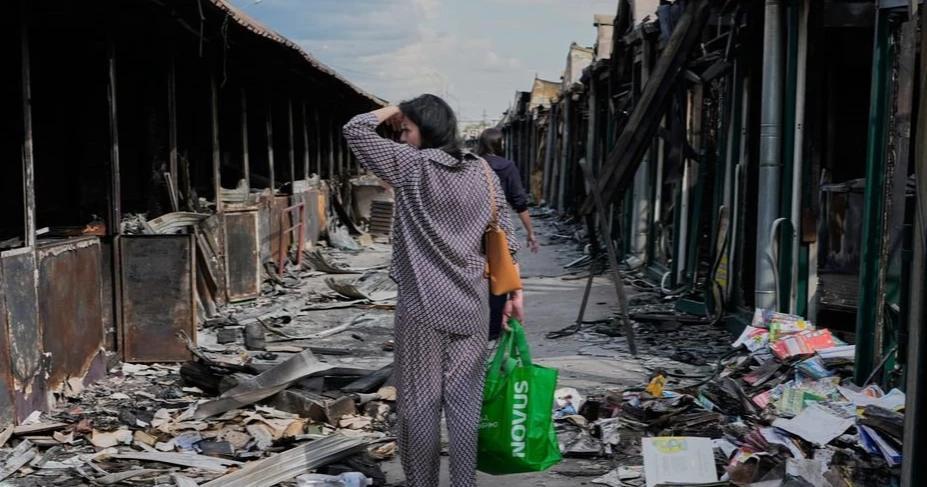
Seconds before a Russian drone struck, Viktor Kruglov was thinking about textbooks tens of thousands of them and how to deliver them to Ukrainian schools more quickly.
Minutes later, a second explosive-laden Shahed drone hit the main warehouse of his publishing company, Ranok, in northeastern Kharkiv.
“Steel was blazing and burning,” Kruglov said, describing the Aug. 1 attack. The huge warehouse’s reinforced concrete melted and its roof collapsed.
The fire continued for nearly a week, destroying millions of books.
Ukraine’s publishing industry is now facing its most serious crisis, with Russian attacks damaging publishing houses, printing facilities and bookstores. The attacks are part of wider damage to the country’s cultural sector. Nearly 5,000 cathedrals, churches, museums, theaters and other cultural sites have been destroyed or damaged, while about 35,000 art objects have been looted, according to Ukrainian authorities.
More than 13 million books about one-third of Ukraine’s annual print production — were destroyed during two months this summer, causing at least $39.3 million, or 1.75 billion hryvnias, in damage, the Culture Ministry said.
Kremlin spokesman Dmitry Peskov did not respond to an Associated Press request for comment on the attacks against Ukraine’s publishing infrastructure.
The destruction comes as demand for Ukrainian-language books has increased since Russia’s 2022 invasion. But publishers say the losses threaten the future of the industry beyond the financial damage.
Publishers may have less money to invest in new writers, while small independent companies could reduce production or shut down. Larger publishers may also become more dependent on established bestsellers.
“This is a deliberate policy of Russia because they understand that culture is what makes us feel resilient, what makes us feel the owners of our land, of our destiny,” Ukraine’s Culture Minister Tetiana Berezhna said.
At least 40 other publishing houses and several bookstores have also been damaged in recent weeks.
“This is a huge blow to the industry, and if we don't move quickly to put strategic support measures in place the industry could collapse entirely,” Kruglov said, describing publishing as an important part of Ukraine’s national security.
The Ranok warehouse, which opened in 2013, was an automated logistics center capable of processing tens of thousands of books daily. The strike destroyed about 8 million books, including 620,000 textbooks supplied to almost all Ukrainian schools.
Kruglov said Ranok has backup warehouses and keeps its files in cloud storage, allowing the company to reprint books and continue operating.=
Berezhna said the attacks were part of what she described as Russia’s systematic destruction of Ukrainian heritage. She noted that Russia had previously restricted Ukrainian-language publishing and public speaking during the 19th century, when much of present-day Ukraine was part of the Russian Empire.
“But still, the Ukrainian language exists. Ukrainian literature exists,” she said, adding that Ukraine’s history offered hope that its culture would survive.
New writers face growing risks
The attacks have also weakened publishers’ ability to take financial risks on new authors, Berezhna said.
Publishing debut writers is generally more expensive and less predictable than producing books by established authors or translated bestsellers. She warned that young writers who could eventually become important Ukrainian literary voices may receive less support.
The Culture Ministry is preparing a financial support package that could include government purchases of Ukrainian books for school libraries, grants for small publishers, rent assistance for bookstores and war-risk insurance for print runs.
However, publishers say more help is needed.
At the Konvi printing plant, which was hit by a Russian missile in July, burned pages from fourth-grade English textbooks remained on the floor months after the attack. Paper was also trapped inside a damaged printing machine.
The plant previously printed millions of books each year, including fiction, educational and scientific works. Commercial director Viktoriia Haidai said replacing the damaged printing press would cost 1.2 million euros ($1.37 million), while restoring full production capacity could take four to five years.
She said textbook printing that previously took three to four months could now take six to seven months, putting future delivery deadlines at risk.
“It's not just the large printing houses that are suffering,” Haidai said. “Many small printers, who don't make themselves known publicly, have also been destroyed.”
Industry seeks foreign and government support
Iryna Baturevych, co-founder of Chytomo, a leading Ukrainian platform covering books and publishing, said the recent losses were unprecedented in the country’s independent history.
She warned that small independent publishers were particularly vulnerable, potentially reducing the diversity of books available, especially in niche and experimental genres.
Children’s publishing is also facing difficulties, she said. With many Ukrainian children living abroad, publishers are shifting toward other genres, while some authors are leaving the profession.
Baturevych said the government would probably find money to keep textbooks in production, but support for the wider publishing industry was less certain.
Ukraine’s financial resources are limited because much of the government’s spending is focused on the war. Roksolana Pidlasa, head of the Ukrainian Parliament’s budget committee, said that as of September, one day of the war costs Ukraine about $190 million.
Baturevych said foreign support would therefore be important for rebuilding the publishing sector.
Kruglov said publishers need three main forms of government assistance: affordable loans and insurance similar to those available to other industries, investment to rebuild warehouses and printing facilities, and measures to increase demand for books and reading.
Publishers currently struggle to obtain such loans because much of their value is tied to intellectual property rather than physical assets that can be used as collateral.
“I hope the state will help, because there can be no independent Ukraine without independent publishing,” Kruglov said.
“The Ukrainian book is the one product that cannot be imported.”