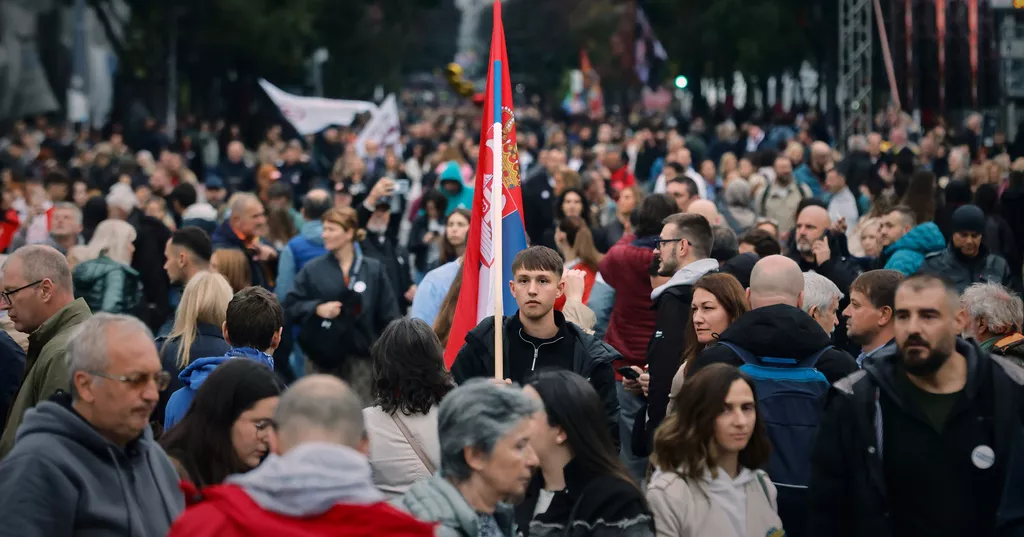
Serbians went to the polls on Sunday in a closely contested parliamentary election seen as a major test for populist leader Aleksandar Vucic and his ruling Serbian Progressive Party (SNS) amid a prolonged student-led protest movement.
Around 6.4 million eligible voters are choosing among 18 parties competing for seats in the 250-member parliament. However, the contest has largely turned into a face-off between Vucic's right-wing SNS and the youth-backed Students' List.
The two main contenders are believed to be running neck-and-neck, making the election one of the most uncertain in recent years. Turnout is expected to be high, potentially leaving smaller parties struggling to cross the 3 percent threshold required to enter parliament.
Vucic has repeatedly outmanoeuvred Serbia's fragmented opposition, but the leaderless student movement has emerged as a significant challenge to his grip on power over the past 14 years.
A victory for the students could have wider implications across Europe, where youth-led and student protests have become increasingly prominent.
The election is also being closely monitored by the European Union as Serbia seeks membership in the bloc. Previous elections have been marred by allegations of irregularities, while international and domestic observers have raised concerns about campaign safety and fairness.
The campaign has been marked by detentions, extensive government control over the media and reports of surveillance and cyberattacks targeting activists. Local elections held earlier this year in 10 Serbian municipalities saw violent attacks on journalists and activists, while the 2023 parliamentary election triggered opposition protests over alleged fraud.
Vucic is seeking a return as prime minister if his SNS wins the most votes. He resigned as president last month to lead the campaign after serving nearly two full terms.
The ruling party's popularity has declined since 16 people were killed two years ago when a concrete canopy collapsed at a railway station in the northern city of Novi Sad. The disaster triggered months of youth-led protests demanding accountability and justice for the victims.
Protesters have blamed alleged high-level corruption and cronyism for negligence during renovation work at the station, which they say contributed to the collapse. Despite the unrest, Vucic retains considerable support, with his admirers viewing him as a capable leader who can guide Serbia through global uncertainties. His image has been reinforced by mainstream media coverage.
The Students' List is a new political initiative led by university students, although the students themselves are not among its candidates. Instead, the list features relatively unknown experts, athletes, farmers and artists.
The initiative seeks to challenge Vucic's highly centralised leadership and promote community solidarity. Its campaign slogan, “We know how,” promises a non-partisan effort to rebuild Serbia's economy and democracy following a change of government.
The movement has attracted voters disillusioned with established politicians. Despite criticism from pro-government media, student activists have travelled by bicycle and on foot through the country to reach voters in rural areas, traditionally strongholds of Vucic's party.
Opinion polls have produced mixed results, with both camps claiming they are ahead. Analysts have warned of possible post-election instability if the outcome is close.
Vucic has said his side would accept defeat if it lost, but has also warned that any protests alleging fraud after an SNS victory would be swiftly suppressed.
The state election commission is not expected to publish the official results before Monday.
Magda Anastasijevic, an Eastern Europe analyst at conflict monitor ACLED, said electoral violence had recently increased in Serbia and could escalate further, particularly if the results were disputed.