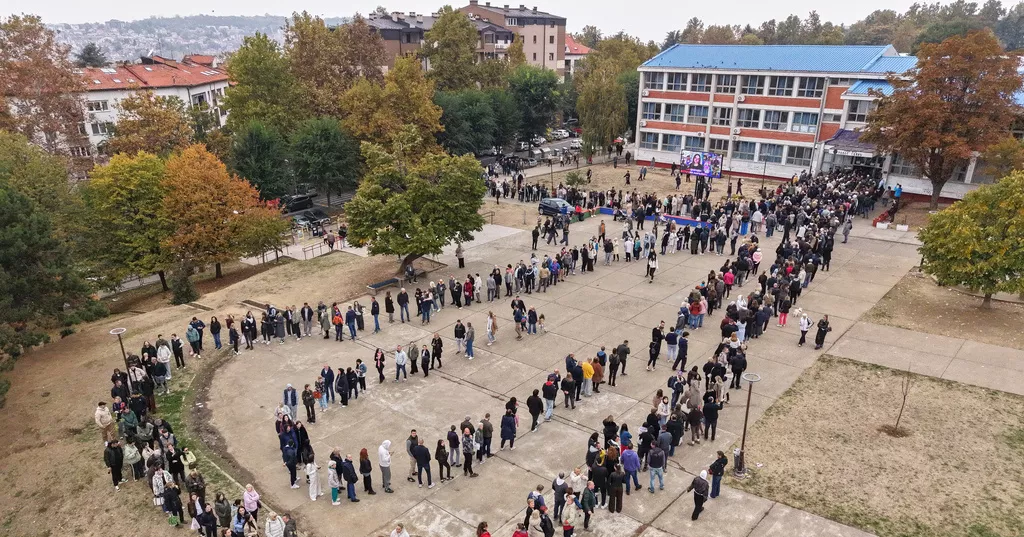
Long queues formed outside polling stations across Serbia on Sunday as voters took part in a closely contested parliamentary election pitting the country's dominant leader, Aleksandar Vucic, against a diverse student-led movement that has spearheaded protests against his government for nearly two years.
Although Serbia's 6.4 million voters could choose from 18 parties seeking seats in the 250-member Parliament, the election has largely turned into a contest between Vucic's right-wing Serbian Progressive Party (SNS) and the youth-backed Students' List.
The two main contenders were believed to be running neck and neck, making the election one of the most uncertain in recent years. High turnout was expected to leave many smaller parties struggling to cross the 3% threshold required to enter Parliament.
Vucic, who has repeatedly outmanoeuvred Serbia's divided opposition, is facing a formidable challenge from the leaderless student movement, which has shaken his hold on power more than any other force since his party took office 14 years ago.
A victory for the students could also have implications beyond Serbia, as youth-led and student protests have spread across several European countries.
Long queues at polling stations
Voters began lining up at polling stations across the country early on Sunday, with local election monitors reporting significantly higher turnout than in previous elections.
The state election commission said around 35% of eligible voters had cast their ballots by noon, compared with 21% at the same time in 2023. The student movement described the long queues nationwide as “queues of hope” on its website.
In the capital Belgrade, Vucic waited nearly two hours with his wife before casting his ballot. He later told reporters that he hoped for a peaceful election day and that he and his party would respect the result.
“The will of the people is the will of God: vox populi, vox dei,” Vucic said. “If we lose, we will recognize the electoral will. If we win, no one will take it away from us.”
Vucic said his camp would announce reliable projections about three hours after polling stations closed at 8pm local time. Asked whether the apparently high turnout indicated that voters wanted change, he said, “Let's wait for the result.”
After voting in the northern Serbian city of Novi Sad, Ilija Srdanovic, a physician who is the first candidate on the youth movement's list of 250 candidates, said the long queues indicated “record turnout in Serbia's recent history.”
“I hope that this day will pass in a democratic atmosphere and in peace and that we will legitimately choose a new government in Serbia,” Srdanovic said.
Opposition groups and some independent monitoring organisations have warned of possible irregularities during the voting process. Local monitors reported incidents involving the photographing of ballots, which they said could indicate pressure on voters, as well as attempted vote-buying and carousel voting.
At a polling station in Belgrade, voter Jovan Mitrovic said he hoped the election would proceed peacefully and conclude smoothly, adding that he wanted “the dawn finally rises in this country after many years.”
Election closely watched by EU
The European Union is closely monitoring the election in Serbia, a candidate country for EU membership, following irregularities reported in previous polls.
International and local election monitors have already raised concerns about the safety and fairness of a campaign marked by detentions, near-total government control over the media, and reports of surveillance and cyberattacks targeting activists.
Local elections held earlier this year in 10 Serbian municipalities were marred by violent attacks on journalists and activists. The 2023 parliamentary election was followed by opposition protests over alleged electoral fraud.
Vucic seeks return as prime minister
If his SNS party secures the most votes, Vucic is expected to become prime minister after serving nearly two full terms as president. He resigned from the presidency last month to lead his party's election campaign.
Support for the populist party has declined since 16 people were killed two years ago when a concrete canopy collapsed at a railway station in northern Serbia, triggering widespread youth protests demanding accountability and justice for the victims.
The disaster fuelled broader allegations of high-level corruption and cronyism. Protesters accused corruption of contributing to negligence during renovation work at the Novi Sad railway station, ultimately leading to the collapse.
Despite the protests, Vucic retains considerable support among Serbian voters. His supporters view him as a capable leader who can guide the country through global uncertainty, an image reinforced by mainstream media coverage.
Students' List offers a different approach
The newly formed Students' List is unlike other political organisations in Serbia. Although driven by university students, none of the students themselves appear on the candidate list. Instead, it features relatively unknown experts, athletes, farmers and artists.
The approach is intended to challenge Vucic's personalised style of rule and restore a sense of community and solidarity. Its campaign slogan, “We know how”, promises a non-partisan effort to rebuild Serbia's economy and democracy following a change of government.
Drawing on their youthful energy, the students have attracted voters disillusioned with established politicians. Despite being criticised by pro-government media, they have travelled by bicycle and on foot across the country to reach voters in rural areas, traditionally strongholds of Vucic's party.
Election outcome remains uncertain
Election surveys have produced varying results, with both camps claiming to be ahead. Some analysts have warned of possible post-election instability if the contest ends in a close result.
Vucic has said his side would accept defeat if it lost the election. However, he has also warned that any protests alleging fraud if his party wins would be swiftly suppressed.
The state election commission is not expected to release the official results before Monday.
Magda Anastasijevic, an Eastern Europe analyst at conflict monitor ACLED, said electoral violence had been increasing in Serbia and could escalate, “particularly if the results are disputed.”