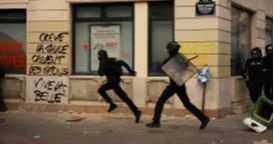
A 14-year-old boy suffered severe facial injuries after a police tear gas grenade struck him during protests by French high school students, drawing fresh criticism over police tactics used against young demonstrators.
The grenade shattered the boy’s jaw and damaged many of his teeth. The police officer who fired it was detained a week later and charged with violence causing mutilation, an offense punishable by up to 15 years in prison. The boy’s mother said he cannot speak after surgery and can eat only through a straw.
Other teenagers have also suffered serious injuries during the nationwide protests, which began over demands for more funding and additional teachers for schools.
In Lens, a 15-year-old lost a hand in an incident involving a police stun grenade. In Tours, prosecutors said a police riot-control projectile is suspected of partially blinding a 16-year-old.
The injuries and thousands of arrests have intensified concerns among lawyers and rights campaigners about the use of force against young protesters.
“It politicizes you at an incredible speed,” said Paris lawyer Alexis Baudelin, who represents more than a dozen detained teenagers.
The Interior Ministry said police have made more than 6,500 arrests since the protests grew last week, including 488 people during nationwide demonstrations Tuesday. The movement began at a high school in the Paris region in mid-September.
Lawyers and policing researchers warned that the police response could leave young people disillusioned with the French state and its ideals of “Liberty, Equality, Fraternity.”
Some police grenades suspended
Interior Minister Laurent Nunez announced Wednesday that police would stop using the type of stun grenade suspected in the Lens teenager’s injury against high school protesters.
He said there was a “strong possibility” that the weapon caused the teenager’s hand injury and that authorities needed to establish exactly what happened.
Nunez defended police actions as proportionate in almost all cases, saying officers had intervened when demonstrations turned violent or involved vandalism.
In the case of the 14-year-old, prosecutors said the officer claimed he fired the grenade in a split second to protect a female colleague who had exchanged blows with the boy.
Investigators described the action as disproportionate. The officer was suspended and barred from carrying a gun. He is the first police officer facing possible prosecution among 18 investigations into suspected misconduct during the protests.
Teenagers describe arrests
Three Paris-region teenagers told The Associated Press they were arrested, handcuffed, searched and held before being released without charges.
Two 17-year-olds, Samy and Warkya, said they believed police targeted them because of their racial backgrounds. French officials have denied racism within the police force.
Samy said officers simply told them they were being taken away despite the teenagers not wearing masks or carrying anything suspicious.
“Here in France, they don't listen to us,” he said, adding that authorities should improve students’ daily lives instead of sending police to demonstrations.
Warkya said her first experience in police custody strengthened her determination to protest but also taught her to run when police appear.
“The police are more powerful than us,” she said. “There’s nothing we can do.”