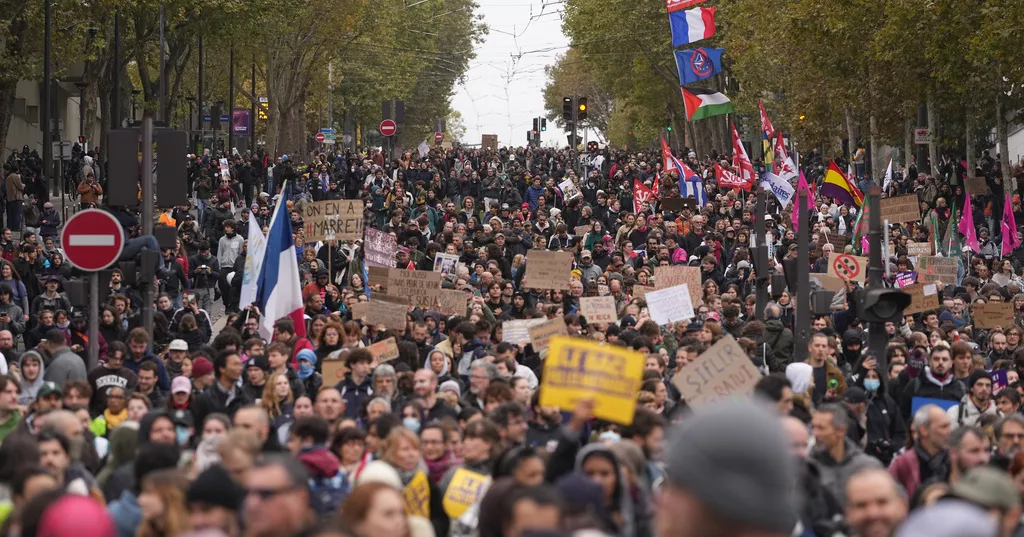
Thousands of students and workers marched in Paris and other French cities on Saturday to demand better education funding and relief from rising living costs, putting President Emmanuel Macron under pressure amid concerns over renewed violence following last weekend’s riots and looting.
Police used tear gas in Lyon, where authorities had banned the rally, while officers in Clermont-Ferrand deployed tear gas and stun grenades to disperse demonstrators attempting to reach the city centre, French media reported.
France’s Interior Ministry said 35,000 people had demonstrated nationwide by 1pm, compared with 60,000 at the same time a week earlier. Authorities planned to deploy up to 70,000 officers, supported by helicopters, armoured vehicles and water cannons, to prevent further looting, car burnings and attacks on public buildings.
In Paris, authorities restricted the march to the southeastern outskirts of the city. Tens of thousands of people were seen marching from Porte d’Italie, although the crowd appeared smaller than the previous week. Trade unions led the procession, followed by demonstrators carrying flags and placards.
The protests began last month over staff shortages at a high school southeast of Paris but have since spread nationwide, drawing students demanding better educational facilities and workers seeking higher wages and pensions.
Energy prices in France rose 21.3% in September from a year earlier, contributing to overall inflation of 3.1%, according to the national statistics agency INSEE.
Macron met high school representatives on Friday. They said he had promised reforms to university admissions but insisted that protests would continue until concrete measures were announced.
More than 500,000 people took to the streets last Saturday, when around 3,000 shops across France were damaged or looted.
Security tightened across France
Shopkeepers in Paris boarded up their storefronts, while gendarmes guarded the area beneath the Arc de Triomphe. Several major museums, including the Louvre, Orsay Museum, Picasso Museum and Grand Palais, remained closed on Saturday.
Art Basel, a major contemporary art fair that opened to the public on Friday, cancelled its weekend programme because of concerns over unrest.
Police also changed the route of the Paris march. At Bastille, the original starting point, officers used loudspeakers to order people to leave or face a 135-euro fine.
Soumaya Abed, a 58-year-old nurse and CGT union member, said she had participated in protests for more than 30 years but had never seen a march begin at Porte d’Italie.
She accused authorities of using last weekend’s violence as an excuse to restrict demonstrations, saying it would not stop students from demanding better school conditions.
Authorities banned rallies in several cities, including Nice, Montpellier and Lyon. Trade unions criticised the restrictions as violations of constitutionally protected freedom of expression.
Thousands also marched peacefully in Orléans, south of Paris, against the far right as Marine Le Pen’s National Rally held a two-day congress there.
Macron’s popularity has fallen to its lowest level since he took office in 2017. He has defended the security measures as necessary to protect city centres, businesses and public buildings.
Interior Minister Nuñez acknowledged on Monday that police had lost control in some cities during last weekend’s unrest. He offered to resign, but Macron rejected the offer.
Students demand more university places
Student groups are demanding 250,000 additional places in higher education and an end to selection through Parcoursup, the national university admissions system.
Their 10-point plan also calls for more teachers and repairs to schools and universities.
According to Education Ministry figures, public middle and high schools lost 15.4 million teaching hours during the 2024-25 school year because absent teachers were not replaced, accounting for 7.5% of scheduled teaching time.
Students are also seeking financial assistance, including an additional 200 euros a month in grants and a freeze on rents in public student housing.
“The money is now concentrated in the hands of very few people,” said Victoria Ambrosini, an art critic and art teacher at Saint-Denis University.