
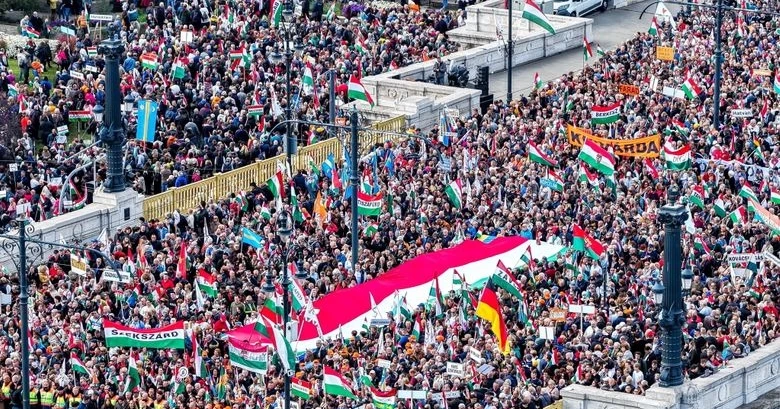
Tens of thousands of Hungarians marched through Budapest on Thursday in a show of support for Prime Minister Viktor Orbán, as he faces one of the most competitive elections of his 15-year rule.
The demonstration, called a “peace march” by organizers, coincided with Hungary’s Oct. 23 national holiday, commemorating the crushed 1956 anti-Soviet uprising. Waving Hungarian flags and banners reading “We don’t want to die for Ukraine,” marchers voiced support for Orbán’s stance against Western involvement in the Russia-Ukraine war.
Participants from across Hungary and neighboring countries filled central Budapest, crossing the Danube’s Margaret Bridge toward the parliament building. Many echoed Orbán’s message of defending Hungary’s sovereignty and Christian values. “Orbán is the only leader who can protect our country from external threats,” said Babett Lugosi, one marcher.
Orbán, the European Union’s closest ally of Russian President Vladimir Putin, has repeatedly opposed military aid to Ukraine and called for an immediate ceasefire. His government maintains warm ties with Moscow while clashing with Kyiv and EU leaders over sanctions and war policy.
Following the march, Orbán was expected to address supporters, rallying his base as his ruling Fidesz party trails in polls behind Péter Magyar’s new center-right Tisza party. Magyar, a former Fidesz insider, has gained popularity with promises to tackle corruption and revive Hungary’s struggling economy, which has suffered from high inflation and stagnation.
In response, Orbán’s allies organized Thursday’s mass demonstration to project unity and strength ahead of the vote scheduled six months from now. Across Budapest, buses brought in supporters from rural areas and even Hungarian communities in Romania’s Transylvania region.
Meanwhile, Magyar’s supporters held a rival rally in central Budapest, highlighting the deepening political divide. Both gatherings served as an early test of momentum heading into a high-stakes election that could reshape Hungary’s political landscape.
One participant, Sándor Kerekes, who traveled from Romania, said he joined to show solidarity. “It’s important to stand together for peace and unity among nations,” he said.