While filming a historical drama about Tibetan resistance fighters in Nepal's Mustang region, actor Tenzin Rigzin Phurpatsang found himself confronting a painful part of his family's history.
The 37-year-old first-time actor was shooting “Four Rivers Six Ranges,” a film about Tibetan fighters who helped the Dalai Lama flee Tibet in 1959. A year later, Phurpatsang's grandfather, Yeshi Wangyal, returned to Tibet after receiving CIA training and joined a separate guerrilla operation. He was later killed fighting Chinese forces.
Phurpatsang, who was born in exile in India and now works as a model in New York, said filming the mountain battle scenes made him think about what his grandfather had experienced.
“Wow, is that what my grandfather went through?” he recalled asking himself.
The questions raised by the film — about Tibet's history, how it is remembered and who has the right to tell it — come at a time when international attention on Tibet has declined.
The film premiered at the International Film Festival Rotterdam last year and was released in Indian cinemas on Sept. 18 after a delay linked to Chinese President Xi Jinping's visit to India.
The future of Tibet and its people is also being closely watched as the 91-year-old Dalai Lama's succession plans become an increasingly important issue. At the same time, China has grown more powerful, the US has reduced its international role and India and China have been working to improve relations.
Chinese state media has accused the film of promoting separatism and said it distorts history. China maintains that Tibet has always been part of the country.
Director Shenpenn Khymsar rejects that criticism, saying the film is based on historical events and that Tibetans should be able to tell their own history.
Phurpatsang also said younger Tibetans need to understand the history of the resistance movement.
“When you don't talk about it, these stories … they become lost,” he said.
Film shot secretly in Nepal
Khymsar grew up watching films such as “Seven Years in Tibet” and Martin Scorsese's “Kundun,” both released in 1997 and focused largely on the Dalai Lama's early life.
He wanted instead to tell the story of ordinary Tibetans who joined Chushi Gangdruk, meaning “the land of four rivers and six ranges.”
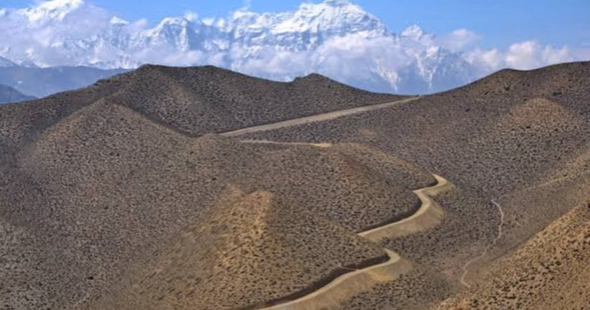
The fighters regrouped in Mustang's rugged mountains and conducted a 13-year guerrilla campaign against Chinese forces with US support. The movement ended in 1974 as US-China relations improved.
Khymsar wanted to film in the same mountains as a tribute to the fighters. But he said Chinese surveillance and pressure on Nepal's Tibetan community made obtaining filming permits difficult.
He submitted what he called a fake screenplay titled “The Himalayan Robin Hood” to secure permission and reduced the planned production from more than 45 days to 19.
“The entire shoot was a covert operation,” Khymsar said.
The production also faced other challenges. Many cast members had never acted before, so Khymsar selected and trained them, including some of his social-media followers. Some actors had never ridden horses, while the production could not afford a dedicated action director or stunt team.
“I feel like the spirits of those warriors were there, helping me,” Khymsar said.
Carole McGranahan, an anthropologist and University of Colorado Boulder professor specializing in Tibet, said there have been few major Hollywood films about Tibet in recent decades as studios sought greater access to China's lucrative film market.
Khymsar said he is still facing difficulties finding international distributors for the movie.
McGranahan said “Four Rivers Six Ranges” is significant because it represents a Tibetan account of Tibetan history.
She also pointed to the upcoming film “Tenzing,” about mountaineer Tenzing Norgay, as another production that could introduce Tibetan history to a wider audience.
Norgay, a Sherpa born in Nepal to Tibetan parents, moved to Darjeeling, India, as a child. He and Edmund Hillary were the first two people confirmed to reach the summit of Mount Everest in 1953.
The new biopic stars Genden Phuntsok, Tom Hiddleston and Willem Dafoe. It is scheduled for a limited theatrical release Oct. 9 and will premiere globally a week later on Apple TV.
“It's not just a film about Everest, or about Nepal or India. It's also about Tibet,” McGranahan said.
Tibet remains sensitive issue in India-China ties
“Four Rivers Six Ranges” was originally scheduled to open in India on Sept. 11, one day before Xi's visit for the BRICS summit and a meeting with Indian Prime Minister Narendra Modi.
The neighboring countries have been trying to improve relations following a deadly border clash six years ago.
Before Xi's visit, Khymsar said India's largest multiplex operator, PVR INOX, informed him that the film's release would be delayed by a week.
“They said we cannot release it (yet). They got some pressure,” he said.
PVR INOX senior vice president for corporate communications Deepa Menon said she had no specific information to provide when asked whether the company had faced government pressure. The Indian government did not immediately respond to questions about the delay.
India and China have economic reasons to improve relations but continue to have competing strategic interests, said Manoj Kewalramani, a geopolitics expert at the Takshashila Institution in Bengaluru.
India wants Chinese manufacturing expertise while avoiding excessive dependence on China. Beijing, meanwhile, wants greater access to India's large market but is concerned about creating stronger competition. Chinese companies are also cautious about investing in India because of the risk of worsening relations, Kewalramani said.
Tibet is particularly sensitive because developments there could affect India's territorial concerns involving Arunachal Pradesh, which India administers as a northeastern state. China claims the territory and calls it Zangnan, or “Southern Tibet.”
India officially recognizes Tibet as part of China but hosts the world's largest Tibetan exile community, numbering about 70,000 people. The Central Tibetan Administration, the Tibetan government-in-exile, is also based in India.
The country also has strong cultural and religious ties with Tibet.
The Dalai Lama formally stepped down from his political role in the Central Tibetan Administration in 2011 but remains the most prominent global figure among Tibetans.
“Because of the succession period looming, it becomes a bit of a powder keg,” Kewalramani said.
According to China's account of the Modi-Xi meeting, Kewalramani said Modi assured Xi that India would not allow “anti-China activities” on its soil, which he interpreted as a reference to Tibet. The statement did not appear in India's account of the meeting.
The period between the Dalai Lama's death and the time his successor reaches adulthood could be particularly uncertain for Tibetans, McGranahan said.
Under a centuries-old tradition, Tibet could potentially be governed by a regent during that period. The Dalai Lama has said his successor should be identified according to Buddhist tradition and has indicated that China should not control the process.
China, however, says it has sole authority to approve the next Tibetan religious leader and maintains that the reincarnation must be found in areas of Tibet under Chinese control.
Against this backdrop, McGranahan said a feature film could help bring Tibet's history to a much wider audience.
“There is something about a story, told through a feature film, that can reach more people and touch them, in public and, hopefully, powerful ways,” she said.