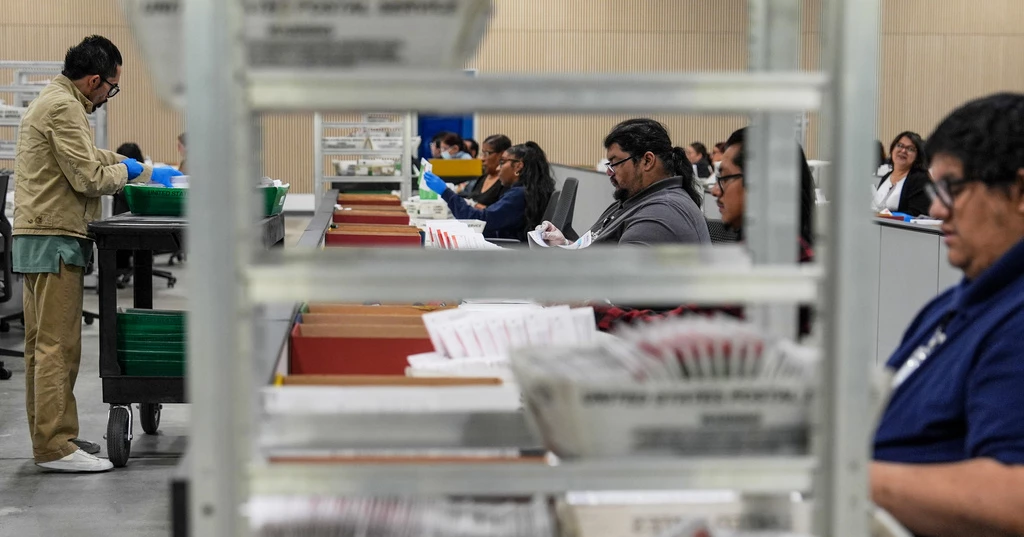
The Trump administration on Monday appealed to the US Supreme Court in an attempt to set aside around 20,000 disputed mail-in ballots in California, just a day before the crucial midterm elections that will determine control of Congress.
The emergency appeal came after a divided federal appeals court rejected the administration's request to segregate the ballots cast by voters whose citizenship status the federal government has questioned.
The Justice Department argued that the ballots should not be counted until the voters' eligibility is verified. California officials, however, said the list was highly unreliable and likely included many US citizens.
The Republican administration has made identifying potential noncitizen voters a priority this year, although voting by noncitizens is rare.
A district court judge had firmly rejected the Justice Department's request, warning that the move could disenfranchise eligible American citizens in Tuesday's midterm elections.
The Justice Department asked the Supreme Court to issue a limited injunction directing California to keep the disputed ballots separate while the legal proceedings continue.
Solicitor General D. John Sauer argued that once the disputed ballots are mixed with other valid ballots, it would be impossible to identify and retrieve them.
Voting has been underway in California, a predominantly Democratic state, since early October. The state mails ballots to all of its approximately 23 million registered voters, and hundreds of thousands have already been processed.
California election officials said identifying and separating the disputed ballots at this stage would be practically impossible.
California Attorney General Rob Bonta, a Democrat, described the appeal as an act of desperation and another attempt to undermine elections and violate the rule of law.
Lower courts have repeatedly sided with California. The district judge warned that separating the ballots could cause major disruption to the midterm elections and undermine public confidence in the democratic process.
In his ruling, US District Judge David O. Carter said that allowing the executive branch to reject votes and threaten an ongoing election based on unproven allegations would put American democracy at risk.
A three-judge appeals court panel upheld his ruling by a 2-1 vote. The majority included judges appointed by former President Donald Trump and former President Joe Biden.
The dissenting judge, who was also appointed by Trump, argued that California's refusal to separate the ballots encouraged violations of federal law.
The Justice Department had earlier sought expedited intervention from the appeals court but failed to secure it.
Trump's administration has secured several victories through emergency appeals before the Supreme Court during his second term. However, the justices previously rejected his attempt to restrict mail-in voting ahead of the midterm elections.