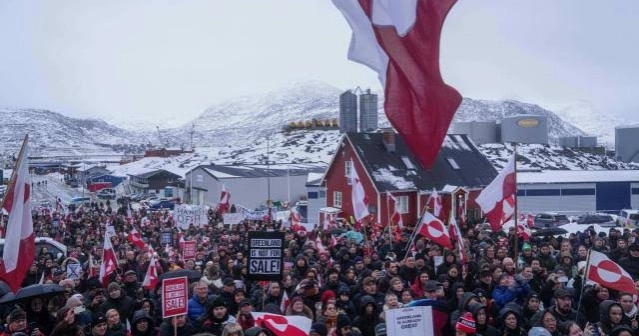
President Donald Trump said Friday that the United States and Denmark had reached an agreement to strengthen the American military presence in Greenland, following months of Trump publicly raising the possibility of taking control of the Arctic island. The proposed deal, however, leaves Greenland under Danish sovereignty.
In a social media post announcing the agreement, Trump said the arrangement would give the United States lasting responsibility for Greenland’s security and address what he described as Washington’s concerns about the territory.
He said his administration would immediately begin working toward expanding the U.S. military presence on Greenland, which is part of the Kingdom of Denmark and is rich in mineral resources.
The agreement followed months of private discussions among American, Danish and Greenlandic officials. The talks focused on ways to respond to U.S. security concerns involving Greenland, which has a population of approximately 56,000.
The issue had received less attention from Trump in recent months as his administration became involved in other international conflicts, including a military operation targeting the government of former Venezuelan President Nicolás Maduro and the war involving Iran and Israel.
The new agreement also gives Trump an opportunity to present a foreign-policy accomplishment before the U.S. midterm elections. The ongoing conflict with Iran has affected the political environment and raised questions about Trump's earlier promises to avoid involving the United States in overseas wars.
Danish Prime Minister Mette Frederiksen’s office said the agreement is expected to be formally signed by the governments of the United States, Denmark and Greenland next week during the United Nations General Assembly. However, approval by the Danish and Greenlandic parliaments will still be required before the agreement can take effect.
Frederiksen said the agreement respects the sovereignty and territorial integrity of both Denmark and Greenland and recognizes their peoples’ right to self-determination.
Greenlandic Prime Minister Jens-Frederik Nielsen said the proposed arrangement serves the interests of all three governments and takes Greenland’s interests into account.
Denmark and Greenland Had Rejected Trump's Push for U.S. Control
After returning to the White House last year, Trump repeatedly urged Denmark to transfer Greenland to the United States, arguing that the island was essential to American national security.
Trump also refused to completely rule out using military force to obtain Greenland, despite Denmark being a NATO ally of the United States.
Both Denmark and Greenland consistently maintained that the territory was not for sale and criticized reports that the United States had been collecting intelligence there. Trump's campaign to gain control of Greenland also faced strong opposition from Russia and several European governments.
Friday's announcement suggested that negotiations may have produced an arrangement capable of easing a dispute that Danish officials had regarded as a serious challenge to their sovereignty.
Trump said he looked forward to working with the people of Denmark and Greenland on the future of what he described as a strategically important territory and pledged that the United States would protect it.
Trump has argued that greater U.S. involvement in Greenland is necessary to counter potential threats from Russia and China. He has also repeatedly claimed that Russian and Chinese military forces were operating near Greenland, claims that have been disputed.
According to a State Department official who spoke anonymously because they were not authorized to discuss the agreement publicly, the deal would prohibit non-NATO military bases in Greenland, restrict investments by potential adversaries and prevent Russia and China from establishing military bases there.
Secretary of State Marco Rubio praised the agreement as a major achievement for the United States.
Rubio said Greenland would remain an important part of North America's strategic defense framework and that the agreement would address U.S. national security concerns relating to the territory.
Greenland's Strategic Importance to North America
The United States has maintained a military presence in Greenland for decades. During the Cold War, Washington operated several military installations there before reducing its footprint.
Today, the United States continues to operate Pituffik Space Base in northwestern Greenland. The facility was established following the 1951 Defense of Greenland Treaty between the United States and Denmark and plays a role in missile warning, missile defense and space surveillance for the United States and NATO.
Greenland's geographical position makes it strategically important to North American defense. The island lies northeast of Canada, and more than two-thirds of its landmass is located north of the Arctic Circle.
Its importance became particularly clear during World War II, when the United States occupied Greenland to prevent Nazi Germany from gaining control of the territory and to help safeguard crucial shipping routes across the North Atlantic.
Despite Trump's forceful demands over Greenland, Danish officials had repeatedly indicated that Copenhagen was willing to cooperate with Washington on expanding the American military presence and increasing U.S. commercial activity on the island.
However, Trump's repeated calls for U.S. ownership of Greenland and his threats to use force created significant unease within NATO and among European allies.
Imran Bayoumi, an associate director at the Atlantic Council's Scowcroft Center for Strategy and Security, said the dispute had damaged America's image in Europe.
He said many Greenlanders, Danes and other Europeans viewed Trump's approach as a challenge to their sovereignty and that rebuilding trust would require considerable effort.