US President Donald Trump said Sunday that Russia and Ukraine had agreed to an “energy ceasefire” in their four-and-a-half-year war, but provided no details as Kyiv reported fresh Russian attacks on energy facilities.
In a brief social media post, Trump said the ceasefire had taken effect immediately, adding, “Do not break it!”
Moscow did not immediately comment on the announcement. Ukrainian President Volodymyr Zelenskyy welcomed Trump's statement as “good news for everyone” but said Russian attacks on energy infrastructure continued in Kyiv and the northeastern city of Kharkiv.
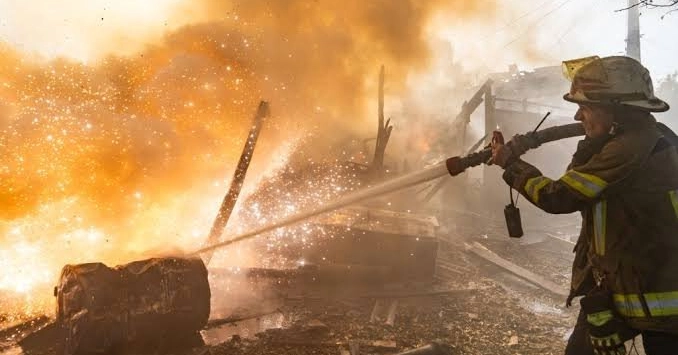
“Unfortunately, Ukrainian skies have been infested with Russian 'shaheds' all day today,” Zelenskyy said in an evening address, referring to Russian-launched drones. He also reported glide bomb attacks and strikes on energy facilities, including a power plant in Kharkiv.
Zelenskyy's office confirmed that the Kharkiv attack occurred after Trump's announcement.
The Ukrainian president said Kyiv was ready to stop attacking Russian energy facilities and expected Moscow to do the same.
Russia has repeatedly targeted Ukraine's energy infrastructure during the war, disrupting electricity, heating and water supplies in an effort to weaken public resistance to its invasion. Ukrainian officials have described the strategy as “weaponising winter”.
Zelenskyy said Ukraine had proposed several measures to reduce tensions, but Russian President Vladimir Putin had rejected them all. He expressed hope that Putin would finally respond positively to appeals from the United States, Ukraine and the international community.
Kyiv remains in contact with Washington, Zelenskyy said, thanking the US for its support. He also said he had discussed the latest developments with Canadian Prime Minister Mark Carney, Finnish President Alexander Stubb and NATO Secretary-General Mark Rutte.
In an interview broadcast earlier Sunday on ABC's “This Week”, Zelenskyy said Ukraine was prepared to stop striking Russian oil refineries if Moscow halted attacks on Ukraine's energy system. He urged Trump to press the Kremlin to accept the proposal.
“We are asking President Trump, (to) give them (a) signal, not (to) attack energy infrastructure of Ukraine,” he said.
On September 14, Trump had also claimed that the two countries agreed not to attack each other's energy infrastructure, but provided no details. Zelenskyy had expressed willingness to comply if Russia did the same, but the proposal did not lead to an agreement.
Trump, Zelenskyy clash over elections
Trump said Saturday that Ukraine should elect a new president, arguing that Zelenskyy had failed to do enough to end the war. He also blamed the Ukrainian leader for high diesel prices in the United States.
In response, Zelenskyy said Ukraine could hold elections if Russia agreed to a 60-day ceasefire.
“Give us two months, 60 days off. Total ceasefire, 60 days, and we will organize elections,” he said, adding that he would accept whatever choice Ukrainian voters made.
“With all respect to President Trump, it's up to our society, up to our people to choose one or another leader,” Zelenskyy said.
He added that holding elections during the war would be unlawful under the current legal framework and that security guarantees would be needed to ensure safe voting.
Ukraine has been under martial law since Putin launched the full-scale invasion in February 2022. The country's constitution prohibits elections while martial law remains in force and allows the president to stay in office until a successor is sworn in.
Organising a nationwide vote would also be difficult because Russia controls roughly one-fifth of Ukrainian territory, millions of Ukrainians have fled abroad and many soldiers remain on the front line. Zelenskyy's presidential term formally expired in May 2024.
The exchange came as Ukraine continued its campaign against Russian infrastructure. A Ukrainian drone strike on Sunday shut down a data centre operated by technology company Yandex in the Russian city of Vladimir, east of Moscow. It was the third attack on the company's facilities in four days.
Russia and Ukraine have continued long-range aerial attacks while fighting on the front line has remained largely deadlocked.
Trump, who announced a deal with Putin on Friday to purchase Russian diesel to help lower fuel prices ahead of the US midterm elections, has repeatedly urged Zelenskyy to stop attacks on Russian energy facilities.
He has blamed Ukraine for record-high US diesel prices rather than the US-led war in Iran, which has pushed up global energy costs. Ukrainian and European officials criticised the proposed diesel deal, saying it would help finance Russia's war effort.
Ukrainian strike disrupts Russian digital services
The Ukrainian drone attack on Yandex's data centre in Vladimir disrupted several of the company's services, leaving users in dozens of Russian cities, as well as in Kazakhstan, Belarus and Armenia, unable to order taxis or access banking services, according to Russian independent news outlet Astra.
“Operations at the data center have been completely halted. There were no injuries,” Yandex Cloud said on its Telegram channel, which provides service updates.
The disruption affected everyday activities in Moscow. Pavel Belyavskiy, a Yandex Taxi driver, said he was unsure whether ride requests were coming through and had to cancel several trips after waiting for passengers he could not contact.
“I'd press the 'call' button to contact them, but nothing happens,” he said. “There's nothing I can do, so I'm just forced to cancel.”
Igor Mann said he could not access an order on Yandex Market, the company's shopping platform. Using a virtual private network did not solve the problem.
“Nothing worked,” he said.
Another Moscow resident, Eduard Malyavko, said the outages had a “direct impact” on daily life beyond simple inconvenience, affecting areas including healthcare.
The latest attack followed two other strikes on Yandex facilities. A drone attack on Thursday disrupted a data centre in Russia's Ryazan region, southeast of Moscow. Ukrainian drones struck another major Yandex data centre in the Kaluga region, southwest of Moscow, the following day, disabling part of the facility, the company said.
Often described as Russia's equivalent of Google, Yandex operates the country's most popular search engine and a wide range of digital services. It is also heavily involved in Russia's artificial intelligence development.
Death toll from Zaporizhzhia bombing rises to 23
Elsewhere, search and rescue operations ended in the southern Ukrainian city of Zaporizhzhia following a Russian bombing on Saturday, according to Ivan Fedorov, a former regional head and co-chair of the regional defence council.
Zelenskyy said 23 people, including four children, were killed in the attack. More than 30 others were injured, Fedorov said, adding that eight remained in hospital.
In Russia, a man was killed and two women were injured in a Ukrainian drone strike in the border region of Bryansk, local officials said Sunday.