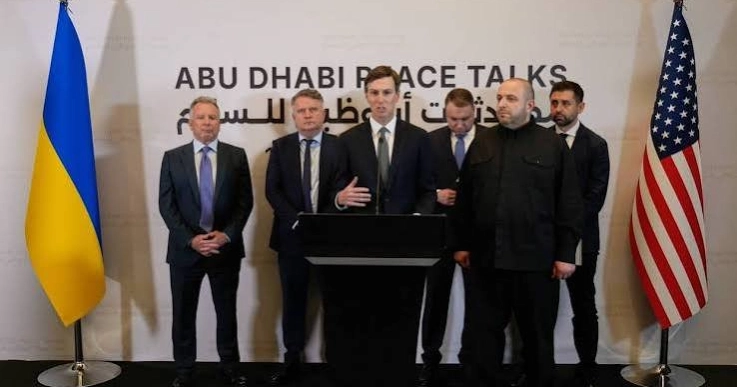
Envoys of US President Donald Trump arrived in Moscow on Thursday to meet Russian President Vladimir Putin and discuss the outcome of US-mediated negotiations between Russian and Ukrainian delegations.
Steve Witkoff and Jared Kushner, Trump's son-in-law, took part in the two-day talks in Abu Dhabi, the United Arab Emirates, which ended Wednesday with an agreement on a major prisoner-of-war exchange but no apparent progress towards ending the nearly five-year conflict.
Kushner said that after meeting Putin, he and Witkoff would travel to Dublin, Ireland, to meet Ukrainian President Volodymyr Zelenskyy.
Zelenskyy offered a cautious response to the outcome of the negotiations, describing the proposed prisoner swap as a positive development. However, he reiterated that Ukraine would not accept demands to surrender territory occupied by Russia in return for peace.
Expectations for a major breakthrough had been low ahead of the first meeting between the two countries' delegations in nine months. Although Russia and Ukraine have exchanged prisoners of war periodically, their positions on the terms of a peace settlement remain far apart.
Key obstacles include the future of Russian-occupied Ukrainian territory, postwar security guarantees for both countries and the role European nations would play in a potential settlement.
Moscow opposes the direct involvement of European countries in the negotiations, citing their concerns about Russia's actions and broader ambitions on the continent. Kushner said one objective of the Moscow meeting was to explore ways to bring European representatives into the talks.
He said both Ukraine and Russia needed clarity on postwar security arrangements, adding that European countries, the European Union and NATO needed to participate in those discussions to build agreement on the way forward.
Kremlin spokesman Dmitry Peskov said Wednesday that European representatives could join the peace negotiations at a later stage. However, he said their current statements "don't indicate any desire on their part to contribute to movement along the path toward peace."
Moscow has criticised European countries for financing Ukraine and supplying it with weapons.
Ukraine wants guarantees that Russia will not launch another attack, while EU officials have said discussions on Europe's security arrangements can begin only after a ceasefire.
Many in Europe view Russia's inclusion in those security plans as a concession to Putin, who has repeatedly described NATO's eastward expansion as a major security threat to his country. Moscow has demanded that the alliance withdraw its troops from areas along Russia's borders.