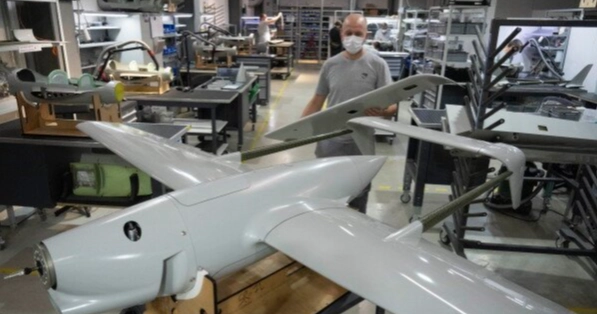
Ukraine has become a global leader in military drone technology since Russia launched its full-scale invasion more than four years ago, helping its forces counter a much larger enemy. However, the country’s growing drone industry still relies heavily on electronic components made in China, a key Russian ally.
Ukraine fears Beijing could restrict supplies of essential components or give Russian defence companies preferential access to Chinese factories.
Over the past two years, Ukraine has tried to reduce its dependence on China by expanding domestic production and importing more components from Taiwan, Europe and the United States. These efforts have reduced its reliance on Chinese motors, flight controllers and other parts, but completely replacing Chinese supplies remains difficult because of their lower prices and China’s huge production capacity.
“If China stops their production to us ... we are blinded,” said Andrii Taganskyi, an executive at Ukrainian weapons manufacturer Odd Systems, which develops cameras for drones.
China has tightened export controls on drones and related equipment several times in recent years, citing concerns about the military use of civilian technology and the continuation of the war. Although the restrictions have not stopped Chinese components from reaching Ukraine, they have caused delays, increased costs and forced Ukrainian companies to use intermediaries in other countries.
“China has leverage,” said Robert Tallost, a researcher at the Royal United Services Institute (RUSI), a think tank. He warned that Beijing could direct more supplies to Russia while limiting shipments to Western countries.
China’s Foreign Ministry said Beijing follows a “prudent and responsible” approach to military exports, opposes the use of civilian drones for military purposes and urges all sides to seek a political settlement.
Replacing Chinese components would raise costs
Ukraine’s drone industry has gained international recognition for developing and assembling advanced systems that have changed modern warfare. However, many essential components remain difficult to produce domestically.
Around a dozen Ukrainian manufacturers said they still depend largely on China for magnets, motors, chips, thermal sensors, battery cells and other materials.
Oleksandr Yakovenko of TAF Industries, a major Ukrainian defence company, said replacing Chinese components entirely with Western alternatives could increase costs by as much as 60% and reduce production by a similar proportion. He and other industry executives said such a trade-off would not be practical.
Nevertheless, Ukrainian manufacturers have made progress in increasing domestic production.
Three years ago, drone maker Vyriy relied on China for nearly 90% of the components used in its attack drones. Today, about 70-80% of its components are made in Ukraine, said its founder, Oleksii Babenko.
Greater domestic production also allows companies to respond more quickly to battlefield demands. Locally made drones and components can be redesigned within days, while changes involving foreign supply chains may take months, said Artur Savchii, an analyst at the Kyiv-based Serpens Center for International Security.
Ukrainian customs data show that nearly 90% of the country’s imported drone components came directly from China at the beginning of 2024. The figure fell to 28% during the first eight months of 2026.
However, the decline may be less significant than the figures suggest, as some components recorded as imports from Poland and the Czech Republic may have been manufactured in China and shipped through those countries.
Thermal cameras highlight the challenge
Ukraine’s continued dependence on Chinese technology is particularly clear in thermal cameras used by military drones.
Ukrainian companies design the cameras but rely on imported sensors that detect infrared radiation and lenses that cannot currently be manufactured domestically, industry representatives said.
Germanium, an important raw material for these lenses, is widely available in China, helping Chinese manufacturers produce them at lower prices than European suppliers.
Although the United States and Europe also manufacture thermal sensors, much of their output is used in their own markets.
Taganskyi said Ukraine could produce thermal cameras entirely from European components, but limited production capacity and high costs remain major obstacles. Europe produces about 600,000 thermal sensors annually, compared with Ukraine’s estimated requirement of four million, he said.
For now, some Chinese components remain essential.
“Without this 5%, there is no camera,” Taganskyi said.
Ukraine competes with Russia for Chinese supplies
Experts say Russia is even more dependent on Chinese components than Ukraine, partly because Western sanctions have restricted its access to other markets. However, Moscow does not face the same concern that Beijing could favour Ukraine when supplying military-related technology.
Ukrainian President Volodymyr Zelenskyy recently raised concerns about China’s closer commercial relationship with Russia.
“They are slightly on Russia's side. And by ‘slightly,’ I mean not direct weapons supplies, but a greater openness to them, a greater willingness to help them rather than us,” Zelenskyy said. He added that even a limited preference could have significant consequences given China’s size.
Competing with Russian buyers for supplies from the same Chinese factories also risks revealing Ukraine’s military requirements to Moscow.
Babenko recalled that Ukrainian forces recovered a Russian drone fitted with advanced antennas for long-range reconnaissance and guidance. His company traced the technology to a Chinese supplier.
When Ukrainian representatives sought to purchase several hundred units, the supplier initially refused before agreeing on the condition that the deal remain confidential because the technology had been developed for Russia, Babenko said.
The incident reinforced the need for domestic manufacturing, he added, warning that Ukraine should prepare for a situation in which China fully sides with Russia.
Companies find ways around export restrictions
Since 2023, China has repeatedly tightened controls on exports of drones and related components. Further restrictions introduced this summer have prevented Ukrainian companies from directly purchasing some long-range civilian drones, motors, cameras and infrared imaging equipment from Chinese suppliers.
To maintain supplies, Ukrainian defence companies have turned to intermediaries in third countries. Executives said the restrictions had disrupted deliveries and increased costs.
One executive described a system in which partner companies purchase components in other countries before they are shipped through additional locations to Ukraine.
Another executive said some companies alter product descriptions on official paperwork to get around export controls. Both spoke anonymously to avoid exposing their methods.
Joseph Webster, a senior fellow at the Atlantic Council, said Chinese manufacturers’ continued willingness to sell to Ukrainian buyers and the ability to route goods through third countries made it difficult to stop the trade completely.
“This dependence is not going to go away in a war where both sides are burning through equipment at a horrifying scale,” said Samuel Bendett, an analyst of military robotics. “Where domestic industry cannot keep up, China can.”