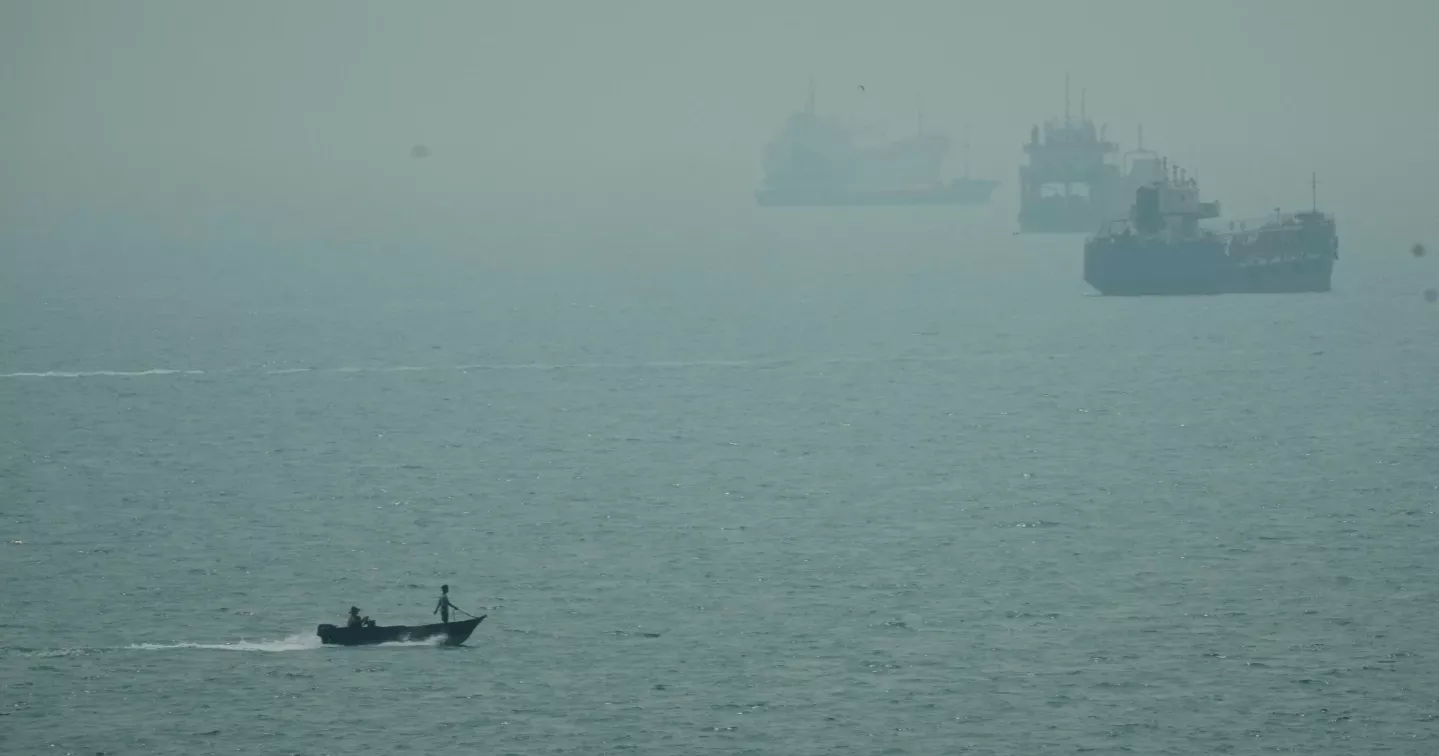
The US military said Tuesday it destroyed five Iranian oil tankers after Iran targeted US Navy warships with ballistic missiles, while Tehran launched missiles at American targets in Jordan in the latest escalation in the more than six-month-old war.
Iranian state media reported that missiles were fired toward US targets in Jordan following the US strikes. Jordan's military said its air defenses intercepted 18 ballistic missiles and that two others landed in uninhabited areas, with no casualties reported.
The latest exchanges came as President Donald Trump pursued a combined military and economic strategy aimed at pressuring Iran to end the war. The US administration also announced sanctions against more than two dozen Iranian commercial and private airlines and foreign cargo service providers as part of efforts to further isolate Tehran.
The United States and Iran are also locked in a confrontation over the Strait of Hormuz, through which roughly one-fifth of the world's oil passed before the war. The conflict has pushed up energy prices, with Brent crude briefly reaching $99.46 a barrel on Tuesday.
US forces destroyed three Iranian oil tankers Saturday after Iran's Revolutionary Guard attempted to strike a US aircraft carrier and destroyer with ballistic missiles. US Secretary of State Marco Rubio said Washington would continue responding to attacks on its naval forces.
“For every time they do that or try to do that, they’re going to lose tankers,” Rubio told reporters during a visit to Colombia.
US Central Command said Tuesday's strikes came after the Islamic Revolutionary Guard Corps targeted a US Navy warship twice over the previous two days. The warship evaded the attacks and continued patrolling regional waters, and no US personnel were injured, it said.
The five tankers destroyed Tuesday were identified as the Kivik, Charminar, Horizon 1 and Riesco in the Gulf of Oman, and the Derya near Iran's Kharg Island in the Strait of Hormuz. The crews were warned to abandon the vessels before the strikes, according to Central Command.
Iranian state television also reported attacks on oil tankers near the southern port of Jask and Kharg Island, saying their crews had been evacuated.
Iran's Revolutionary Guard Navy meanwhile warned crews of oil tankers near Kuwait and Bahrain to leave their vessels, saying the ships could be targeted in retaliation. It accused the two Gulf countries of hosting US forces and supporting American attacks.
The US blockade of Iranian ports has further squeezed Tehran's economy by restricting oil exports, while US forces have been assisting a limited number of vessels transiting the Strait of Hormuz along a route near Oman.
Iran has sought to impose its own designated route for ships passing through the strait, which had been regarded as international waters before the war.
Danny Citrinowicz, an Iran expert at Israel's Institute for National Security Studies, warned that continued military exchanges could trigger further retaliation and deepen the economic impact of the conflict.
“There is no kinetic solution to the Strait of Hormuz problem,” he said, warning that attempts to resolve the dispute militarily could push Washington and Tehran toward an escalation that becomes increasingly difficult to control.