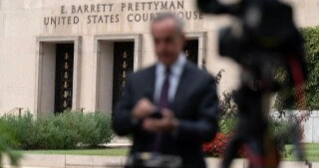
A federal judge has temporarily blocked President Donald Trump's decision to bar CNN, MS NOW and Politico from the White House grounds, ordering the administration early Thursday to restore the outlets' access.
The ruling is the latest development in a growing dispute between Trump and news organizations whose coverage he has criticized.
Trump announced the ban Friday, accusing the outlets of publishing what he called “fake news.” His administration later argued that some of their reporting posed a national security risk.
The three outlets challenged the decision in court, arguing that the ban violated the First Amendment because they were targeted based on the content of their reporting.
US District Judge Timothy Kelly ordered the White House to “immediately return, reinstate, and restore” the outlets' access.
He issued a temporary restraining order that will remain in effect for 14 days, saying the news organizations had met the legal requirements and were likely to succeed in arguing that their press passes had been revoked without proper legal process.
“This is a high bar, but Plaintiffs have met it,” Kelly wrote.
The decision provides temporary relief to the outlets as tensions between Trump and news organizations continue to grow.
Kelly said the government must establish clear standards for conduct that could justify revoking a press pass. He described the White House's explanation of what constituted objectionable reporting as “so vague it hardly does the trick.”
Kelly, who was nominated by Trump in 2017, previously ordered CNN journalist's access to be restored in a similar case in 2018.
The judge heard arguments Wednesday. Temporary restraining orders are generally intended to preserve the existing situation while a court considers a case in greater detail.
“This is a strong ruling vindicating freedom of the press, due process and the rule of law,” Theodore Boutrous Jr., an attorney for the three outlets, said in an emailed statement.
The White House did not immediately respond to an Associated Press request for comment.
Judge questions national security argument
During an emergency hearing Wednesday, Kelly said he was required to follow previous rulings in similar First Amendment cases, even when the government disagreed with them.
The White House had argued that some of the previous cases cited by the outlets were wrongly decided.
“Maybe,” Kelly wrote, “but this Court is bound by D.C. Circuit precedent, full stop.”
Kelly also rejected the administration's argument that the press-pass revocations were necessary for national security, saying the government had provided little evidence to support the claim.
“Nothing in the record ... suggests that the revocation of Plaintiffs' hard passes was motivated by national security concerns,” he wrote.
He also expressed doubt that revoking the outlets' press passes actually advanced the government's stated national security interests.
Lawyers debate White House access
Boutrous told the court that the outlets faced immediate and lasting harm from losing access, particularly during major international events.
“We're at war. We have world leaders coming to Washington,” he said.
Justice Department attorney Michael Velchik repeated the administration's argument that the president has authority to decide who receives access to the White House.
“Access to the White House is a privilege, not a right,” Velchik said.
Velchik argued that Trump was not targeting the outlets because of their political viewpoints, noting that the president had also strongly criticized other news organizations without banning them.
“The president should be able to take immediate action to protect national security,” he told the court.
Boutrous disputed that argument, saying the administration only raised national security after the outlets filed their lawsuit.
“Suddenly it's a national security case,” he said.
Boutrous also argued that Trump's repeated criticism of negative coverage supported the outlets' claim that the ban was linked to their reporting.
White House cites specific reports
In a court filing Tuesday, administration lawyers provided letters sent to the three outlets listing what they described as “a non-exhaustive list of reporting incidents” that allegedly threatened national security or spread false information.
The examples included CNN's reporting about “top-secret” construction details involving an East Wing bunker, MS NOW's reporting about an alleged leak investigation and Politico's publication of a document about funding for the White House ballroom that included detailed descriptions of Secret Service security improvements.
The administration also cited additional examples in separate letters.
Politico's letter listed six incidents, including a June report that quoted an unnamed senior administration official discussing whether a preliminary agreement could end the conflict with Iran.
The report appeared to refer to a background briefing arranged by the White House, during which an official spoke to reporters anonymously under rules established by the administration. Several other news organizations also reported the official's comments.
Other networks suspend Trump coverage
The ban also prompted other news organizations to take action in support of the three outlets.
A five-network US press pool that rotates coverage of the president and includes CNN suspended its coverage of Trump's events.
The networks continued the suspension after Wednesday's hearing. At Joint Base Andrews, where Trump formally welcomed Chinese President Xi Jinping, journalists from Fox News, CBS and NBC were present but did not record video.
Other television outlets present included NewsNation, Newsmax, Right Side Broadcasting Network, One America News and LindellTV, according to signs displayed on their cameras and tripods.
Before Wednesday's hearing, other news organizations, including The Associated Press, filed an amicus brief urging the court to immediately restore CNN, MS NOW and Politico's access to the White House.