Ukrain war
Over 16,000 civilians detained by Russia during the war in Ukraine are still held, UN
More than 16,000 Ukrainian civilians detained by Russia since the start of the war remain deprived of their liberty, many without access to communication and on grounds that violate international law, the United Nations estimates.
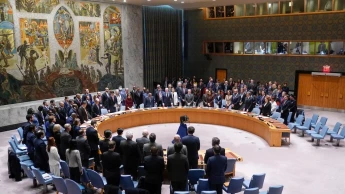
Claudia Fuentes Julio, the U.N. assistant secretary-general for human rights, told an informal Security Council meeting Monday that Russian authorities continue to subject Ukrainian civilian detainees and prisoners of war to widespread and systematic torture and ill-treatment, including sexual violence.
Since Russia launched its full-scale invasion of Ukraine in February 2022, U.N. human rights officials have interviewed 910 Ukrainian POWs and 403 civilian detainees after their release. The U.N. has not been granted access to detention facilities in Russia.
More than 95% of interviewed Ukrainian POWs and 85% of civilian detainees reported torture or ill-treatment, often repeatedly. They also described sexual violence, food shortages and inadequate medical care.
The U.N. human rights office has documented the executions of 129 Ukrainian POWs at the beginning of their captivity and the deaths of 48 others in custody due to torture, denial of medical treatment or other inhumane detention conditions, Julio said.
The Security Council also heard accounts from former detainees, including Crimean Tatar activist Leniie Umerova and Ukrainian soldier Khuan Leyva Garsiya.
Garsiya, who spent 1,183 days as a POW after surrendering at the Azovstal steel plant in Mariupol, said he was tortured and abused because of his Cuban background and education in the United States. He described beatings, freezing, electrocution and sexual abuse, saying two friends were beaten to death in detention.
Umerova said she was detained after attempting to enter Russia from Georgia to visit her seriously ill father in Crimea. She said Russian authorities held her on fabricated charges and transferred her between seven facilities in six months.
Julio also said U.N. monitors interviewed 816 Russians and 57 third-country nationals who were captured while serving in Russian forces in Ukraine. About half reported torture or ill-treatment, mainly during initial captivity and interrogation. However, conditions in Ukrainian detention facilities generally complied with international humanitarian law and had improved since 2022, she said.
Russia's deputy U.N. Ambassador Maria Zabolotskaya rejected the allegations, saying Russian forces comply with international humanitarian law. She accused NATO countries of using the meeting as part of a disinformation campaign against Russia.
Ukraine's deputy U.N. Ambassador Volodymyr Pavlichenko said Russia was unwilling to discuss the return of prisoners of war and civilian detainees, including abducted children.
1 month ago
.jpg)
In Ukraine and internationally, scenario darkens for Russia
Europe pushed Monday to toughen its response to Russia’s invasion of Ukraine, with Sweden following Finland in deciding to seek NATO membership and European Union officials working to rescue proposed sanctions that would target Russian oil exports helping to finance the war.
On the ground, Ukrainian troops resisted attempted Russian advances and even rolled back front lines. In a small but symbolic boost for Ukrainian morale, a patrol of soldiers recorded triumphant video of their push to the Russian border in the region of Kharkiv. Ukrainian forces have already driven Russian troops back from the region’s capital, reducing their ability to hit the battered city with artillery.
As fighting raged, international efforts to respond to Russia’s aggression continued to pick up pace. Swedish officials announced their intention to seek NATO membership — following a similar decision from its neighbor Finland. Those are seismic developments for the Nordic countries that have traditionally positioned themselves as militarily “nonaligned.”
Russian President Vladimir Putin has looked grimly upon the alliance’s post-Cold War expansion in Eastern Europe, seeing it as a threat. But if the invasion was meant as a check on NATO, it appears to have backfired — by driving Sweden and Finland into NATO’s arms and pushing members of the alliance to send massive shipments of weapons to Ukraine.
Yet the Russian leader on Monday seemed to brush off that setback, saying “there is no direct threat to Russia created by the expansion involving these countries.”
Also Read: Russian neighbor Finland announces it wants to join NATO
“But the expansion of military infrastructure onto this territory will of course give rise to our reaction in response,” he said.
NATO’s secretary-general, Jens Stoltenberg, has said the membership process for both Finland and Sweden could be very quick — though member Turkey has cast some doubt over the move.
Swedish Prime Minister Magdalena Andersson said Monday that joining the 30-member military alliance was her country’s best defense in the face of Russian behavior.
“Unfortunately, we have no reason to believe that the trend (of Russia’s actions) will reverse in the foreseeable future,” she said.
In addition to sending military aid to Ukraine, Europe is also working to choke off funding for the Kremlin’s war, by reducing the billions of dollars it spends on imports of Russian energy.
But a proposed EU embargo on imports of Russian oil faces opposition from a small group of countries led by Hungary, which is one of a number of landlocked countries that are highly dependent on the imports, along with the Czech Republic and Slovakia. Bulgaria also has reservations.
“We will do our best in order to deblock the situation,” EU foreign policy chief Josep Borrell said. “I cannot ensure that it is going to happen because positions are quite strong.”
Western weapons deliveries to Ukraine and sanctions against Russia have helped the outgunned and outnumbered Ukrainian forces slow the Russian advance — and even turn it back in places.
4 years ago