School meal
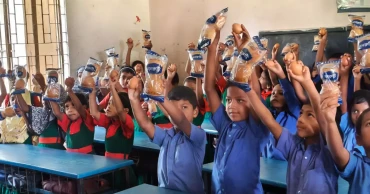
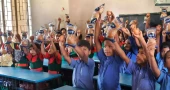
In Lalmonirhat chars, a school meal is changing the learning day
In the remote char areas of Lalmonirhat where poverty, river erosion and long distances often make regular schooling difficult for children, a free school-feeding programme is drawing students back to classrooms and helping them stay attentive through the school day.
Teachers, students and guardians in the district’s Patgram and Kaliganj upazilas said the programme has made a visible difference in school attendance, children’s interest in learning and their ability to remain in classrooms for longer periods.
They are now calling for the pilot initiative to be expanded to primary schools across the country, particularly in disadvantaged and hard-to-reach areas.
The programme was introduced in 310 primary schools in the two upazilas on December 28 last year.
Under it, children from pre-primary to Class V receive free food during the school break.
The menu includes fortified buns, eggs, bananas and 200-millilitre packets of milk.
Buns are supplied every school day, while milk and bananas are served on alternate days and boiled eggs are provided on the remaining three days of the week.
According to the Lalmonirhat District Primary Education Office, 22,829 children in Patgram and 19,850 in Kaliganj upazila are receiving the meals every day.
For children living in the chars, the significance of the programme goes beyond simply providing a snack.
Many of them leave home in the morning after having a limited meal and remain at school until the afternoon.
In several schools, students have to travel considerable distances, sometimes crossing rivers or using boats, to attend classes.
At Votmari Government Primary School in Kaliganj, many students come from char areas across the Teesta.
Headteacher Asaduzzaman Dulu said students previously became tired and inattentive after midday because they had little or no food during the long school day.
“Most of our students come from the char areas across the Teesta. They used to become weak and inattentive after noon because they had to stay at school for a long time without food,” he said.
“Now that they receive nutritious food, their attendance has increased significantly. We are currently seeing attendance of around 95 to 97 percent, and at times we are struggling to accommodate all the students in the classrooms,” he added.
Heshne Hasin Kingbodonti and Taslima Yasmin Humaira, students of Modonpur Bairati Government Primary School, said staying at school from morning until afternoon was difficult when they were hungry.
“Now we get nutritious food from the government, which gives us the strength to stay in class and concentrate on our lessons. The food is also of good quality,” they said.
For parents such as Azizar Rahman and Manjum Ali, the programme is particularly important because they cannot afford to provide money or a separate tiffin for their children every day.
“We are poor people. We cannot give our children food or money for tiffin every day. What they eat at home in the morning is often not enough for them to stay at school throughout the day,” they said, urging the authorities to continue the programme nationwide.
From attendance to nutrition
The impact is also being reflected in attendance figures.
Lalmonirhat Assistant District Primary Education Officer Ahsan Habib said attendance in schools in the two upazilas was around 70 percent but has risen to around 90-95 percent after the introduction of school feeding.
6 days ago

SAJIDA Foundation partners with Thrive to feed 330 students in 3 schools
SAJIDA Foundation has entered a partnership with Thrive, a nonprofit organisation dedicated to delivering healthy food to hungry children, to provide food to 330 students in three schools.
Non-government organisation SAJIDA is sponsoring nutritious meals, delivered by Thrive, for all the schoolchildren of Apon Alo School (Rayer Bazar, Dhaka), Jaago School (Habiganj, Sylhet), and Ucchash School (SonPocha Char River Island, Bogura) from May 9 to August 31.
"Thrive's work really brings us back to our roots as a school started in a garage. Healthy meals give children the fuel they need to learn and succeed in their education," said Muhymin Chowdhury, director (challenge fund, partnerships and communications) at SAJIDA.
READ: Ecnec rejects Tk 17,290-cr primary school meal project
Thrive has been delivering meals to schools since its inception ten years ago and has served these three schools for more than four years.
Having SAJIDA sponsor all of these schoolchildren in some of the poorest areas of Bangladesh allows Thrive to move additional children off its waitlist.
"SAJIDA's generous donation and willingness to ensure a healthy meal for these children every school day for four months gives us the ability to expand our reach and feed even more hungry kids," Priscila Heffelfinger, co-founder of Thrive, said.
READ: 3 mn school children to receive food rations
While this programme marks Thrive and SAJIDA's largest effort to date, the organisations worked together in the past.
Last March, SAJIDA, Thrive, and the Amal Foundation teamed up to bring emergency food relief to Rohingya families displaced by a devastating fire in the Balukhali refugee camp in Cox's Bazar.
READ: All govt pry schools to go under midday-meal programme by 2023
SAJIDA supported the cost of 5,000 hot meals.
4 years ago