BSREA

EVs could cut running costs by 75% but Bangladesh faces structural barriers: DCCI
Electric vehicles (EVs) could slash transport running costs by as much as 75 per cent compared to fossil fuel vehicles but deep structural barriers, from crippling energy shortages to near-absent charging infrastructure are slowing Bangladesh's transition, according to a paper presented by the Dhaka Chamber of Commerce and Industry (DCCI) on Saturday.
DCCI President Taskeen Ahmed presented the paper at a seminar titled “The Electric Vehicle (EV): Challenges and Prospects in Bangladesh”, organised by the chamber in collaboration with the Bangladesh Sustainable and Renewable Energy Association (BSREA) at DCCI Auditorium in Motijheel, Dhaka.
Against Bangladesh's total registered vehicle fleet of 67.24 lakh, only 669 registered EVs (excluding electric three-wheelers) are on the road, the paper noted, a striking contrast with an estimated six million locally manufactured, largely unregulated electric three-wheelers already in circulation.
The government has set a target of 30 per cent EV adoption in the public and autonomous sectors by 2030.
The presentation highlighted that EVs offer a running cost of approximately Tk 2.8 to 3.8 per kilometre compared to Tk 11 to 14 per kilometre for petrol and diesel vehicles, along with 30 to 50 per cent lower maintenance expenditure.
Yet the high initial purchase price remains a significant deterrent for consumers, it said.
Six structural challenges were identified as the primary barriers to EV growth: limited charging infrastructure with uneven urban-rural coverage, high upfront vehicle costs, a severe depot shortage with fewer than 30 state-run depots nationwide despite over 53,000 buses operating across the country, underdeveloped battery safety and recycling ecosystems, uncertain payback periods, and most critically, the ongoing energy crisis.
With national electricity demand standing at around 17,000 MW, persistent power shortfalls are forcing industries to operate at roughly half their capacity, making large-scale EV grid charging a daunting challenge.
Bangladesh has introduced a series of policy incentives in recent budgets, including reducing EV charger import duties from 39.75 per cent to 1 per cent, cutting EV registration AIT from Tk 2,00,000 to between Tk 25,000 and Tk 1,00,000 depending on motor capacity, raising auto loan limits for electric and hybrid vehicles from Tk 60 lakh to Tk 80 lakh, and extending VAT exemptions on local EV assembly until June 2031.
Drawing on cross-country comparisons, the paper cited Norway, where EVs account for 97.4 per cent of new car sales, as a model built on sustained tax exemptions, toll waivers and near-total renewable electricity generation.
China and India were cited for demonstrating scalable approaches centred on two- and three-wheeler electrification before expanding to larger vehicles.
The DCCI recommended that Bangladesh adopt a phased EV roadmap prioritising two- and three-wheeler local manufacturing, launch pilot EV bus deployments of 300 to 500 units in Dhaka and Chattogram, mandate standardised charging equipment, integrate EV-ready provisions into building codes, and develop a centralised national charging rollout plan aligned with urban planning.
A National Energy Storage Roadmap is being formulated to support clean energy and EV battery systems, the paper noted.
3 months ago
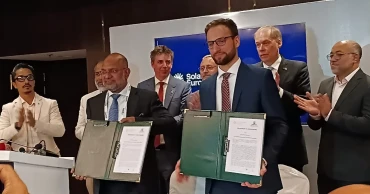
BSREA, Solar Power Europe sign MoU to boost EU solar business in Bangladesh
Bangladesh Sustainable and Renewable Energy Association (BSREA) has signed a Memorandum of Understanding (MoU) with Solar Power Europe.
Mustafa Al Mahmud, president of BSREA and Mate Heisz, CEO of Solar Power Europe signed the MoU documents on behalf of their respective sides on the 3rd day of Bangladesh Investment Summit 2025, held at Hotel Intercontinental, Dhaka.
Speaking on the occasion Mate said that around 300 European solar energy companies are working with Solar Power Europe and the companies have a vision to invest in renewable energy.
The signing of the MoU creates opportunities for the member companies of Solar Power Europe to do business with the Bangladesh private sector.
Before signing the MoU, Mate moderated a panel discussion on ‘ Unlocking the Potential of Bangladesh for investors in Renewable Energy’.
Holcim Group reaffirms commitment to Bangladeshi market
In the panel discussion, representative of Bank Europe, International Finance Corporation, Sustainable and Renewable Energy Development Authority (SREDA), CEO of Pran RFL and other private sector investors of Europe and Bangladesh joined.
Foreign and Bangladeshi private sector Entrepreneurs participated in a renewable energy session held at the summit.
1 year ago

Govt working to revise renewable energy policy: Recent primary fuels crisis a reason
The government is working to revise the “Renewable Energy Policy of Bangladesh 2008” to make it more effective in the changed energy and power sector scenario.
Official sources said, Sustainable and Renewable Energy Development Authority (Sreda), the focal organization under Power Division of the government, has already appointed a consultant.
The consultant – Development Technical Consultants Pvt. Ltd (DTCL) – has started reviewing the existing renewable energy policy, REPB-2008, and organize focus group discussion for stakeholders.
Read:Govt deliberately pursuing import-dependent energy policy: Speakers
According to renewable energy industry insiders, the first meeting of the stakeholders will be held on September 20 in Sreda office.
The consultant firm convened the meeting on behalf of Sreda where it will make a presentation on the existing policy and seek opinions of the stakeholders to update it in a national and global changed scenario, said an industry insider.
He said the initiative have come from the government as a follow-up of its statements to 26th meeting of the United Nations Climate Change Conference (COP26), held in Scotland, United Kingdom, from October 31 to November 13 2021.
Read: Experts for reining in energy corruption, exploration of alternative sources
In the COP26 meeting, Bangladesh Prime Minister Sheikh Hasina in written statement said: “We are also working for a more sustainable energy mix. We hope to have 40% of our energy from renewable sources by 2041”.
She also said, “Recently we submitted an ambitious and updated NDC (Nationally Determined Contributions) to the UNFCCC. We have cancelled 10 coal-based power plants worth 12 billion dollars of foreign investment.
Currently, as per Sreda statistics, the country generates about 911 MW (solar 677 MW, hydro 230 MW and others 2 MW) while the total power generation is more than 25,000 MW which shows the renewable energy’s share is less than 4 percent.
Read: Patience can help overcome crisis in energy sector: Nasrul
The recent crisis in primary fuels is another reason behind the move, said a Sreda official.
State Minister for Power, Energy and Mineral Resources Nasrul Hamid, recently at a function, said that among other options of renewable energy, solar power has huge potential for Bangladesh. But since it requires substantial land allocation, it needs an innovative solution.
He also said Bangladesh is now promoting the options of rooftop and floating solar panels and net metering system has been introduced to popularise the use of solar power.
Read Huawei Technologies intends to support RMG industry in renewable energy
“There is a good opportunity to work on wind power as well,” he said, adding that wind mapping has been completed for 9 potential sites and feasibility will be conducted on the potential for offshore wind power.
Private investors in renewable energy sector welcomed the Sreda initiative to review the renewable energy policy and bring necessary amendments to promote non-conventional energy sources.
Dipal Barua, president of Bangladesh Solar and Renewable Energy Association (BSREA), termed the initiative “time befitting.”
Read TEI GET to promote renewable energy in Bangladesh
He said despite a huge potential, the country could not utilize it due to lack of proper action plan.
Munawar Moin, Vice President of BSREA and President of Solar Module Manufacturers Association of Bangladesh (SMAB), said the government should introduce a policy under which the local solar industry could utilise their full potentials.
Cost of solar energy decreased substantially and has created a huge scope for investment in mega projects, he said.
Read Green Economy in Bangladesh: Prospects and Challenges
4 years ago