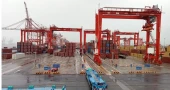
Tianjin Port
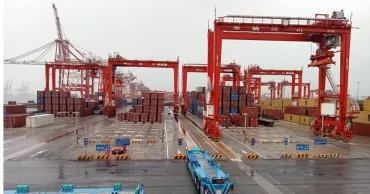
Tianjin Port advances as China’s premier smart shipping hub
Tianjin Port, recognised as one of China’s leading modern comprehensive ports and the world’s highest-grade artificial deep-water port, continues to expand its global reach.
Connecting with over 500 ports across more than 200 countries and regions, it operates more than 40 sea-rail multimodal routes and 147 container shipping lines.
In recent years, the port has shifted its focus towards intelligent shipping services, transforming into a comprehensive port and logistics operator.
As part of the “China Up Close: Tianjin Tour,” journalists from various countries recently visited the port.
The visit was co-hosted by China Global Television Network (CGTN) and the Tianjin Municipal People's Government.
During the tour, journalists observed the port’s operations, which are powered entirely by clean energy.
In 2019, President Xi Jinping visited Tianjin Port and instructed authorities to digitalise the facility. Since then, the port has focused on implementing digital technologies, achieving automation across several sectors, according to a port official.
"We offer our partners online services through a single station, and many new methods are currently being trialled to enhance our service efficiency," said the official.
Feng Miao, Manager of Operation Management at Tianjin Port, said that the port utilises its own global navigation satellite system, BeiDou (BDS), for precise positioning and navigation.
Furthermore, all dispatching and instructions within the port are managed by Huawei, which has contributed to increased operational efficiency, he added.
Tianjin Port handles various types of cargo, including liquid bulk, general cargo, roll-on/roll-off (RoRo) vehicles, and containers, facilitating seamless connections with ports worldwide. The port is also equipped to manage specialised cargo such as metal ore, coal, oil, automobiles, steel, and grain.
1 year ago
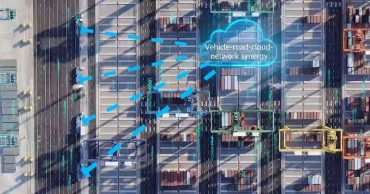
'China's Tianjin Port now smarter, more efficient, thanks to Huawei'
Global ICT infrastructure and solutions provider Huawei, has come up with a 5G network, 4L autonomous driving and other technological innovations to make ports smart, safer and efficient.
Recently, a smart terminal was built by Tianjin Port Group (TPG), together with Huawei and other partners.
This initiative was taken to deal with port congestion that caused severe disruptions in global supply chains, goods handling problems and other port-related issues resulting in a decrease in overall efficiency.
At the Tianjin Port, under the guidance of the BeiDou navigation satellite system, the whole process of moving the container trucks to the automatic locking and unlocking stations can now be completed in one go.
"The intelligent and digital transformation of the port has led to tangible benefits and increased efficiency. Now, each container at the Tianjin Port consumes 20 percent less energy, and cranes are 20 percent more efficient on average, with each crane operating 39 container units per hour," Huawei said in a statement.
Read: Huawei launches all-band 5G solution series
Jason Li, board member of Huawei Bangladesh, said: "Smart ports and terminals can be the focal point in the next few years for realising the Smart Bangladesh vision. If Bangladesh can turn Chattogram and Mongla ports into smart ones, it will have very positive impacts on the economy and also help to address the problems in daily operations at ports."
Tianjin port is one of China's most technologically advanced ports and a vital hub for the One Belt One Road initiative. It has a 300000-ton-class wharf with a channel depth of 22 meters. It has 192 berths of various types and 128 berths above the 10,000-ton-class.
By the end of 2021, the port's cargo throughput reached 435 million tons, ranking ninth in the world, while the container throughput exceeded 18.35 million TEUs, ranking the eighth port in the world.
3 years ago