VAR
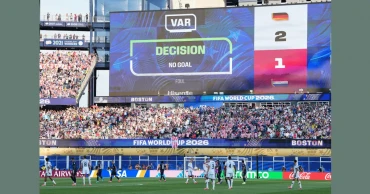
The new rules behind World Cup decisions
It was another game-changing moment at the World Cup that had more to do with television replays in a room far away than a moment of brilliance on the field.
The sending off of Switzerland's Breel Embolo in Saturday's quarterfinal game against Argentina was the latest call that may have left fans scratching their heads, not least because of the confusing name of the newly implemented law that swung the match.
It is called the “mistaken identity” rule. Yet, technically, Embolo was not shown a second yellow card — resulting in a red — for a case of mistaken identity. It was because the referee Joao Pinheiro did not see in real time that the forward had simulated a foul under a challenge from Argentina's Leandro Paredes.
Paredes was initially shown a yellow card, which is a key factor. Under FIFA rules, because Paredes was shown a card, the video assistant referee (VAR) can intervene and recommend that the onfield official reviews the sideline monitor.
After review the referee deemed Embolo to have committed a “clear simulation” and showed him a second yellow card and sent him off.
The rules state that the VAR can assist when the referee penalizes the “wrong team for an offense that results in a red or yellow card being shown to the wrong player.”
It was a pivotal point in the match, coming five minutes after Switzerland had made it 1-1. Argentina won 3-1 after extra time.
“The referee made the wrong decision,” Switzerland coach Murat Yakin said. “I know they will protect their referee but this rule destroyed our game today, and it’s very painful, and to be eliminated in that way hurts a lot.”
It is not the first time at this World Cup that teams have hit out against new rules or technology.
Germany infuriated by disallowed goal
Newly tightened regulations contributed to Germany's shock elimination in the round of 32.
Defender Jonathan Tah’s potentially game-winning goal in extra time against Paraguay was ruled out after VAR review for a foul on goalkeeper Orlando Gill.
Replays showed Germany’s Waldemar Anton push Gill to the ground, but the minimal contact led to criticism of the decision. FIFA’s referees chief Pierluigi Collina said officials had been told to punish incidents when players try to block opponents and make no attempt to play the ball, especially where goalkeepers are concerned.
Germany went on to lose the game in a penalty shootout, with Tah firing a decisive spot kick over the bar.
Elimination could have a seismic effect on German soccer, with coach Julian Nagelsmann resigning and Jurgen Klopp expected to take over.
High tech ball costs Croatia
The words “connected ball technology” will likely haunt Luka Modric and Croatia for years to come.
The high-tech soccer ball fitted with “advanced sensors” used at this World Cup cost Croatia a dramatic late equalizer against Portugal in the round of 32.
Josko Gvardiol thought he'd scored in added time to make it 2-2, but the goal was ruled offside after VAR review because the in-ball sensors picked up the slightest of touches from Croatia's Igor Mantanovic in the buildup that was undetectable to the naked eye or even video replays.
FIFA said the in-ball sensors, which capture data 500 times per second, were so finely tuned to be “capable of determining any slight contact ... allowing officials an unprecedented level of data to make fast, accurate decisions.”
Croatia coach Zlatko Dalić, who has since stepped down, was not impressed.
“All these decisions take the joy out of football,” he said.
Egypt heartbroken against Argentina
It was shaping up to be one of the great World Cup upsets. Egypt led 2-0 against defending champion Argentina in the round of 16 and might have been 3-0 up if not for VAR.
With the score at 1-0 in the second half, Egypt's Mostafa Zico finished off a sweeping attack. But wild celebrations were cut short when a foul on Argentina's Lisandro Martinez earlier in the move was confirmed on video review and the goal was disallowed.
Argentina staged a spectacular late comeback to win 3-2.
Egypt coach Hossam Hassan launched a furious tirade.
"We have suffered injustice,” he said.
The Egyptian soccer federation went further.
“Several key incidents raised serious concerns and left profound questions about the consistency and fairness of decisions that directly influenced the course of the game,” it said.
Questions were raised about the amount time between the foul on Martinez, which happened deep in Egypt's half, and the goal at the other end of the field.
FIFA referees chief Collina responded to criticism to say there was "no defined limit regarding either the distance from goal or the amount of time between the incident and the goal.”
“Nobody can question the integrity of the FIFA World Cup match officials,” he added.
A double blow for Norway against England
The high tech sensor was called into action again as England beat Norway 2-1 in the quarterfinals.
Norway's players and staff were adamant the ball hit a cable that suspends overhead cameras in the buildup to Jude Bellingham's equalizing goal in the first half. If it had, play would have been stopped.
But FIFA insisted there was no contact, saying the sensor “showed no peak in the ‘heartbeat of the ball’ when in the air, and therefore no evidence that the ball touched the overhead wire.”
Norway also had a goal disallowed when the score was 1-1 after VAR spotted a foul by Erling Haaland on England's Elliot Anderson. The infringement came before the corner was taken and, under new rules to try to limit fouls by attacking teams during corner routines, VAR is allowed to intervene regarding incidents that happen even before the ball is kicked.
2 months ago

VAR debate reignites as Premier League and FA Cup decisions spark controversy
The ongoing debate over the use of video assistant referees (VAR) in English football has intensified following several controversial decisions during the FA Cup fourth round and Premier League matches.
VAR, introduced to ensure accuracy in refereeing, was absent in the FA Cup until the fifth round this season, giving fans a glimpse of matches without technological interruptions. The weekend’s games, however, saw multiple contentious moments, including offside goals allowed and a penalty not awarded at Aston Villa, reigniting debate over the system’s impact on the sport.
Former Tottenham midfielder Danny Murphy said football might be better without VAR, arguing that it disrupts the game’s flow and delays decisions. Newcastle manager Eddie Howe acknowledged the tension, noting that while VAR improves decision accuracy, it can reduce the excitement for players and spectators. Aston Villa’s Unai Emery described the system as "necessary" to support referees.
At Anfield, Liverpool’s 3-0 win over Brighton featured further VAR controversy, with a young substitute’s goal ruled offside and a penalty awarded to Mohamed Salah sparking debate. Liverpool manager Arne Slot said VAR should be limited to clear-cut decisions, while Manchester City’s Pep Guardiola noted its benefits but remained uncertain on whether it improves the game overall.
Ex-players and former referees offered mixed views on officials’ reliance on VAR. Alan Shearer criticized referees for depending on the technology, while Shay Given and Graham Scott highlighted its role as a “comfort blanket” that aids decision-making.
Fans remain divided, with some claiming VAR has ruined football’s spontaneity, while others insist it is essential to ensure fair play and correct errors. The debate is expected to continue as English football navigates the balance between accurate officiating and maintaining the game’s traditional flow.
With inputs from BBC
7 months ago

Heading into its second World Cup, VAR still divides opinions among football fans
The introduction of VAR at the last World Cup proved one thing for sure: It’s nigh impossible to remove controversy from football even at the highest level.
The technology — short for Video Assistant Referee — has transformed the game, but not everyone agrees that the change has been for the better.
Part of the reason is that the rules of the game remain open to interpretation, so there still aren’t enough camera angles or slow-motion replays to reach a unanimous consensus for every incident on the field.
At some point, human discretion will still be required, and that opens up the potential for argument.
Even matters that can be determined using frame-by-frame evidence is not immune from dispute. A classic example would be the number of offside calls labeled to be “against the spirit of the game.”
Some argue a modicum of common sense should give the benefit of the doubt to the attacking team. The logic being that a measurement that could be as small as the length of fingernail should not be enough to see a goal disallowed.
The problem, however, comes when deciding where the new bar should be set. Should it be the length of a finger? A hand? An arm?
It becomes a discretionary call — and from there comes the issue of consistency, of human error, of controversy.
For so long coaches have stuck to the mantra of wanting consistency. However unsatisfying the use of VAR is for offside calls, it is, for the most part, consistent.
Yet in October, Tottenham manager Antonio Conte was sent off for his furious reaction after Harry Kane’s injury-time goal against Sporting Lisbon in the Champions League was ruled out.
“VAR is doing a lot of damage,” the Italian coach said. “I want to see if in another stadium of a big team if they are ready to disallow this type of goal. I’d like to know this.”
There was period at the 2018 World Cup when it felt like everything was a penalty — there were a record 29 at the tournament four years ago. After that came a spell when penalties were endlessly being retaken because of the number of encroachments or premature movements from goalkeepers, all of which could be meticulously dissected back at VAR headquarters.
The system has ironed itself out since then, but controversy remains.
Jurgen Klopp was critical of it in Liverpool’s 3-2 loss to Arsenal in October. Pep Guardiola’s rage when Manchester City had a goal ruled out against Liverpool at Anfield a week later was a defining image of that match.
Read more: Can South America's giants break Europe's stranglehold on the World Cup?
It has also become a unifying force among supporters. They hate it.
However, the sight of the referee gesturing to review an incident on a sideline monitor is greeted with celebration in the expectation a decision will almost certainly be overruled or corrected.
Like it or not, VAR has become an intrinsic part of the game since it was first introduced to international football in a game between Italy and France six years ago.
“That was on Sept. 1, 2016, and in the six years since, VAR has not brought the ‘end of football,’ as some reported at the time, but instead it is now part of the fabric of our sport, and it is hard to imagine football without it,” former referee Pierluigi Collina told FIFA.
“VAR has been one of the biggest changes in the history of football, so it is understandable that it takes people time to comprehend and appreciate it. Encouraging players, coaches, fans and the media to better understand the technology and its uses has been a crucial goal for us over the past years.”
Collina accepts decision-making can still be too lengthy a process. Newer technology has been designed to improve that. Semi-automated offside technology will be deployed in Qatar, which will include a tracking system to pin-point the precise positions of players. In-stadium graphics will better illustrate decision-making for fans.
But that will not remove the subjective nature of officiating — and with it the potential for ever more controversy.
Read more: FIFA World Cup: Qatar’s stadiums rife with migrant labour abuse
3 years ago