World Cup semifinal
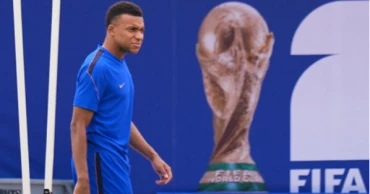
France, Spain set for blockbuster World Cup semifinal with unbeaten records on the line
France and Spain will put their unbeaten records on the line when they face each other in the first semifinal of the FIFA World Cup on Tuesday, with only one team earning a place in Sunday's final.
Both sides are playing in their 17th World Cup and neither has trailed in any match during this year's tournament. France, led by Kylian Mbappé, and Spain, inspired by teenage star Lamine Yamal and impact substitute Mikel Merino, will meet at AT&T Stadium, home of the NFL's Dallas Cowboys.
Top-ranked France has scored 14 goals while conceding only twice in the tournament. Mbappé, winner of the 2022 Golden Boot, has scored eight goals to share the tournament lead with Argentina captain Lionel Messi. The French forward is also just one goal away from matching Messi's career World Cup record of 21 goals.
"We are confident because of the journey we have had so far, but we also want to remain humble, which has defined us since the start of the tournament," France midfielder Adrien Rabiot said.
Mbappé, 27, has now scored 20 goals in 20 World Cup matches. He famously scored in France's 2018 final victory over Croatia, becoming only the second teenager after Pele to score in a World Cup final. Coach Didier Deschamps said Mbappé is fully fit after being substituted in the 77th minute of France's quarterfinal victory over Morocco, in which he scored.
Spain will rely on 19-year-old Yamal, who celebrated his birthday on Monday. The young winger has already enjoyed success against France, scoring in Spain's 2-1 victory in the semifinals of the 2024 European Championship just before turning 17. Spain also defeated France 5-4 in last year's UEFA Nations League.
"I think if France has to fear anyone, it should be us," Yamal said after Spain's quarterfinal win over Belgium. "We were the team that eliminated them before."
Yamal has scored once in this World Cup while registering 10 shots on target despite still recovering from a left hamstring injury that forced him to miss the closing weeks of Barcelona's season.
"This is the biggest match I have ever played," Yamal said on Monday. "The best birthday gift would be reaching the final."
France defender Jules Koundé, Yamal's teammate at Barcelona, said he was not bothered by the youngster's confident remarks.
"He always believes in himself and in the team he plays for. That's simply extra motivation for him," Koundé said.
Spain has scored 10 goals and conceded only once since opening the tournament with a goalless draw against Cape Verde. Merino has emerged as a key player, scoring late winning goals in Spain's last two knockout matches.
The Arsenal forward scored in the 88th minute to seal a 2-1 victory over Belgium in the quarterfinals after netting in first-half stoppage time of extra time during Spain's 1-0 win over Portugal in the round of 16 at the same venue.
Goalkeeper Unai Simón also enjoyed a record-breaking run, going 650 World Cup minutes without conceding before Belgium scored in the 41st minute of the quarterfinal.
Spain midfielder Alex Baena said the team has continued to improve throughout the tournament.
"From the first game until now, we've gradually found our rhythm. The more we have played and trained together, the stronger we have become," he said.
Four former champions in the semifinals
For the first time since 1990, all four World Cup semifinalists are former champions.
Defending champion Argentina, which beat France in the dramatic 2022 final, will face England in the second semifinal on Wednesday in Atlanta.
The World Cup final will be played on Sunday at MetLife Stadium in East Rutherford, New Jersey, while the third-place playoff is scheduled for Saturday in Miami Gardens, Florida.
History between France and Spain
France and Spain have met only once before in the World Cup, with France winning 3-1 in the round of 16 at the 2006 tournament in Germany.
Since then, both countries have lifted the trophy. Spain won its only World Cup title in 2010, while France claimed its second crown in 2018.
France, playing on Bastille Day, is aiming to become only the third nation after Brazil and Germany to reach three consecutive World Cup finals. Brazil achieved the feat between 1994 and 2002, while West Germany reached three straight finals from 1982 to 1990.
France is appearing in its seventh World Cup semifinal and its fifth in the last eight editions. Spain has reached the semifinals only twice before—in 1950 and during its title-winning campaign in 2010.
Dallas hosts its final World Cup match
Tuesday's semifinal will be the ninth and final World Cup match at AT&T Stadium, the highest number hosted by any venue during the tournament.
The stadium has witnessed several memorable moments, including Lionel Messi scoring three goals during Argentina's group-stage matches. On June 22, after missing a penalty, Messi scored twice against Austria to become the all-time leading World Cup scorer with his 20th and 21st career goals before adding another against Jordan on June 27.
The venue also hosted Cristiano Ronaldo's final World Cup appearance, as the 41-year-old Portugal star ended his sixth and last tournament in a 1-0 round-of-16 defeat to Spain on July 6.
2 months ago

Morocco face France in politically charged World Cup semifinal
Hind Sabouni bristles with pride as she recalls her country's history-making World Cup run as it eliminated one European soccer powerhouse and former colonial power after another — Belgium, Spain and Cristiano Ronaldo's Portugal — to become the first African and Arab nation to reach the semifinals.
For the 26-year-old English teacher in Morocco's capital, and many of her countrymen both inside the North African nation and throughout the diaspora, it's about to get more complicated. Next up is France: The defending champion and Morocco’s former colonial ruler for much of the first half of the 20th century.
Wednesday’s match has political and emotional resonance for both nations. It dredges up everything that’s complex about the relationship in which France still wields considerable economic, political and cultural influence.
“This game is one of a kind,” Sabouni said. “Especially since France is next to beat.”
“We can show the rest of the world that Morocco is no longer France’s backyard."
For the former protectorate, the match against the defending champion is an opportunity to show that Morocco is a formidable foe — on the soccer pitch at least — even though immigration between the two countries has blurred the lines for many in France and Morocco about who to support Wednesday in Qatar.
Read more: Motherly love boosts Morocco’s team spirit at World Cup
Over the past decade, Morocco’s relationship with France has changed. Sabouni said her generation of Moroccans is tired of France’s dominance. Young Moroccans, she said, “speak English instead of French, they buy more American products than French ones and even those who want to seek a better life abroad try to avoid France.”
“Even though this is just a football game, some people view it as an opportunity for revenge,” Sabouni said.
But not everyone.
Kenza Bartali, a communications professional in Rabat, sees no political overtones to the match. She obtained her master's degree in France, and lived for two years in Paris and the southern cities of Nice and Toulon between 2016 and 2018. She made “wonderful friends" who are still her friends today. “Most Moroccan students were treated with respect," the 26-year-old said.
Still, there is no doubt which team she's supporting.
“I sincerely hope that Morocco advances to the final,” Bartali said. “I am aware that it will be difficult because France is a very good team, but we are hoping for the best.”
Sabouni's sentiments resonate with Moroccans and other North Africans in France. Although the younger generation of immigrants and their descendants appear to be more at ease with multiple identities and languages in France, they still face institutional discrimination, racial and ethnic prejudice in public life, economic hardship and lack of job opportunities.
As in previous World Cups, France once again has turned to their national soccer team made up of players from diverse backgrounds as evidence that the country has indeed become a melting pot despite lurking prejudice, stoked against immigrants by elected right-wing politicians.
“Cultural changes and changes in life on the ground do have an effect and the team represents that,” said Laurent Dubois, a professor at University of Virginia in Charlottesville who has authored two books on French and international soccer.
Read more: Morocco become first African & Arab nation to reach WC semis
“The way the players inhabit being French and don’t seem to have an issue with also being African or anything else at the same time is an antidote to the immigrant resentment on the right.”
In Morocco, people have embraced the team's foreign-born players as their native sons. They welcome the experience and professionalism they bring from Europe's top clubs and are proud they chose Morocco as their national team when they could have played for the countries of their births, from Spain to Canada to Belgium and beyond.
The Morocco national team depends heavily on the diaspora, with 14 of the squad’s 26 players born abroad, including their French-born coach, Walid Regragui, the highest proportion for any team at the World Cup.
Like Morocco’s supporters at home and an estimated 5 million scattered around Europe and beyond, many players grapple with family tales of colonial history, the challenges of immigration and questions of national loyalty. They want desperately to detach from the burdens of the past and win a place in the World Cup final — whether home for them is in France or Morocco, or Belgium, Canada, Tunisia, Algeria or elsewhere.
“Most of the Moroccan players who were born abroad chose Morocco as their national team because they feel they play for more than just to win a football match,” said Maher Mezahi, a Marseille-based Algerian journalist covering African football. “They play to elevate national pride and to make their family proud."
For Regragui, his and his player's dual identities are meaningless in the biggest match the squad has faced.
“I’m a dual national, and that’s an honor and a pleasure,” the Moroccan coach said. “And it’s an honor and a pleasure to face France. But I’m the Morocco coach and we’re going to be playing the best team in the world. The most important thing is to get through to the final.”
“When we play for the Moroccan national team, we are Moroccans,” Regragui said.
3 years ago