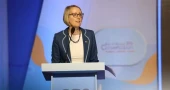
British High Commissioner Sarah Cooke
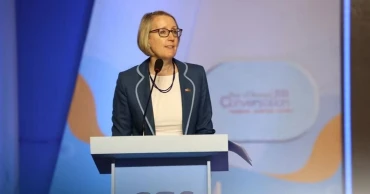
Contemporary security challenges require coordinated responses extending beyond traditional boundaries: Sarah Cooke
Highlighting the importance of broader security cooperation, British High Commissioner to Bangladesh Sarah Cooke has said Bangladesh and the UK share a common interest in a free and open Indo-Pacific and recognise Bangladesh’s responsibilities in the Bay of Bengal, a region of increasing strategic importance.
She said contemporary security challenges, including economic security, cybersecurity and climate-related insecurity, require coordinated responses extending beyond traditional boundaries.
Speaking at the Bay of Bengal Conversation in Dhaka, the High Commissioner described Bangladesh as a “strategic and trusted partner” of the United Kingdom.
She said relationship has evolved from predominantly development cooperation into a modern strategic partnership reflecting Bangladesh’s growing global role.
“Today, our relationship has matured into a much more modern strategic partnership, one that reflects Bangladesh's growing global role,” she said while addressing on the second day of the Bay of Bengal Conversation 2026 organised by the Centre for Governance Studies (CGS).
Prime Minister Tarique Rahman inaugurated the three-day international conference on Saturday which is scheduled to end on Monday.
Turning to Bangladesh-UK relations, Cooke said the partnership had for many years been shaped predominantly by development cooperation, which played a vital role in supporting Bangladesh’s economic development and resilience.
“At its heart are the people who connect our nations,” she said, noting that more than half a million people of Bangladeshi heritage live in the UK.
“These connections are one of the great strengths of our relationship,” the High Commissioner said.
LDC Graduation
She also highlighted strong economic ties, saying the UK is one of the largest investors in Bangladesh.
“From finance to fashion, education to energy, British companies have supported Bangladesh’s economic transformation and created many jobs,” Cooke said.
As Bangladesh prepares for graduation from least developed country status, she said the UK is focused on supporting a transition that is “both smooth and sustained.”
She said the UK’s Developing Countries Trading Scheme is widely regarded as one of the world’s simplest and most generous trade preference regimes.
“Bangladesh currently benefits from duty-free access to the UK market for 99.8% of product lines, and the country will continue to do so for a three-year transition following LDC graduation,” the High Commissioner said.
“After that, 92% of product lines will remain duty free, including for ready-made garments. It’s a clear signal of our commitment to be a reliable, long-term economic partner for Bangladesh,” Cooke said.
She said the UK remains committed to strengthening its partnership with Bangladesh based on “trust, mutual respect, shared interests and growing ambition.”
International System
The British High Commissioner said the international system is currently under strain from geopolitical competition, conflict, economic uncertainty, technological disruption and climate change, but described the situation as also presenting an opportunity.
“How countries respond will shape not only their own futures, but the international order for decades to come,” she said.
The British High Commissioner stressed that the answer to growing instability is not retreat or fragmentation, but stronger cooperation among nations.
“Effective international institutions, respect for international law, and enduring partnerships remain essential to our collective security and prosperity,” she said.
Cooke said the UK remains committed to multilateralism, collective security and international law, as well as trade, investment, economic openness and tackling climate change.
On the Middle East, Cooke said the UK condemns Hamas’s terrorist attack and supports Israel’s security, but added that this cannot justify Israel’s actions in Gaza and the West Bank.
“Far too many people have died,” she said, adding that the UK, together with international partners, has taken concrete steps to protect the two-state solution.
She said these efforts include action on illegal settlements and renewed diplomatic efforts at the United Nations to advance a just and lasting peace.
The UK is also working with partners to support de-escalation across the wider region, she said, noting that recent conflict in the Gulf has underlined the importance of regional stability and freedom of navigation through the Strait of Hormuz.
Cooke also highlighted the changing nature of security, saying it is no longer defined by military strength alone.
“Climate shocks threaten food security, drive displacement, and put pressure on societies, with women particularly vulnerable to its effects,” she said.
At this year’s UN General Assembly, she said, the UK Foreign Secretary joined Dr Khalilur Rahman and other foreign ministers to discuss climate change and ecosystem degradation as national security risks.
Rohingya Crisis
Cooke particularly highlighted the Rohingya refugee crisis as an area where regional cooperation is urgently needed.
“The UK continues to stand alongside Bangladesh, recognising the extraordinary generosity the country has shown in hosting more than 1 million Rohingya refugees,” she said.
The UK remains committed to supporting refugees and host communities, maintaining international attention on the crisis and working towards what she described as the only sustainable solution - the voluntary, safe and dignified return of the Rohingya to Myanmar when conditions allow.
Cooke said the UK co-sponsored discussions at this year’s UN General Assembly aimed at maintaining international focus on the crisis.
“As penholder on Myanmar at the UN Security Council, the UK continues to press for international action and accountability,” she said.
The UK also remains one of the largest donors to the Rohingya response, supporting refugees and host communities in Bangladesh while providing humanitarian assistance to vulnerable communities in Rakhine State, she said.
On climate change, Cooke said Bangladesh is among the countries that understand the realities of climate vulnerability best.
“The impacts of rising sea levels, changing weather patterns, and extreme weather events are not theoretical. They are already being felt by communities across the country, with consequences that will extend over generations,” she said.
She said Bangladesh is globally recognised for its resilience, innovation and leadership on climate adaptation.
The UK, she said, is working with Bangladesh through practical partnerships and international action to strengthen that resilience.
At the United Nations, Cooke said, the UK announced $330 million for the Global Environment Facility, one of the leading multilateral funds for protecting nature and tackling environmental threats.
In Bangladesh, she said, the partnership between the Bangladesh Meteorological Department and the UK Met Office is helping strengthen flood forecasting and early warning systems.
“It’s enabling communities, businesses, and government to prepare earlier for climate shocks,” she said.
The UK is also working with Bangladesh to unlock greater climate finance and develop high-integrity carbon markets to channel investment towards the country’s long-term resilience, Cooke said.
Concluding her remarks, Cooke said the UK believes that the answers to global challenges lie in partnership and cooperation.
“Not in managing crises after they emerge, but building resilience before they occur,” she said.
“And this is the spirit of the UK’s partnership with Bangladesh. It is a relationship based on trust, mutual respect, shared interests and growing ambition,” Cooke said.
“It’s a relationship that we are committed to strengthening still further in the years ahead.”
6 days ago
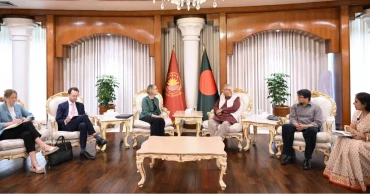
British envoy greets Prof Yunus ahead of receiving prestigious King Charles Harmony Award
British High Commissioner to Bangladesh Sarah Cooke on Wednesday met Chief Adviser Professor Muhammad Yunus and extended her congratulations to him on his forthcoming receipt of the prestigious King Charles Harmony Award.
The High Commissioner met the Chief Adviser at the State Guest House in Dhaka, ahead of his official visit to the United Kingdom.
"It is a great honour," the Chief Adviser said, referring to the award.
Professor Yunus is set to depart Dhaka on June 9 on a four-day official visit.
During the visit, the Chief Adviser is expected to hold meetings with senior British officials, said CA’s Deputy Press Secretary Abul Kalam Azad Majumder.
The discussions between the Chief Adviser and the British High Commissioner encompassed a range of mutual interests, including trade and investment, aviation cooperation, migration and the interim government's efforts in asset recovery.
Prof Yunus for ‘horror museum’ to document enforced disappearances
They also discussed the reform initiatives undertaken by the interim government and the latest political developments in Bangladesh.
Prof Yunus informed the High Commissioner that the second round of talks between the National Consensus Building Commission and political parties began this week and is expected to conclude soon.
He expressed interest in receiving technical support from the UK, including training by British researchers, to bolster Bangladesh's ocean research efforts.
The meeting was also attended by Lutfey Siddiqi, Special Envoy of the Chief Adviser; Lamiya Morshed, SDGs Affairs Principal Coordinator; and James Goldman, Deputy High Commissioner of Britain.
1 year ago

British High Commissioner wanted to know EC’s efforts in ensuring that journalists can work freely: CEC
British High Commissioner to Bangladesh Sarah Cooke on Sunday said her country is encouraging “free, fair, participatory and peaceful” elections in Bangladesh.
She said fair elections will help Bangladeshi citizens exercise their democratic rights.
Read: UN expresses desire to see a fair, peaceful election in Bangladesh: Obaidul Quader
“We had a very constructive introductory discussion,” High Commissioner Cooke told reporters after her first meeting with Chief Election Commissioner Kazi Habibul Awal and his team.
She said they discussed the vital roles of strong democratic institutions, media, and civil society.
The British high commissioner said they also discussed the role of independent observers during the election.
Talking to reporters, the CEC said High Commissioner Cooke wanted to know the Election Commission’s efforts for ensuring that journalists can work freely.
Read: UK keen to boost trade and investment with Bangladesh: Sarah Cooke tells PM Hasina
He said the media raised the demand regarding the use of motorcycles.
The CEC said they were considering whether it would be misused or not.
Some — using muscle power— might create problems, taking advantage of motorcycle use.
“Keeping that in mind, we made a provision,” said the CEC.
Read: I’m committed to deepening Bangladesh-UK extensive cooperation: Sarah Cooke
At the meeting, Election Commissioner Anisur Rahman and EC Secretary Md. Jahangir Alam were also present.
Bangladesh Election Commission is taking preparations to hold the next national election in December this year or January next year.
3 years ago