Khaleda Zia
Tarique pays tribute to Zia, Khaleda on BNP’s founding anniversary
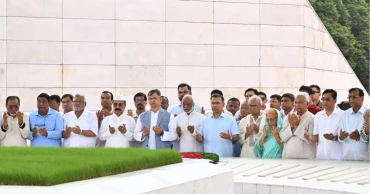
BNP Chairman and Prime Minister Tarique Rahman on Tuesday paid homage to slain party founder Ziaur Rahman and its former chairperson Khaleda Zia by placing a wreath at their graves marking the party’s 48th founding anniversary.
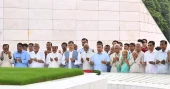
Tarique, also the eldest son of Zia and Khaleda, flanked by party senior leaders, placed the wreath at his parents’ graves at She r-e-Bangla Nagar around 9:20am and offered fateha there.
They also offered Fateha and joined a munajat seeking eternal peace for the departed souls of the party’s founder and former chairperson.
BNP Acting Secretary General Ruhul Kabir Rizvi, Standing Committee members Gayeshwar Chandra Roy, Dr Abdul Moyeen Khan, Salahuddin Ahmed, Selima Rahman, Dr AZM Zahid Hossain, Aman Ullah Aman, Farhad Halim Donar and Ismail Zabihullah, Vice Chairman Nurul Islam Moni, Joint Secretaries General Khairul Kabir Khokon, Habib-un-Nabi Khan Sohel, Shahid Uddin Chowdhury Anee and Syed Emran Saleh Prince, Abdus Salam Azad, Treasurer Rashiduzzaman Millat, Publicity Secretary Sultan Salahuddin Tuku and Dhaka North city unit president Aminul Haque, among others, present.
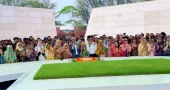
After Tarique left the grave premises and security restrictions were eased, a large number of BNP leaders, activists and supporters gathered there.
They chanted slogans such as “Shubho, Shubho, Shubho Din, BNP-r Jonmodin” and “Ek Zia Lokantore, Lokkho Zia Ghore Ghore”.
Leaders and activists of different BNP-affiliated organisations including that of Dhaka city units, Jubo Dal, Swechchhasebak Dal, Muktijoddha Dal, Krishak Dal, Mohila Dal, Tanti Dal, Matsyajibi Dal, Doctors Association of Bangladesh (DAB), Agriculturalists Association of Bangladesh (AAB), Jatiyatabadi Samajik Sangskritik Sangstha (Jasas) and Chhatra Dal, also paid homage at Ziaur Rahman’s grave.
1 month ago
Khaleda Zia was martyred as part of a conspiracy: Rizvi
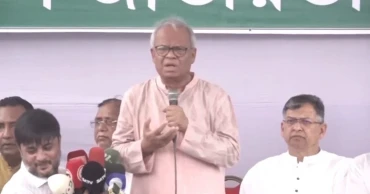
BNP Acting Secretary General Ruhul Kabir Rizvi on Wednesday said the late Begum Khaleda Zia, thrice-former prime minister and matriarch of the BNP, was killed through a conspiracy and described her as a martyr.
“Since the Ershad regime and throughout Hasina’s 17 years of unbearable fascist rule, various conspiracies were hatched to remove her from the world. Shaheed President Ziaur Rahman and Begum Khaleda Zia were also killed through conspiracies. She too is a martyr,” he said.
Rizvi made the remarks while briefing journalists after a joint meeting at the BNP central office in Nayapaltan in the afternoon, ahead of the party’s 48th founding anniversary.
He said the two of them had relentlessly struggled for the nation, its people, democracy, the right to speak and freedom of expression, and that every effort had been made to remove both of them from the world.
Recalling the history of BNP, Rizvi said the party was founded by “a rare man” who inspired a misguided nation by declaring independence for the liberation of the motherland.
Rizvi said Ziaur Rahman’s assassination also dealt a blow to democracy, as within a few months Hussain Muhammad Ershad came to power and democracy was subsequently killed.
Against this backdrop, he said, Ziaur Rahman’s wife, the “extraordinarily courageous” Begum Khaleda Zia, took charge of BNP to restore democracy.
“She led BNP through movements and struggles. Begum Khaleda Zia turned BNP into pure gold by putting it through fire. She herself was tortured and persecuted, and numerous false cases were filed against her,” Rizvi said.
Rizvi said BNP had developed into a broad-based political organisation under the influence of the two leaders.
“From one end of the country to the other, BNP has a strong base in different localities. Across Bangladesh, BNP has become a strong organisation,” he said.
According to Rizvi, this was BNP’s greatest achievement and the reason why the party could not be defeated or forced to surrender despite severe repression, torture and fascist oppression.
He said BNP had consequently become a popular political party and had played an “extraordinarily nationalist and patriotic” role in every sphere, including domestic and foreign policy.
“We believe in strengthening our own sovereignty and protecting our own independence. We do not want any other country to be subjugated, and we respect the independence of other countries. Similarly, we want other countries to respect our independence and sovereignty,” Rizvi said.
He said BNP is now widely respected because of this ideology.
Among those present at the joint meeting were BNP Chairman’s Adviser and Dhaka South City Corporation Administrator Abdus Salam; Joint Secretary Generals Khairul Kabir Khokon, Habib-un-Nabi Khan Sohel and Abdus Salam Azad; Water Resources Minister Mohammad Shahiduddin Chowdhury Anee; and leaders and activists of BNP and its affiliated and associate organisations.
1 month ago
BNP MPs from reserved women seats pay tribute at graves of Zia, Khaleda Zia
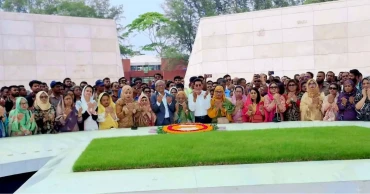
A total of 36 newly elected Members of Parliament of the BNP alliance from the reserved women’s seats of the 13th Jatiya Sangsad paid tribute to BNP founder Ziaur Rahman and former prime minister Khaleda Zia.
The MPs placed floral wreaths at their graves at Chandrima Udyan in the capital around 1 PM.
BNP Secretary General and Local Government, Rural Development and Cooperatives Minister Mirza Fakhrul Islam Alamgir was also present.
Following the laying of wreaths, a special prayer (munajat) was offered seeking eternal peace for the departed souls of Ziaur Rahman and Khaleda Zia.
Forty-nine newly elected women MPs took oath on Sunday to represent their respective parties from the reserved seats.
Speaker Hafiz Uddin Ahmad, Bir Bikram, administered the oath at the Oath Room of the Jatiya Sangsad Bhaban.
The 36 BNP alliance MPs are Selima Rahman, Shirin Sultana, Rasheda Begum Hira, Rehana Akter Ranu, Newaz Halima Arly, Farida Yasmin, Bilkis Islam, Shakila Farzana, Helen Jerin Khan, Nilufar Chowdhury Moni, Nipun Roy Chowdhury, Zeeba Amina Khan, Mahmuda Habiba, Sabira Sultana, Sunsila Jabrin, Sanjida Islam (Tulee), Sultana Ahmed, Fahmida Haque, Anna Minz, Subarna Shikdar, Shamim Ara Begum Swapna, Shammi Akter, Ferdousi Ahmed, Bithika Binte Hossain, Suraiya Jerin, Mansura Akter, Jahrat Adib Chowdhury, Momtaz Alo, Fahima Nasrin, Arifa Sultana, Sanjida Yasmin, Nadia Pathan Papon, Shawkat Ara Akter, Madhabi Marma, Selina Sultana and Rezeka Sultana.
5 months ago
PM says Fatema Begum now a member of their family
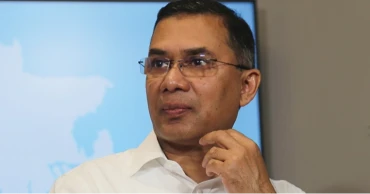
Prime Minister Tarique Rahman on Saturday shared a personal story involving Fatema Begum, a domestic worker who had long served his late mother Khaleda Zia, saying she has now become a member of their family.
“Many of you may be familiar with a name — Fatema. This woman was also in jail with my mother when she was ill. She has been with her for a long time, for many years, and has now become a member of our family,” he said.
Tarique, the eldest son of former prime minister Khaleda Zia, was speaking at the Upazila Health and Family Planning Officers (UHFPO) Conference-2026 at the Osmani Memorial Auditorium.
The Health Services Division under the Ministry of Health and Family Welfare organised the conference, with over 500 UHFPOs from across the country taking part.
The Prime Minister also handed awards to the best-performing officers in six categories.
Referring to a recent incident, Tarique said a relative of Fatema recently faced complications during delivery at her home in Barishal and was taken to a local hospital.
“After being taken to the Barishal hospital doctors mentioned various complications and immediately decided to refer her to Dhaka,” he said.
The Prime Minister said he later learned from his wife that even some basic treatment could not be provided at the local level.
“They sent her to Dhaka right away. Fatema informed my wife and she spoke to a few people. As a result, her relative managed to receive better treatment,” he added.
He expressed concern saying such support is not available to everyone.
“But the question is, not everyone is Fatema, and not everyone is related to her. Because of that connection, my wife came to know about the matter and took care of it. The baby was born, though unwell, but the situation was somehow managed,” he said.
The Prime Minister noted that many complications could have been avoided if those responsible at the hospital had been more attentive.
“If those on duty had been a bit more careful and caring, many of the problems could have been avoided—if not all, at least a significant number,” he said.
He urged healthcare professionals to be more responsible and compassionate in their duties.
“As a citizen of this country, I request you to support us and support the government so that no one needs to depend on personal connections like Fatema’s case. Every person should be able to receive at least basic healthcare services,” Tarique said.
Calling for a more humane and accountable healthcare system, he urged all concerned to work together to ensure fair and effective service delivery across the country.
6 months ago
Parliament adopts condolence motion on death of Khaleda Zia, Khamenei, others
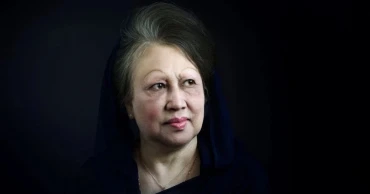
The first session of the 13th Parliament on Thursday unanimously adopted a condolence motion expressing profound grief at the death of three-time Prime Minister Begum Khaleda Zia, 31 former lawmakers and several other eminent personalities.
Former President AQM Badruddoza Chowdhury was among 31 ex-parliamentarians.
Other noted personalities included former Indian Prime Minister Manmohan Singh, Head of the Catholic Church Pope Francis (Jorge Mario Bergoglio) and Iran’s Supreme Leader Ayatollah Ali Khamenei.
PM Tarique calls for meaningful parliament, constructive debate
The motion was moved by newly elected Speaker Major (Retd.) Hafiz Uddin Ahmed.
The other ex-parliamentarians also include BNP’s Farhad Ahmed Chowdhury (Kishoreganj-4) and Nadim Mostafa (Rajshahi-4), Workers Party’s Shahidullah Shahid (Thakurgaon-3), Lutfun Nesa Hossain (Reserved Women’s Seat-6), Mahbubur Rahman (Patuakhali-4), Mostafizur Rahman (Dinajpur-5), Deputy Leader of Parliament Matia Chowdhury (Sherpur-2), BNP’s Shahiduzzaman Beltu, (Jhenaidah-4).
Besides, BNP Chairperson’s Adviser Rozi Kabir (Reserved Women’s Seat-8), SM Akram (Narayanganj-5), BNP’s SA Khalek (Dhaka-11), Sector Commander and second Chief of Army Staff of Bangladesh KM Shafiullah, Bir Uttam, (Narayanganj-1), BNP’s Abdul Momin Talukder (Bogura-3), BNP’s Abdullah Al Noman (Chattogram-9), Nazim Uddin Ahmed (Lakshmipur-1) and Col (retd) M. Anwarul Azim (Cumilla-10).
Hafiz Uddin Ahmed elected Speaker, Kayser Kamal Deputy Speaker of 13th Parliament
Former President of Gono Forum Mostafa Mohsin Montu (Dhaka-3) and BNP’s Abdul Mannan Talukder (Sirajganj-3), Iftikhar Uddin Talukder Pintu (Netrokona-3) and Hafez Ruhul Amin Madani (Mymensingh-7) were among the ex-MPs.
The other ex-MPs are BNP’s Borhan Uddin (Noakhali-6), BNP’s Motiar Rahman Talukder (Barguna-3), Nur Afroz Ali (Reserved Women’s Seat-14), Abdul Karim Khandker (Pabna-2), Sukumar Ranjan Ghosh (Munshiganj-1), Jatiya Party’s former minister and BNP’s former MP Major General (Retd.) Mahmudul Hasan (Tangail-5), former minister Ramesh Chandra Sen (Thakurgaon-1), Abdul Mannan Khan (Dhaka-1), BNP’s Mia Abdullah Wazed (Brahmanbaria-4) and Joaherul Islam (Tangail-8), Saleha Khatun (Reserve seat-30), Salahuddin Quader Chowdhury, Chowdhury Kamal Ibne Yousuf and Nasiruddin Ahmed Pintu.
The Parliament also expressed deep grief at the demise of those who sacrificed their lives in the long 17-year struggle from 2007 to August 05, 2024 for ensuring voting rights, democracy, the rule of law, justice and human rights.
It also recalled with respect former BNP lawmaker M Ilias Ali and BNP leader Sajedul Islam Sumon and others who were victim of enforced disappearance and killings in the time.
The Speaker described 2024 as the milestone for the struggle to establish democracy for the people of Bangladesh.
Besides, the House expressed profound shock at the demise of July Uprising martyrs including Abu Sayed, Mir Mahfuzur Rahman Mugdho, Shahariar Khan Anas, Mehedi Hasan Junayed and Farhan Faiyaz.
The Parliament mourned the death of students in the Uttara Milestone school air crash on July 21, 2025, including school teacher and Independence Award 2026 recipient (posthumously) Maherin Chowdhury, the death of army officers in the 2009 Pilkhana carnage and the loss of lives of those who were killed during the 2013 Shapla Chattor Hefazat rally.
The names of former Jamaat MPs Motiur Rahman Nizami, Ali Ahsan Mohammad Mojaheed and Delwar Hossain Sayeedi, among others, were included in the condolence motion on request.
During the halfway of placement of the condolence motion, Chief Whip Nurul Islam Moni requested the Speaker to include the names of former Jamaat MPs Motiur Rahman Nizami, Ali Ahsan Mohammad Mojaheed and Delwar Hossain Sayeedi as well as some others including former BNP MP Mashiur Rahman (Jhenaidah-2) in the motion.
At this stage, Leader of the Opposition Dr Md Shafiqur Rahman took the floor and said some names were dropped from the motion.
He requested the Speaker to give the floor to Deputy Opposition Leader Dr Syed Abdullah Mohammed Taher to propose the dropped-out names.
Then Dr Taher said it is unfortunate that the condolence motion was prepared as one-sided one. “If we want the Parliament to be neutral and vibrant, we need to be more careful on these issues,” he said.
Noting the names of those ‘who were ministers and very important personalities in the past remain’ out of the motion, he proposed some names including Motiur Rahman Nizami, Ali Ahsan Mohammad Mojaheed, Delwar Hossain Sayeedi, Moulana Abdus Sobhan, AKM Yousuf, Muhammad Kamaruzzaman, Abdul Quader Mollah and Mir Quasem Ali for inclusion in the condolence motion.
Later, Opposition Chief Whip Md Nahid Islam requested the Speaker to include the names of Sharif Osman Bin Hadi (Osman Hadi), Abrar Fahad and Felani Khatun (a 15-year-old Bangladeshi girl who was shot and killed by the Indian BSF in 2011) in the motion.
The Speaker incorporated all the names placed by the Chief Whip, the Deputy Opposition Leader and the Opposition Chief Whip.
A one-minute silence was observed and a munajat offered seeking eternal peace for the departed souls.
Religious Affairs Minister Kazi Shah Mofazzal Houssain (Kaikobad) conducted the Munajat.
The condolence motion was adopted by a voice vote following two separate discussions on the death of Khaleda Zia and sacrifice of July martyrs.
BNP Secretary General and LGRD Minister Mirza Fakhrul Islam Alamgir, Home Minister Salahuddin Ahmed, State Minister for Power, Energy and Mineral Resources Aninda Islam Amit (Jashore-3), BJP chairman Andaleeve Rahman (Bhola-1) and Jamaat MP ATM Azharul Islam (Rangpur-2) participated in the discussion on Khaleda Zia.
They highlighted the contribution and sacrifice of Khaleda Zia to Bangladesh and democracy during her 43 year-long political career.
Water Resource Minister Md. Shahiduddin Chowdhury Anee, BNP MP Goyasawar Chandra Roy, Opposition Chief Whip Nahid Islam and State Minister for Planning Md. Zonayed Abdur Rahim Saki joined the discussion on the July martyrs.
Mirza Fakhrul described Khaleda Zia as a courageous leader and visionary stateswoman who never compromised on the issues of democracy or the country’s independence and sovereignty throughout her political life.
“In her 43 years of political life, she never compromised on the issue of democracy. She never compromised on the issue of the sovereignty and independence of Bangladesh. And that was her greatest achievement that inspires the people of Bangladesh,” he said.
Salahuddin Ahmed said Khaleda Zia actually took oath as the Prime Minister four times – Twice in 1991 (first during the presidential system and the second after introduction of parliamentary system), once in 1996 and again in 2001.
Noting that Khaleda Zia never lost election in any constituency, the Minister said, “Whenever she contested, no matter from how many constituencies, in the election, she was elected everywhere.”
Salahuddin said she was recognised by the people of Bangladesh as ‘Deshanetri’ (the Leader of the Country) and mother of democracy for her unprecedented sacrifices in different democratic movements including the anti-autocratic movement and anti-fascism struggle.
Nahid Islam demanded justice for the killings during the July uprising, enforced disappearances and past incidents of corruption and plunder, saying the spirit of July represents a democratic, inclusive and fascism-free Bangladesh.
7 months ago
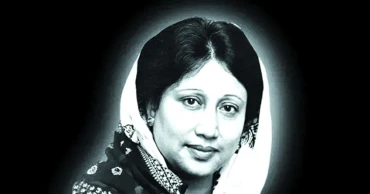
Khaleda Zia to receive ‘Indomitable Woman of Democracy’ award
Former Prime Minister Begum Khaleda Zia will be honoured with the ‘Indomitable Woman of Democracy’ award by the Ministry of Women and Children Affairs, on the occasion of International Women’s Day 2026.
The award recognizes her remarkable efforts and fearless leadership in restoring and strengthening democracy in Bangladesh.
The award will be presented during the International Women’s Day celebration at Osmani Memorial Hall in Dhaka on March 8, according to a ministry press release.
The recognition highlights her fearless leadership and unwavering efforts in establishing democratic practices in the country.
Like previous years, this year five women will be honored as ‘Indomitable Women’ across five categories.
Others include Nurun Nahar Akter for achievements in the economy, Mosammat Bobita Khatun in education and employment, Nur Banu Kabir as a successful mother, Mosammat Shamla Begum for overcoming adversity, and Mosammat Afroza Yasmin for her exceptional contributions to social development.
7 months ago
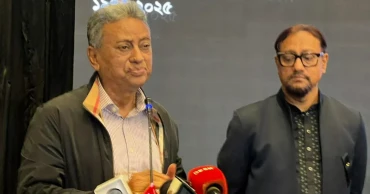
Khaleda Zia was a unique example of uncompromising politics: Khosru
BNP Standing Committee member Amir Khosru Mahmud Chowdhury on Saturday said former Prime Minister Begum Khaleda Zia was a unique example of uncompromising politics.
“When many compromised in difficult political realities or stepped aside under pressure, Begum Khaleda Zia never compromised for a moment—from the beginning to the end,” he said while addressing a civic mourning meeting in memory of Khaleda Zia at the International Convention Hall in the port city.
After entering politics, Khosru said, Khaleda Zia spent most of her life in political movements, often outside of power. “Although she was in power for only 10 to 11 years, she remained on the streets for nearly 30 years, continuing her struggle for democracy without compromise.”
Drawing comparisons with world leaders, Amir Khosru, also a BNP candidate for the Chattogram-11 constituency, said Khaleda Zia’s sacrifices stood alongside those of leaders like Martin Luther King Jr. and Nelson Mandela, who remained uncompromising throughout their lives.
“Although we could not fully understand the depth of her sacrifice during her lifetime, after her death we have realised how deeply she had made a place in the hearts of the people of Bangladesh,” he said.
Amir Khosru said Khaleda Zia lit the torch of democracy through her lifelong struggle and has now handed over that responsibility to Tarique Rahman. “This torch is extremely valuable, and we all must carry it forward,” he added.
Referring to the upcoming election scheduled for the 12th, Amir Khosru said the struggle for democracy might become more difficult in the post-election period.
“Many may think life will become easier after the election, but it will not. The fight for democracy does not end here. The post-election phase may be even more challenging,” he said, calling for unity to uphold Begum Khaleda Zia’s ideals.
The meeting, chaired by Chattogram City Corporation Mayor Dr Shahadat Hossain, recalled the political life and contributions of Khaleda Zia.
Mayor Dr Shahadat Hossain said the country must follow the path shown by Khaleda Zia to move forward.
“Her contributions to democracy, rule of law, justice and fundamental rights will inspire future generations,” he said.
Indian Assistant High Commissioner Dr Rajeev Ranjan said Khaleda Zia was a rare symbol of determination and unwavering faith in leadership.
“As the first female Prime Minister of Bangladesh, she achieved a unique place in history. She was a visionary statesman committed to democratic values and public service,” he said.
Consul General of Turkey Salauddin Kashem Khan, Vice-Chancellor of Chattogram Medical University Prof Dr Omar Faruk Yusuf, Principal of Chattogram Medical College Prof Dr Jashim Uddin, former principals Prof Dr Imran Bin Yunus and Prof Dr Siddique Ahmed Chowdhury, Premier University VC Prof Dr Nasrul Qadir, East Delta University VC Prof Dr Nazim Uddin, BNP Joint Organising Secretary and Chattogram-5 candidate Barrister Mir Mohammed Helal Uddin, Bangladesh Federal Union of Journalists (BFUJ) Secretary General Quader Gani Chowdhury, among others, spoke at the event.
8 months ago
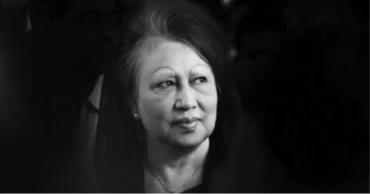
Indian parliament pays tributes to Bangladesh’s former PM Khaleda Zia
In a gesture of respect and bilateral solidarity, both Houses of the Indian Parliament - Lok Sabha and Rajya Sabha - paid solemn homage to the former Prime Minister of Bangladesh and former Chairperson of the Bangladesh Nationalist Party Begum Khaleda Zia.
The Parliament recalled her historic tenure as the first woman Prime Minister of Bangladesh and her contributions to the development of Bangladesh-India relations.
Indian Prime Minister Narendra Modi, along with the Members of both the Houses of Parliament, observed a moment of silence to honour her memory and extended deep condolences to the bereaved family and the people of Bangladesh.
The Rajya Sabha on Wednesday paid tribute to Bangladesh's former prime minister Khaleda Zia, besides erstwhile members of the upper house of the Indian parliament, L Ganesan and Suresh Kalmadi, who also passed away recently.
Soon after the house met for the day and before the laying of papers, Rajya Sabha Chairman CP Radhakrishnan read out the obituary references for Khaleda Zia and the two former members, according to the Press Trust of India.
The house stood in silence as a mark of respect for the departed. Later, the chairman said the Secretary General will convey to members of the beloved families our sense of deep sorrow and deep sympathy.
Reading out the reference for Begum Zia, he said, “I refer with profound sorrow to the passing away of Begum Khaleda Zia, former prime minister of Bangladesh and chairperson of the Bangladesh Nationalist Party”.
Begum Khaleda Zia passed away on December 30, 2025, after a prolonged illness.
“She was the first woman prime minister of Bangladesh and served in the office three times between 1991 and 2006. She also served as the leader of the Opposition from 1996 to 2001. Begum Khaleda Zia made important contributions to the development of Bangladesh and to Indo-Bangladesh bilateral relations,” the chairman said.
“The house joins the beloved family, the government and the people of Bangladesh in mourning the passing away of her excellency Begum Khaleda Zia,” Radhakrishnan said.
He also referred to the demise of L Ganesan, who passed away on January 4, 2026, at the age of 91 years. He served as a member of the Rajya Sabha, representing Tamil Nadu, from June 1980 to April 1986. He was born on April 4, 1934, in the Thanjavur district of Tamil Nadu.
8 months ago

Indian Parliament to pay homage today to Khaleda Zia
The Rajya Sabha of India will hold obituary references on Wednesday to pay tributes to several distinguished personalities, including former Bangladesh Prime Minister and Bangladesh Nationalist Party (BNP) Chairperson Begum Khaleda Zia.
According to the official List of Business of the Upper House of India, the obituary references will be taken up half an hour after the conclusion of the President’s Address to a joint sitting of Parliament.
Besides Khaleda Zia, the House will also pay homage to former Rajya Sabha members Shri L. Ganesan and Shri Suresh Kalmadi.
Earlier in the session, the Secretary-General will lay on the table a copy of the President’s Address, in both English and Hindi, delivered to both Houses of Parliament assembled together on January 28.
Khaleda Zia’s grace, sense of dignity were truly admirable: Nurul Kabir
Khaleda Zia, a three-time Prime Minister of Bangladesh, significantly shaped the country’s politics and democracy, influencing its regional relations, including with India.
The List of Business was issued by Rajya Sabha Secretary-General P. C. Mody on January 27.
8 months ago
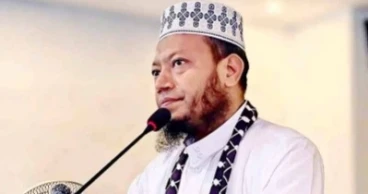
IU Chhatra Dal leader files case against Mufti Amir Hamza over defamatory remarks
Solaiman Chowdhury Shihab, joint convener of Islamic University's (IU) Chhatra Dal unit, has filed a penal case against Bangladesh Jamaat-e-Islami nominated candidate Mufti Amir Hamza over alleged defamatory remarks.
The complaint alleges that during a Waz Mahfil, Amir Hamza mocked the late Arafat Rahman Koko, son of former Prime Minister Khaleda Zia, and made offensive comments about Khaleda Zia’s imprisonment. Shihab said he saw videos of the remarks on social media on January 16.
The petition requests the court to issue a summons or arrest warrant under sections 500, 501, and 502 of the Penal Code.
Advocate Abdul Majid, the petitioner’s lawyer, said the court has taken the case under consideration and scheduled a hearing for February 1.
Pickup–Nasimon collision in Kushtia leaves one dead
When contacted regarding the case, Mufti Amir Hamza’s personal assistant Abu Bakar said they have not yet received any notice from the court. “Once a notice is served, we will take appropriate legal action,” he added.
Earlier, Amir Hamza had claimed on his verified Facebook page that he had received death threats. In the post, he urged followers to care for his three daughters in his absence and pledged to continue his fight for justice in Kushtia.
9 months ago