nation-building
PM urges students to equip themselves for greater role in nation-building
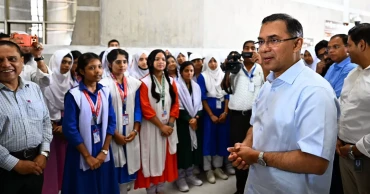
Prime Minister Tarique Rahman on Tuesday urged students to equip themselves with knowledge and skills needed to help build the country while interacting with them during their visit to Parliament to observe its proceedings.
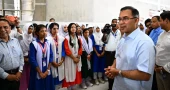
The Prime Minister met teachers and students from different educational institutions during a break in the parliamentary sitting at the Jatiya Sangsad in the afternoon, said a release issued by the Prime Minister's Press Wing.
He exchanged greetings with the students, inquired after their studies and encouraged them to work hard so they could contribute to the country's development.
State Minister for Local Government, Rural Development and Co-operatives Mir Shahe Alam and Prime Minister's Additional Press Secretary Atikur Rahman Rumon accompanied the Prime Minister.
As part of the government's initiative to allow students to observe parliamentary proceedings, teachers and students from different educational institutions, including four foreign students, visited the Jatiya Sangsad on Tuesday.
3 months ago
PM asks students to prepare for contributing to nation-building
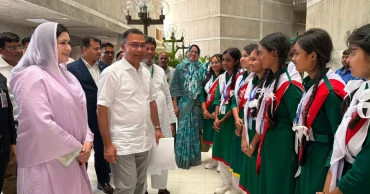
Prime Minister Tarique Rahman on Monday advised students to prepare themselves to work for the welfare of the country and contribute to nation-building in the future.
He made the remarks while interacting with a group of students who came to observe the budget session of Parliament, according to a release issued by the PM’s Press Wing.
The Prime Minister spoke to the students during the lunch break of the budget session as he was leaving his office at the Jatiya Sangsad Bhaban to attend a programme at the Bangladesh-China Friendship Conference Centre.
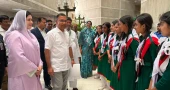
His wife Dr Zubaida Rahman was also present during the interaction.
A total of 45 students from four educational institutions in Madaripur visited Parliament on Monday to watch the budget session.
They were waiting in front of the Prime Minister's Office inside the Parliament Complex when Tarique Rahman stopped to speak with them.
During the brief exchange, the Prime Minister encouraged the students to focus not only on their studies but also on sports, cultural activities and other creative pursuits.
He said participation in such activities will help them develop their talents and prepare themselves to serve the country in the future. “Students should get ready to contribute to country's progress.”
The students expressed their excitement during the meeting with the Prime Minister and thanked him for what they described as a memorable experience.
The visit was arranged by Madaripur-2 MP Md Jahandar Ali Mia, who facilitated the participation of students from four educational institutions in his constituency.
The institutions were United Islamia Government High School, Donovan Government Girls' High School, Rajoir Girls' High School and Takerhat Popular High School and College.
Apart from attending the budget session, the students toured different parts of the Parliament Complex and learned about the history, architecture and functions of the Jatiya Sangsad.
3 months ago
PM seeks students’ cooperation to maintain stability for nation-building
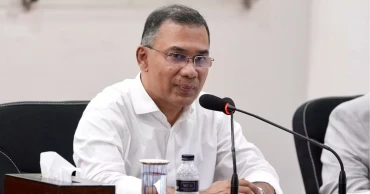
Prime Minister Tarique Rahman on Tuesday sought cooperation from university students to help maintain a stable political situation for nation-building and taking the country forward.
“If we cannot keep the country’s political situation stable, we will not be able to build anything. Even if we build something, it will collapse,” he said while exchanging views with a group of students at Professor Muzaffar Ahmed Chowdhury Auditorium in Faculty of Social Sciences building at the University of Dhaka.
The Prime Minister also encouraged students to learn a third language alongside Bengali and English to expand their employment opportunities worldwide.
The interaction programme was held after the inauguration of a daylong workshop titled ‘Transforming Higher Education in Bangladesh: Roadmap to Sustainable Excellence’ organised by the University Grants Commission of Bangladesh at the Nawab Nawab Ali Chowdhury Senate Bhaban.
More than 150 students participated in the event and asked the Prime Minister questions on education, employment, corruption, political culture, museums, language and governance and the Prime Minister responded to their queries
At the beginning of the programme, Tarique warmly greeted the students and recalled visiting the Dhaka University campus after nearly 35 years.
Addressing the students, the Prime Minister said there is a significant age gap between him and the younger generation but stressed the importance of understanding their vision for Bangladesh.
He said he wanted to know what kind of Bangladesh the students dream of, what the government can do for the country, and how the students themselves can contribute to nation-building.
The Prime Minister then invited the students to begin an open discussion on the future of Bangladesh.
Replying to a question from Kaberi Azad, a Master’s student of the Drawing and Painting Department of Dhaka University, Tarique said political stability is essential for building institutions and ensuring sustainable national development.
He said people expect rapid changes and improvements in the country but everything has to be built gradually in a stable environment.
“For this, a stable environment is necessary and I think every student can play a big role in this regard. Through social media or any other platform, you have to gradually build public opinion to this end,” the Prime Minister said.
He said it is quite natural that political parties will engage in politics but parliament should be the main centre of politics.
“We have done many things on the street politics. But now stability must come. Politics has to move to parliament. Just creating noise on the streets will not build anything,” Tarique said.
The Prime Minister said discussion, dialogue and thoughtful decision-making are necessary for building the country. “To build anything, stability is needed. Discussion is needed. We have to work thoughtfully,” he said.
“We need your cooperation in this regard because the future is yours. You have to be strong on these issues and raise your voice in protest when necessary,” Tarique added.
During the interaction, the Prime Minister also spoke about teacher recruitment, corruption, money laundering and social attitudes.
Replying to another question, the Prime Minister said teacher recruitment at Dhaka University had not always been carried out in the proper manner and alleged that political considerations were often given priority over merit.
“Unfortunately, Dhaka University is still not in a strong international ranking position. One of the main reasons is that teacher recruitment was perhaps not carried out properly in the past,” he said.
Tarique said the situation could improve if teachers are appointed based on merit and academic results. “If we recruit teachers based on merit and academic performance, I believe it is possible to change the situation.
He also referred to the lack of research publications among some academics seeking higher administrative positions at universities and urged university authorities to address the issue.
Replying to a question from Islamic History and Culture department student Mobasheruzzaman Hasan regarding seat shortages in halls and libraries, unemployment and irregularities in public recruitment, the Prime Minister said development projects are necessary for a country, but alleged corruption and inflated costs have become a major concern.
Referring to mega infrastructure projects undertaken after 2008, he questioned the high expenditure in some of them including the Rooppur Nuclear Power Plant project.
The Prime Minister also referred to allegations of excessive spending in public projects, mentioning the much-discussed “pillow scam”, where a pillow was reportedly purchased at an abnormally high price.“The burden of this extra expenditure ultimately falls on people,” he said.
Citing a white paper published during the interim government period, Tarique said nearly $16 billion had been siphoned out of the country every year.“Had this money remained in the country, many student problems, including seat shortages, could have been solved,” he said.
The Prime Minister also commented on the concept of “zero tolerance” against corruption, saying the term appears somewhat unrealistic to him.“No matter how much we say ‘zero tolerance’, it is very difficult to achieve completely in reality. But we are trying to bring it under control as much as possible.”
The Prime Minister also said changing long-standing practices and attitudes would take time and could not be achieved within a few months or years.
Narrating a personal observation from earlier in the day, the Prime Minister said he noticed water overflowing from an apartment building in Mohakhali because a pump had not been switched off.
“In my view, this may be called negligence, but it can also be considered a form of corruption,” he said.
Referring to the use of artificial intelligence in identifying traffic rule violations, he said many people react negatively even when fined for minor offences because social attitudes have not changed. “That is why changing people’s mindset is also important.”
During the discussion, Tarique stressed the need for trained museum curators and cultural experts in Bangladesh.
Referring to the country’s museums, he said many of them appear neglected and poorly maintained.
The Prime Minister said the government has already taken initiatives through the Education Ministry and Cultural Affairs Ministry to improve museum management and develop skilled professionals in the field.
Tarique also spoke about a government initiative to take schoolchildren to parliament and museums as part of civic and historical education.
Replying to a question from student Al Amin regarding the declining use of Bangla among English-medium students, the Prime Minister said language and cultural identity depend largely on family values and mindset.
He shared his personal experience of living in Britain after his family left Bangladesh and said his daughter still speaks Bangla fluently despite spending 17 years abroad. “If you speak with my daughter, you would never feel she lived in England for 17 years,” Tarique said.
He said many families in Bangladesh constantly speak English with children studying in English-medium schools, which may improve language skills but can weaken attachment to Bangla and local culture.“This is a matter of mindset. It cannot be solved through force or regulations alone. Change has to come from within,” he said.
Dhaka University Vice-Chancellor Prof ABM Obaidul Islam and Marketing Department Professor Morshed Hasan Khan were present on the stage during the programme.
Vice-Chancellor Prof ABM Obaidul Islam presented a commemorative crest to the Prime Minister after the event.
4 months ago
Bangladesh envoy in Canada highlights vital role of young people in nation-building
High Commissioner of Bangladesh to Canada Nahida Sobhan has underscored the vital role of young people in nation-building.
During a panel discussion at the Youth Festival in Toronto, she commended the commitment and unity exhibited by Bangladeshi-origin youth in Canada during the 2024 movement.
The envoy highlighted the critical role of young voices in driving sustainable nation-building efforts.
“The High Commission remains fully committed to engaging with Bangladeshi-origin youth in Canada, empowering them to be catalysts for progress and representing Bangladesh’s dynamic potential,” said the high commissioner, according to a message here.
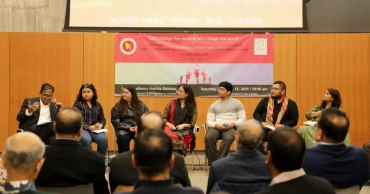
The High Commission of Bangladesh in Ottawa, in collaboration with Progressive Action for Community Empowerment (PACE), hosted an event at the Albert Campbell Public Library in Toronto on January 18 as part of the ongoing Youth Festival 2025, an initiative by the government of Bangladesh.
The event, themed “Let’s Change the Country, Let’s Change the World,” served as a platform for Bangladeshi-origin youth in Canada to explore their role in shaping a progressive and inclusive Bangladesh.
A diverse group of students and young professionals who actively supported and organized protest events in Toronto during the historic July–August 2024 movement in Bangladesh attended the gathering.
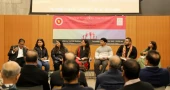
A Davos-style panel discussion was the key highlight of the event, where participants shared innovative ideas and solutions to address critical challenges facing Bangladesh’s future.
Srijoni Rahman, one of the young panelists, emphasised the transformative potential of the Bangladeshi diaspora in driving positive change.
While thanking the High Commission of Bangladesh in Canada, she said Bangladeshi foreign missions should encourage youth engagement and foster a positive mindset so that the youth of the Bangladeshi diaspora can meaningfully contribute to Bangladesh’s transformation.
She also said Bangladesh has always been a model and an inspiration for youth-led movements, and youths have always been catalysts for bringing about change.
Read: Environment Minister urges youths to adopt Sheikh Kamal's ideals for nation-building
"We should draw lessons from our values – the values derived from our War of Independence in 1971 and the July-August movement – to ensure social justice and equity.”
Another panelist Urbi Khan, a youth representative from the Bangladeshi community and a journalist at the Toronto Star, reminded the audience that the youth have always been the vanguard of change in Bangladesh’s storied history, including during the recent July-August movement.
She maintained that Bangladesh itself is the cherished fruit of revolutionary struggles, nurtured by the sacrifices and indomitable spirit of its people.
1 year ago