Congo Rebels
Rwanda-backed rebels reach east Congo’s 2nd major city
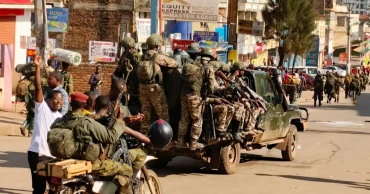
Rwanda-backed rebels reached the center of east Congo’s second largest city, Bukavu, on Sunday morning and took control of the South Kivu province administrative office after little resistance from government forces, many of whom fled the rebels' advance.
Scores of residents cheering on the M23 rebels in central Bukavu on Sunday morning as they walked and drove around the city center after a dayslong march from the region's major city of Goma 63 miles (101 kilometers) away, which they captured late last month. Several parts of the city, however, remained deserted with residents indoors.
The M23 rebels are the most prominent of more than 100 armed groups vying for control of Congo’s mineral-rich east, and are supported by some 4,000 troops from neighboring Rwanda, according to the U.N.
Armed fighters have raped scores of children in eastern Congo, UNICEF says
It was not clear if the rebels had taken decisive control of the city of about 1.3 million people. Their presence in central Bukavu is an unprecedented expansion of the rebels' reach in their yearslong fighting with Congolese forces. Unlike in 2012 when they only seized Goma in the fighting connected to ethnic tension, analysts have said the rebels this time are eyeing political power.
Many Congolese soldiers were seen on Saturday fleeing the rebels’ advance into Bukavu alongside thousands of civilians amid widespread looting and panic.
Congo’s President Felix Tshisekedi held a security meeting in the faraway capital of Kinshasa, where officials noted that Bukavu was “briefly” invaded by M23 but remains under the control of the Congolese army and allies from local militia, the presidency said on X. There were no signs of fighting or of Congolese forces in most parts of Bukavu on Sunday.
Tshisekedi has warned of the risk of a regional expansion of the conflict. Congo's forces are being supported in Bukavu by troops from Burundi and in Goma by troops from South Africa.
Burundi's president, Evariste Ndayishimiye, appeared to suggest his country will not retaliate in the fighting. In a post on X he said that “those people who were ready to get profit of the armed attack of Rwanda to Burundi will not see this.”
The Congo River Alliance, a coalition of rebel groups that includes M23, said it was committed to “defending the people of Bukavu” in a Saturday statement that did not acknowledge their presence in the city. “We call on the population to remain in control of their city and not give in to panic,” Lawrence Kanyuka, the alliance’s spokesperson, said in a statement.
1 year ago

Rwanda-backed rebels take more towns after seizing east Congo's largest city
Rebels backed by Rwanda captured more towns in eastern Congo on Wednesday as they moved beyond the key city of Goma in an apparent attempt to expand their control in the conflict-battered region.
The rebels advanced toward the center of South Kivu province after taking several towns, including Kalungu, Kanyezire and Mukwinja, according to a local civil society leader and an aid worker in the area. They spoke on condition of anonymity because they were not authorized to talk to the media, AP reports.
UN spokesman Stephane Dujarric said the developments were concerning, and that the United Nations was taking measures to protect civilians and UN staff.
The advance also raised fears of a prolonged occupation by the rebels, who have said they plan to set up a new administration in Goma, a city of 2 million people.
“Left unchecked, the fighting could spread ... recalling the horrors of the late 1990s and early 2000s, when millions died,” the Crisis Group said, citing the last, multi-country war there.
Rwanda-backed rebels claim capture of Goma in eastern Congo
Unlike now, the rebels captured Goma only briefly during their first rebellion in 2012, withdrawing after a few days under international pressure on Rwanda.
Meanwhile, Congolese President Félix Tshisekedi was conspicuously absent from a virtual summit of a regional East African bloc that began late Wednesday, hosted by Kenya.
Tshisekedi was on an official visit to Angola, which had mediated a ceasefire between Congo and Rwanda last year, the Angolan presidency said in a statement. He was to discuss the situation in eastern Congo with Angola’s President João Lourenço.
Faced with the rebel offensive, soldiers fighting for Congo — many of them mercenaries from other nations — were laying down their weapons at the border with Rwanda. Congo’s army seemed to be in disarray, and those at the border appeared disorganized and ill-equipped for any major fighting.
A rebel spokesman said nearly 300 mercenaries have surrendered their arms and returned to their countries.
“Let the people of Goma be calm, peace is here,” said Willy Ngoma, a spokesman of the M23 group. Ngoma, who is on the U.N. Security Council’s sanctions list for crimes committed by the rebels.
Death toll from Nigerian gasoline tanker explosion rises to 86
“It’s like you are fighting without command,” said Jean Marie Ndahambaza, one of the surrendering soldiers.
Armed groups have long vied for control of eastern Congo, which is rich in minerals critical to much of the world’s technology, and has been the scene of proxy battles between Congo and neighboring Rwanda, as well as other powers. Fighting reignited this week, and the rebels backed by Rwanda, known as M23, announced Monday that they had captured much of the provincial capital of Goma.
1 year ago

Rwanda-backed rebels claim capture of Goma in eastern Congo
Rwanda-backed M23 rebels announced Monday they had seized Goma, the last government stronghold in eastern Congo’s mineral-rich region. The capture marks a significant escalation in one of Africa’s longest-running conflicts, raising fears of worsening humanitarian conditions and a potential spillover into a broader regional crisis.
The rebel advance has forced thousands to flee their homes, adding to the over one million displaced residents already in Goma. Local hospitals are overwhelmed, treating hundreds of injured civilians caught in the crossfire daily.
Who are the rebels?
M23, one of nearly 100 armed groups in eastern Congo, traces its roots to a failed integration of ethnic Tutsis into the Congolese army. Named after a March 23, 2009, peace agreement, the group resurfaced in 2022 following a decade of dormancy after being defeated in 2012.
About 70 people killed in attack on hospital in Sudan's Darfur region, WHO chief says
Comprising primarily ethnic Tutsis, M23 claims to protect Tutsis and Congolese of Rwandan descent from discrimination. Critics argue the group’s actions serve as a front for Rwandan influence in eastern Congo.
In areas under their control, M23 has established parallel governance systems, replacing local chiefs, levying taxes, and managing natural resources.
The rebels have recently captured multiple towns, encircling Goma as part of their offensive.
Congo, the US, and UN experts accuse Rwanda of backing M23, which has grown from a few hundred fighters in 2021 to an estimated 6,500. Rwanda denies direct involvement but admits it has deployed troops in eastern Congo to protect its security. UN experts estimate there are as many as 4,000 Rwandan soldiers operating in the area.
Congo’s Foreign Minister Thérèse Kayikwamba Wagner, addressing the UN Security Council on Sunday, accused Rwanda of “direct aggression” and escalating tensions. In response, Rwanda’s UN Ambassador Ernest Rwamucyo placed blame on Congo, stating the crisis stemmed from its lack of commitment to peace.
The roots of the conflict
Eastern Congo has long been a hotspot of violence, driven by its vast reserves of valuable minerals, including copper, cobalt, lithium and gold. These resources, worth an estimated $24 trillion, have drawn local and international actors seeking control, often at the expense of the population, 60 per cent of whom live below the poverty line.
The conflict’s origins date back to the 1994 Rwandan genocide, where Hutu militias killed hundreds of thousands of Tutsis and moderate Hutus.
Death toll from Nigerian gasoline tanker explosion rises to 86
After the genocide, nearly two million Hutus, including suspected perpetrators, fled to eastern Congo, intensifying tensions with local Tutsis.
This historical animosity laid the groundwork for years of violence and provided a justification for foreign interventions, particularly by Rwanda, which has cited ongoing threats from Hutu militias in the region.
Strategic importance of Goma
Goma serves as a critical hub for trade, security and humanitarian operations in eastern Congo. Its airport is vital for transporting supplies to the region.
Since 2021, Congolese government forces, supported by Burundian troops and UN peacekeepers, have struggled to keep the rebels at bay.
The city’s fall represents a major victory for M23 and a devastating loss for the Congolese government. Its capture also raises concerns about heightened risks to civilians, with the UN warning of potential human rights abuses in the aftermath.
1 year ago