Kushtia farmers
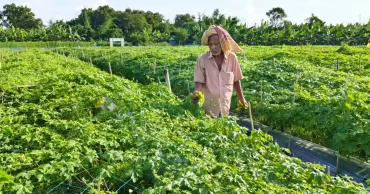
Pesticide-free bitter gourd yields well, low prices disappoint Kushtia farmers
Two farmers in Kumarkhali upazila have achieved a good harvest of pesticide-free bitter gourd using Good Agricultural Practices (GAP) for the first time in the area, but low market prices have left them struggling to earn returns that match their higher cultivation costs.
Green bitter gourd vines laden with fresh produce grow on bamboo and net trellises inside a three-bigha field enclosed by blue nets in Dhalnagar village under Chandpur Union.
Farmers Dabir Uddin Farazi and Abdul Bari have cultivated the Alisa variety of bitter gourd on the land using GAP, an environment-friendly farming approach aimed at producing safe and quality food while reducing dependence on chemical pesticides.
Over the past 10 days, they have sold around 2,200 kg of bitter gourd at wholesale prices ranging from Tk 30 to Tk 55 per kg, earning around Tk 65,000-70,000.
They expect to harvest and sell another 4,000 kg or more over the next one and a half months if weather conditions remain favourable, with the expected market value exceeding Tk 250,000.
However, the farmers say they are not receiving any premium for their pesticide-free produce as there is no separate market or designated corner for pesticide-free vegetables.
“GAP cultivation costs more because we have to buy nets, traps and organic fertiliser. But the yield is good and the vegetables are healthy. Consumers are still reluctant to pay a higher price for pesticide-free vegetables,” said Dabir Uddin.
He said they spent around Tk 180,000 on land preparation, seeds, materials and cultivation on the three bighas.
22 days ago

GK Irrigation Project revived, bringing relief to Kushtia and Chuadanga farmers
Farmers in Kushtia and Chuadanga districts, who have long struggled with water shortages during the crucial farming seasons, are now witnessing a significant improvement in their agricultural prospects, thanks to the operational revival of the Ganges-Kabadak (GK) Irrigation Project.
For years, inadequate irrigation has hampered crop production, leaving farmers in these regions at the mercy of unpredictable water sources.
42,000 Bangladeshi expats seek voter registration abroad
But with the start of the irrigation season this year, the project promises relief, providing irrigation water to over 11,000 hectares of land in Kushtia alone.
The neighbouring Chuadanga district is also set to benefit, as the revived system promises a steady water supply.
A Boon for Farmers
The early water supply this season is expected to significantly reduce the costs associated with farming. Farmers expect saving between Tk 3,000 and Tk 4,000 per bigha in cultivation expenses during the Boro season, owing to the improved water availability.
Agricultural experts said that timely water access will lead to considerable reductions in irrigation costs and help maintain crop health throughout the season.
According to local farmers and officials from the Department of Agricultural Extension, the availability of water at the right time will ensure that farmers’ efforts to cultivate crops are not in vain.
“This early water supply is a blessing for us,” said Akkas Ali, a farmer from Shimulia village in Kushtia Sadar Upazila. “We had already planted our seedlings, not expecting irrigation, but now, we see hope in the form of this water.”
The positive impact is not limited to those directly connected to the canals. Even farmers whose fields lie outside the immediate reach of the canals are benefiting from the indirect advantages, such as improved groundwater levels, which had suffered due to previous years of drought and failed irrigation systems.
Solving Groundwater Woes
In recent seasons, groundwater levels in Kushtia and Chuadanga had dwindled, making water extraction through shallow pumps difficult. However, with the canals now filling up, this issue is expected to be alleviated.
Sufi Md Rafiquzzaman, Deputy Director of the Kushtia Department of Agricultural Extension, highlighted that the revival of the GK project would not only benefit Boro rice cultivation but also help with other crops, including Aus paddy.
Farmers cultivating Aus paddy, in particular, stand to gain from the improved water availability. Seedbeds for Aus paddy are expected to be prepared after March 15, with transplantation beginning 20 to 25 days later.
This will provide much-needed support for the local economy, as the region gears up for its Boro rice cultivation, with a target of 36,464 hectares in Kushtia. As of now, 35,996 hectares have been successfully cultivated.
Challenges and Solutions
Despite the optimism surrounding the project’s revival, challenges remain. The pumps, originally installed in 2009 by a Japanese company, have faced recurring issues, with two pumps becoming inoperable last year.
Currently, only one of the three pumps is functional, supplying water at a rate of 1,300 cusecs per second. A second pump is expected to be operational by the end of the month, but a third pump remains irreparable.
Efforts to repair and replace parts of the pumps are ongoing, with Japanese engineers inspecting the equipment and replacement parts already arriving.
The Padma River’s water level, which is currently 4.40 meters, must also remain above 4.20 meters for the system to function effectively. If the water level falls below this threshold, the water supply to the agricultural fields will need to be halted.
Latest 'HOBEKI?' graffiti sparks intrigue in Chattogram’s CRB area
Future Prospects
Looking forward, significant investments are being made to modernise the GK Irrigation Project. Rashidur Rahman, Executive Engineer of the Kushtia Water Development Board, revealed plans for a Tk 1,400 crore project aimed at renovating the GK pump house.
The proposed upgrades include the installation of two large and five small pumps, as well as extensive canal renovations and tree planting along the canals.
Once the upgrade is completed, the system will be able to maintain irrigation supplies even if the Padma River’s water level drops by 3 centimetres, a considerable improvement over the current situation.
History
The GK Irrigation Project, which began in 1959, has a long and storied history of providing water for the irrigation of vast agricultural lands. Initially designed to irrigate 197,500 hectares, the project’s scope has shrunk over the years due to reduced pump capacity.
With the restoration and expansion of the system, the project is now able to supply water to over 190 kilometres of main canals and 467 kilometres of branch canals across four districts.
When all three pumps are operational, the project will be able to provide 3,900 cusecs of water per second, ensuring that farmers in Kushtia and Chuadanga have reliable access to water, essential for sustaining their livelihoods.
Eid shopping in Faridpur starts picking up
As the GK project resumes its critical role in supporting the agricultural community, farmers in Kushtia and Chuadanga can look forward to a more prosperous and secure farming season, experts said.
With continued support, they said, both technical and financial, the long-term prospects for these districts appear bright, promising an era of improved agricultural productivity and resilience.
1 year ago