Astronomy
Hidden chemical patterns may help scientists detect alien life
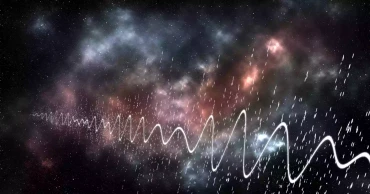
Scientists say they have identified a hidden chemical pattern that could help detect life beyond Earth.
The new study, published in the journal Nature Astronomy, suggests that scientists may not need to focus only on finding specific molecules on distant planets and moons. Instead, they can look at how those molecules are organized.
“We’re showing that life does not only produce molecules,” said Fabian Klenner, an assistant professor of planetary sciences at University of California, Riverside and co-author of the study. “Life also produces an organizational principle that we can see by applying statistics.”
Looking beyond individual molecules
For years, scientists have searched for signs of life by looking for compounds such as amino acids and fatty acids. But these molecules can also form naturally without any biological activity.
They have been found in meteorites and created in laboratories that mimic conditions in space. As a result, simply detecting these chemicals is not enough to confirm the presence of life.
The researchers found that amino acids in living organisms are usually more diverse and more evenly distributed than those produced through non-biological processes.
Fatty acids showed the opposite pattern. In this case, non-living chemical reactions tended to produce more evenly distributed mixtures than living systems.
Statistical clues to life
The team said this is the first study to show that signs of life can be identified using statistical analysis alone, without relying on a specific instrument.
That means the method could potentially be applied to data already being collected by missions exploring Mars, Europa and Enceladus.
“Astrobiology is fundamentally a forensic science,” said Gideon Yoffe, a postdoctoral researcher at the Weizmann Institute of Science and lead author of the study.
“We’re trying to infer processes from incomplete clues, often with very limited data collected by missions that are extraordinarily expensive and infrequent,” he said.
Borrowing from ecology
To develop the method, the researchers adapted a statistical approach commonly used in ecology to measure biodiversity.
Ecologists use two key concepts: richness, which counts how many different species are present, and evenness, which measures how evenly they are distributed.
The scientists applied the same ideas to chemical data from around 100 existing datasets, including samples from microbes, soils, fossils, meteorites, asteroids and laboratory-made materials.
In study after study, biological samples showed clear organizational patterns that distinguished them from non-living chemistry.
Ancient fossils still carried the signal
The method was also able to detect different levels of preservation in biological materials.
“That was genuinely surprising,” Klenner said. “The method captured not only the distinction between life and nonlife, but also degrees of preservation and alteration.”
Even heavily degraded samples retained signs of their biological origin. Fossilized dinosaur eggshells included in the study still showed detectable statistical patterns linked to ancient life.
A useful tool for future missions
The researchers stressed that no single method will be enough to prove the existence of extraterrestrial life.
Klenner said any future claim would need multiple independent lines of evidence, interpreted within the geological and chemical context of the environment being studied.
Still, the team believes the new statistical approach could become an important tool for future space missions.
“Our approach is one more way to assess whether life may have been there,” Klenner said. “And if different techniques all point in the same direction, then that becomes very powerful.”
Source: Science Daily
5 months ago
Astronomers unveil stunning multi-colour map of nearby galaxy
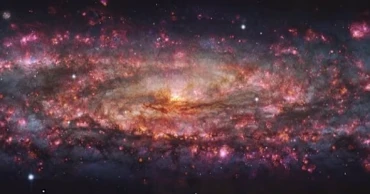
Astronomers have revealed a nearby spiral galaxy in all its brilliant glory, shining in thousands of colours.
The dazzling panoramic shot released Wednesday of the Sculptor galaxy by a telescope in Chile is so detailed that it's already serving as a star-packed map, reports AP.
Scientists used the European Southern Observatory's Very Large Telescope to observe the galaxy for some 50 hours, stitching together more than 100 exposures to create the picture. The image spans 65,000 light-years, almost the entire galaxy. A light-year is 5.8 trillion miles.
Sculptor — officially labeled NGC 253 — is considered a starburst galaxy, one heavy with stellar action. It's located 11 million light-years away in the Southern Hemisphere's constellation Sculptor, and easy to view with binoculars or small telescopes.
“The Sculptor galaxy is in a sweet spot,” the observatory's Enrico Congiu, who led the research, said in a statement. “It is close enough that we can resolve its internal structure and study its building blocks with incredible detail, but at the same time, big enough that we can still see it as a whole system.”
Japanese private lunar lander heads for Moon’s remote northern region
The more shades of colour from stars, gas and dust in a galaxy, the more clues to their age, composition and motion, according to the scientists. Sculptor's latest snapshot contains thousands of colours — a glowing montage of purples, pinks and yellows — compared with just a handful for traditional pictures.
The team has already discovered 500 planetary nebulae, clouds of gas and dust from dying stars that can serve as cosmic mile markers. Their research has been accepted for publication in the journal Astronomy & Astrophysics.
1 year ago