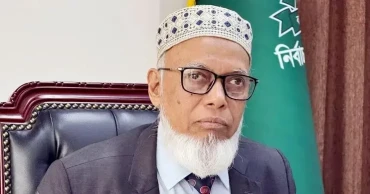
Election Commissioner Abdur Rahmanel Masud
EC targets October to start phased local government elections
Election Commissioner Abdur Rahmanel Masud on Monday said the Election Commission is taking preparations to start the arrangement of phased elections to local government bodies in October next.
“We think the elections will be held at the right time. We have said this before and we are saying it again—we are moving forward with October in mind," he said while addressing a fruit festival organised by the Reporters Forum for Election and Democracy (RFED) at the Nirbachan Bhaban in the city.
City corporation elections after Ramadan: EC Masud
The Election Commission, however, said there is a matter of it won’t be logical for the EC to come up with a clearer announcement over the election as holding local government elections requires coordination with the government on several issues due to ground reality.
"As many aspects of the election require coordination with the government, it would not be reasonable for the Election Commission to make a definitive announcement without formal and informal discussions with the government," he said.
He said if elections are held in October, the schedule will have to be announced around 45 days before the polls date. “We are making our preparations accordingly," he added.
The commissioner said the EC would soon write to the government requesting the speedy resolution of demarcation and boundary-related complications, which remain one of the key prerequisites for holding local government elections.
Citing that most of local government bodies are currently vacant, he viewed that elections to union parishad and municipalities shall be held first as chiefs and members of municipalities and union parishads serve as ex-officio members of upazila parishads.
As a result, upazila parishad elections cannot effectively be completed before elections to municipalities and union parishads.
Since of the members of Union Parishads, municipalities and upazila parishads are the voters in the Zila Parishad election, the polls can’t be held before elections to three types of local bodies in a particular district.
Election Commissioner Abul Fazal Md Sanaullah said the EC has already taken all primary preparations for local government polls.
He said the commission has already uploaded the draft electoral code of conduct to its website, received observations from stakeholders and is reviewing relevant laws to make any necessary adjustments.
On boundary delimitation, Sanaullah said the EC has decided to coordinate closely with the Local Government Division to ensure the process is completed as quickly as possible.
"We have started preparations from our side so that, like the national election, we can conduct very fair local government elections in a nice manner,” said the election commissioner.
Two other election commissioners Tahmida Ahmad and Anwarul Islam Sarker, EC Senior Secretary Akhtar Ahmed and Principal Information Officer Syed Abdal Ahmed were present at the event presided over by RFED President Kazi Emad Uddin (Jabel).
3 months ago

EC plans unified code of conduct for local polls, poster-free campaigns
The Election Commission (EC) is planning to introduce a uniform code of conduct for elections to all five types of local government bodies to make the rules easier for people to understand and ensure effective enforcement ahead of a massive electoral cycle likely to begin later this year.
As part of preparation to conduct elections to local government bodies throughout the country, the commission has already taken initiative to revise separate election codes for city corporations, municipalities, zila parishads, upazila parishads and union parishads.
The EC has, in principle, taken a decision to make the election codes for the local bodies largely similar to the code of conduct applied in the recent 13th parliamentary election.
Following the successful implementation of the latest code for parliamentary polls during the February-12 general election, the Commission now plans to incorporate several provisions, including restriction on using posters as well, in the polls codes for the local body elections.
Election Commissioner Abdur Rahmanel Masud said a proposal for a single code of conduct for all local government bodies would be placed before the Commission.
“I think a single code of conduct rule should be there for all local government bodies. I will place a proposal for it,” he told UNB.
Asked about possible changes to the codes, Masud said the local election code would be almost similar to the one used in the 13th parliamentary election.
“There will be a ban on the use of posters and restrictions related to misuse of AI and social media,” he said.
Senior officials of the EC Secretariat have already been instructed to prepare draft amendments to the polls codes and election conduct rules for city corporations, municipalities, district, upazila and union parishads.
EC officials said the ban on posters in parliamentary elections gained positive results and the same approach would now be applied to local government polls to reduce environmental pollution and bring changes to traditional campaigning methods.
Ahead of the last general election, the EC issued the Code of Conduct for Political Parties and Candidates in Parliamentary Elections Rules, 2025, prohibiting the use of posters,helicopters and drones, along with prohibition on misuse of artificial intelligence (AI) and social media in election campaigns.
Under the 2025 code, posters are completely banned, while pamphlets, leaflets, handbills, festoons or banners made from non-biodegradable materials such as rexine, polythene or plastic are also prohibited. However, candidates are allowed to install a maximum of 20 billboards in a constituency, each measuring no more than 16 feet by 9 feet.
The parliamentary election code also prohibits malicious use of AI in campaign activities. Harmful content, including hate speech, misinformation, manipulated images, fabricated election-related information and inflammatory language targeting opponents, women, minorities or any other groups, is barred on social media platforms.
Punishment for violating the parliamentary election code was also strengthened, with the maximum penalty increased to six months’ imprisonment and a fine of Tk 150,000, up from six month jail and Tk 50,000 fine previously.
EC officials said the Commission is also considering measures to prevent undue influence by members of parliament in local government elections as the upcoming elections to the local bodies without the use of political party symbols.
Abdur Rahmanel Masud said laws have already been passed in parliament to conduct the elections to local government bodies using non-party electoral symbols.
“We have received copies of the laws… But the commission has not yet decided when the elections will begin. For now, we are keeping preparations in place,” he said.
With the government establishing a designated room named ‘visiting room’ for MPs at the upazila Parishad complex, the EC is thinking of introducing new provisions to prevent lawmakers from influencing in local polls from those offices.
The commission is also planning changes to nomination forms, including mandatory disclosure of overseas assets in affidavits.
Officials said the commission is taking preparations assuming that local government elections may start at the end of this year.
During the Deputy Commissioners’ Conference on May 5, Chief Election Commissioner AMM Nasir Uddin and the four election commissioners instructed field administrators to prepare for local polls and maintain standards similar to parliamentary elections.
According to EC estimates, elections to 12 city corporations, over 450 upazila parishads, more than 300 municipalities and 61 zila parishads are already overdue and can be held immediately without legal complications.
Besides, the legal timeframe for holding elections to around 600 union parishads began in April, making polls mandatory by October next. The 180-day countdown for elections in more than 2,800 additional union parishads will begin by July.
In this situation, the EC would be able to announce election schedules once it receives a green signal from the local government division, although the government has indicated that local government elections may begin at the end of the current year.
4 months ago
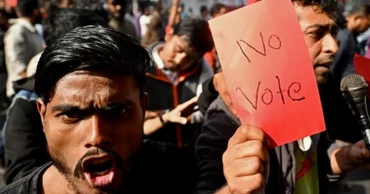
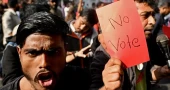
Bangladesh elections could see ‘No Vote’ choice, candidate caps
The Election Commission has drafted the Representation of the People Order (Amendment) Ordinance, 2025, proposing major changes, including a ‘No Vote’ option to avoid uncontested elections, involving the armed forces as a law enforcement agency and limiting candidates to contesting in no more than two constituencies.
The draft RPO also enhanced the EC’s authority to stop the polls and cancel the candidacy of an elected member of parliament even during the post-election period on charge of inconsistent or false information in an affidavit and the statement of income and expenditure.
If the draft RPO is enacted, the Commission’s authority over the government departments and officers and the presiding officer’s authority to stop the polling would go up.
“The draft of RPO is almost finalized. But only one thing related to expatriate voters is now being reviewed. The draft RPO will soon be sent to the law ministry (to make it law by promulgating an ordinance),” Election Commissioner Abdur Rahmanel Masud told UNB on Monday.
He said the draft RPO, if passed, would allow the Election Commission to stop voting in a whole constituency for irregularities, a power the Awami League removed in 2023 before the 2024 polls.
The current commission, headed by Chief Election Commissioner AMM Nasir Uddin, drafted the RPO (Amendment) Ordinance, 2025 ahead of the 13th parliamentary election planned to be held in early February 2026.
In the draft law, the Armed Forces, — Bangladesh Army, Bangladesh Navy and Bangladesh Air Force —have been added to the definition of law enforcing agencies alongside Police, Armed Police Battalion, Rapid Action Battalion, Ansar Force, Battalion Ansar, Border Guard Bangladesh and Coast Guard.
PR system possible if only law is amended: CEC Nasir
The Armed Forces had earlier been included in the definition of law enforcement agencies, but the Awami League government dropped them during its first term after the 2008 general election. As a result, the armed forces were deployed as just striking forces in the past three general elections in 2014, 2018 and 2024.
The draft law empowers the Election Commission to declare the candidacy of an elected contestant illegal and even cancel the election within five years if it finds any inconsistency or false information in the candidate’s affidavit or the statement of income and expenditure.
EC’s Priority
Two new provisions — Articles 5(3) and 5(4) of the RPO, 1972 — have been inserted to ensure the EC’s dominance and enhance its authority over government officials and departments.
The Article 5(3) stipulates that if any dispute arises between the government and the EC regarding assistance, the EC’s requirements shall take precedence.
The Article 5(4) authorises the EC to take necessary punitive action against any officer, employee or government department if it is satisfied that they have neglected their duties.
A new provision proposed in the Article 7 of RPO states that the disciplinary action taken in response to the recommendations of this Commission shall be recorded in the personal records, service records and annual confidential report of the officer or person. The appointing authority shall inform the Commission in writing about the actions taken against the officers concerned within ten working days, it added.
BNP against PR system, says Fakhrul
Another amendment proposes that no person can contest in more than two constituencies simultaneously. Under the existing Article 13A of the RPO, a person can be a candidate in more than three constituencies. The draft law says if someone contests in more than two, all his nomination papers will be void.
‘No Vote’
The EC has incorporated a ‘No Vote’ option to ensure no one is elected uncontested. If only one person remains as a contesting candidate after scrutiny or withdrawal of candidature, that candidate must contest against a ‘No Vote’ option in that constituency.
If ‘No Vote’ gets more ballots than the candidate, a fresh schedule must be announced for the election. If the candidate gets more votes, he will be declared elected.
The provision for the ‘No Vote’ option along with other electoral symbols was incorporated in the RPO ahead of the 2008 national election but was dropped before the 2014 election.
Single Platform for Candidates
A new provision requires returning officers or assistant returning officers to take measures for bringing all candidates on a single platform after symbol allocation to announce their manifestos and pledge to abide by the code of conduct in a spirit of harmony among them.
Polling Suspension
Under the proposed Article 25, a presiding officer could stop the polling, if it is interrupted beyond control, or if ballot boxes are unlawfully removed, destroyed, lost or tampered to such extent that the result of the poll at the polling station cannot be ascertained. The current RPO does not permit a presiding officer to stop polling before seeking help from law enforcement agencies and failing to restore order.
Post-Polls Candidacy Cancellation
The proposed ordinance allows the EC to investigate any affidavit or statement of income-expenditure return submitted by an elected candidate for discrepancies or false information even after the election. If, after a hearing and investigation, the commission is satisfied that such discrepancies exist, it can declare the candidacy unlawful, cancel the election, and arrange a fresh poll in that constituency.
'No vote' to return only for single-candidate seats: EC
The draft law also made it mandatory for an aspirant to mention the statements of income sources and assets of the persons and dependents.
The next national election in Bangladesh is likely to be held in the first half of February, as indicated by Chief Adviser Prof Muhammad Yunus and Chief Election Commissioner AMM Nasir Uddin.
The Chief Election Commissioner also said the Election Commission has stepped up preparations across the country for the election.
1 year ago