new pay scale
Phased new pay scale for govt employees from July 1, says Khosru
Finance Minister Amir Khosru Mahmud Chowdhury on Thursday announced that a new pay scale for government employees will be implemented in phases starting from July 1, citing the rising cost of living and inflationary pressures.
He made the announcement while presenting the proposed national budget for the 2026-27 fiscal year in Parliament.
The minister said government employees have been receiving salaries and allowances under the same pay structure for nearly eleven years. “During this period, the cost of living has increased significantly due to inflationary pressures. In recognition of this reality, the government is announcing the phased implementation of a new pay structure for public employees beginning on 1 July 2026.:
He said merit, integrity, competence, experience, and professional qualifications will serve as the principal criteria for all appointments, transfers, and promotions across the public service in the government’s pursuit of building a “Meritocratic Bangladesh.”
Khosru expressed firm belief that the ongoing reforms will extend far beyond the simplification of administrative procedures. “They will contribute to improving the overall business environment, attracting greater domestic and foreign investment, creating new momentum for enterprises of all sizes, strengthening the foundations of production and exports, and expanding employment opportunities across the economy.”
An amount of Tk 89,380 crore has been earmarked for salaries and allowances of government officials and employees in the next fiscal year.
The allocation is Tk 4,641 crore, or 5.47 percent, higher than the revised allocation of Tk 84,739 crore in the outgoing fiscal year.
According to budget documents, the original allocation for government salaries and allowances in FY26 was Tk 84,114 crore, which was later revised upward to Tk 84,739 crore.
The proposed allocation also marks a significant increase from the actual expenditure of Tk 69,423 crore recorded in FY25, indicating a rise of nearly Tk 20,000 crore in annual spending on government pay and benefits over two years.
Of the total allocation, Tk 13,874 crore has been earmarked for officers’ salaries, up from Tk 12,927 crore in the revised budget for FY26, reflecting an increase of Tk 947 crore.
For salaries of employees, Tk 30,671 crore has been allocated, compared to Tk 29,170 crore in the revised budget, registering an increase of Tk 1,501 crore.
The largest share of the allocation will go to allowances, which have been proposed at Tk 44,835 crore, up from Tk 42,642 crore in the revised budget. The increase in this category alone amounts to Tk 2,193 crore.
According to the experts, annual increases in salary and allowance allocations have become necessary due to rising living costs, inflation and the continued recruitment of personnel in public service.
An analysis of the proposed budget shows that the government's total recurrent expenditure has been estimated at Tk 5.51 crore for FY27, with around 16.2 percent of the amount set aside for salaries and allowances of government employees.
4 months ago

New pay scale could fuel bribery 'premiums' without reforms to public admin: TIB
While acknowledging the rationale behind the initiative to increase the salaries and allowances of government employees, Transparency International Bangladesh (TIB) has called for an assessment of the economic capacity to bear such an additional burden.
The organization also stressed the need for public administration reforms to ensure accountability, professional excellence, and easy access to services for all citizens, who will indirectly fund these expenses.
TIB demanded transparency and accountability to curb public sector corruption and irregularities, warning that failing to do so would turn the new pay scale into an infallible tool for raising bribery premiums.
2 candidates hid British citizenship in affidavits: TIB
In a statement on Sunday, TIB Executive Director Dr. Iftekharuzzaman said, “The proposed salary hike for government employees will have a direct impact on citizens already burdened by economic crises. No strategy has been formulated to generate the massive funds required for realizing the proposal that would provide any corresponding facilities or financial relief for the public.
Moreover, a conducive environment to sustain such state expenditure has not been established. Above all, has the government considered that increasing salaries and allowances will directly lead to a higher cost of living for the general public, as all sectors, including commodity prices, will experience increased expenditure? Whatever the government's plan may be, what is it? How will it be handled? The government must clarify.”
Dr. Zaman said that even though taxpayer money pays government employees, it seems like many people think they have the right to bribe, corrupt, and commit illegal acts.
He said, "Evidence suggests that raising salaries in the public sector does not reduce corruption." Instead, the public ultimately bears the burden, as illegal activities like bribery typically grow faster than the pay increase itself.
There is no reason to believe it will be different this time. Allowing public servants to persist with a lack of service-oriented mindset, unaccountable behavior, and unbridled corruption while meeting their demands for salary hikes for narrow interests is equivalent to mocking the general public.”
The TIB Executive Director also remarked that even if the government finds a reliable way to increase salaries without imposing an additional financial burden on the public, the hike cannot be viewed in isolation.
TIB finds Tk 2,926 crore irregularities in six renewable power projects
He said, “If the proposal is considered subject to making all transparency and accountability mechanisms, relevant laws, and regulations mandatory in the public sector, the public might accept it, at least on a trial basis. A primary prerequisite for such an increase must be the annual updating and public disclosure of income, expenditure, and asset statements for all employees at all levels.
The new pay scale should only apply to those who disclose their annual asset statements; it must not be effective for those who do not. We urge the government to be stringent in this regard.”
8 months ago
Finance adviser urges patience on new pay scale, backs referendum
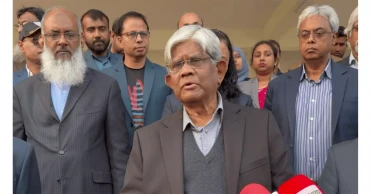
Finance Ministry Adviser Dr. Salehuddin Ahmed on Friday asked government officials to be patient regarding the new pay scale.
He said the pay scale has been prepared after 10 years.
“There are many calculations. A committee has been formed. They are working. After the committee submits its report, the scale will be implemented,” he said.
He added that funding is the main issue and assured that there is no reason to be discouraged.
Dr. Saleh Uddin Ahmed made the remarks while inspecting the Gurudaspur Upazila Mini Stadium in Natore.
He was accompanied by Cabinet Secretary Dr. Sheikh Abdur Rashid, Finance Secretary Dr. Sheikh Khairuzzaman Majumdar, Secretary of the Economic Relations Division Md. Shahriar Kader Siddiqui, and other senior officials.
The finance adviser also said that everyone should vote in favor of referendum.
He noted that there has never been a reform in Bangladesh for the people; changes have always been party-based.
Pay Commission to reveal report date soon, work continues: Dr Salehuddin
He further added, “Through referendum, the political government will gain strength in the future. That is why the government is speaking in favor of public voting.”
Dr. Saleh Uddin Ahmed praised the mini stadium during his visit.
Natore Deputy Commissioner Asma Shahin briefed him about the facilities.
8 months ago