CPD calls for tax justice
CPD calls for tax justice-oriented fiscal framework
Bangladesh's national budget for FY2026-27 lacks a coherent tax justice framework and falls short on progressive taxation, revenue leakage control, and accountable governance, the Centre for Policy Dialogue (CPD) said Thursday.
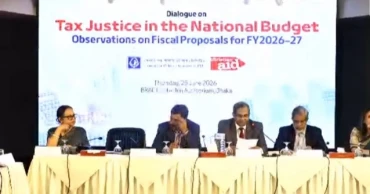
Tamim Ahmed, Senior Research Associate at CPD, presented these findings at a programme titled “Tax Justice in the National Budget: Observations on Fiscal Proposals for FY2026-27” held at the BRAC Centre in the capital.
CPD Research Director Khondaker Golam Moazzem moderated the event organised in partnership with Christian Aid.
The study evaluated the adopted budget against four pillars of tax justice, equitable financing of development, reduced regressivity, elimination of revenue leakage, and accountable governance.
CPD noted that Bangladesh's tax-to-GDP ratio has fallen to the lowest level in South Asia, with the new BNP-led government pledging to raise it to 10 percent in the medium term and 15 percent by 2035.
However, the think tank said a revenue-centric approach without structural reform risks deepening inequality.
CPD estimates Bangladesh lost BDT 226,236 crore to tax evasion and avoidance in FY2022-23 alone, while actual VAT collection stands at only 28-29 percent of its potential.
The presentation flagged that indirect taxes: VAT and consumption-based levies, account for roughly 65-66 percent of total NBR revenue, placing a disproportionate burden on lower-income households.
The budget's reliance on VAT as the single largest revenue source at 38 percent drew particular concern.
While the five-year personal income tax roadmap and the new 35 percent slab for incomes above BDT 35 lakh from FY29 were welcomed as progressive steps, CPD said the current tax-free threshold of Tk 3.75 lakh fails to provide adequate inflation-adjusted relief to low-and middle-income taxpayers.
CPD also criticised the budget's silence on introducing an inheritance tax framework and its failure to reduce the standard VAT rate from 15 percent to a more competitive 10 percent.
On the third pillar, CPD acknowledged positive measures including automated audit selection, mandatory TIN for bank accounts, central data integration linking NBR with NID, banks, and utilities, and the absence of a tax amnesty scheme.
However, it flagged the absence of a comprehensive tax expenditure report, no clear tariff reform roadmap ahead of LDC graduation, no penalties for non-cooperation with NBR during audits, and continued fossil fuel-based tax incentives for power producers.
The legalisation of undisclosed real estate investments was flagged as raising “significant fairness concerns” by potentially rewarding non-compliance.
While praising the separation of revenue policy from administration and the 66 percent increase in NBR's budget allocation, CPD raised accountability concerns.
It noted the absence of nationwide Electronic Fiscal Devices, inadequate attention to digitalisation of associated institutions, and the marginal increase in the Competition Commission's allocation.
CPD recommended indexing income tax thresholds annually to inflation, consolidating the eight-slab VAT structure into a simplified three-tier system, introducing a direct wealth tax, mandating e-invoicing for VAT-registered businesses, and institutionalising a Tax Justice Impact Assessment for every annual budget.
The think tank also urged that the newly created Revenue Policy Division and Revenue Management Division be insulated from political and administrative interference through legal safeguards.
3 months ago

CPD calls for tax justice, FDI reform, review of US trade deal
Centre for Policy Dialogue (CPD) on Saturday urged major reforms in tax collection, business climate, trade deals and foreign investment management, warning that without evidence-based decisions and strong accountability, Bangladesh’s post-election economic transition could be at risk.
CPD said Bangladesh must urgently overhaul its revenue system, ease the cost of doing business, review recently signed trade agreements and strengthen foreign direct investment (FDI) facilitation to ensure sustainable growth and smooth graduation from Least Developed Country (LDC) status.
Presenting the study titled ‘New Government’s Priorities in Addressing Socio-economic Challenges: Introducing Knowledge-based Decision Making in the Executive and Legislative Process’ at its Dhanmondi office, CPD Research Director Dr Khondaker Golam Moazzem highlighted structural weaknesses in Sections 3, 4, 5 and 6 of the report covering revenue mobilisation, business environment, trade policy and FDI.
Tax-GDP Ratio
CPD said Bangladesh’s tax-to-GDP ratio has fallen to approximately 6.8 percent, the lowest in South Asia, significantly weakening fiscal capacity at a time of rising development needs.
The newly elected government has pledged to raise the ratio to 10 percent in the medium term and 15 percent by 2035. But CPD cautioned that revenue sustainability would remain uncertain without prioritising tax justice and plugging systemic leakages.
The study identified ‘leaking revenue’ as the weakest area across all decision-making indicators.
To address regressivity and inefficiency, CPD recommended consolidating the current eight VAT slabs into a simplified three-tier structure: standard, reduced and zero rates, with a long-term transition toward a two-tier system.
It also proposed eliminating tax exemptions for non-essential services, including exclusive clubs and stock market-related entities, and phasing out tax cut incentives for fossil fuel-based power producers.
Mandatory digital tax return submission, establishment of a digital tax dispute resolution system within 30–45 days and performance-based corporate tax incentives were among the key recommendations.
CPD further suggested linking revenue gains from VAT rationalisation to direct transfers for low-income households instead of broad reduced-rate exemptions.
Business Environment
The report noted that Bangladesh’s business environment continues to suffer from transport-logistics bottlenecks, unreliable utilities, regulatory complexity, corruption, weak human capital alignment and fragile banking systems.
It warned that corruption in administrative processes remains the most severe constraint to ensuring an enabling business environment.
Despite digital reforms such as the partial launch of “BanglaBiz” and activation of the Bangladesh Single Window system, CPD found that transparency and accountability remain weak.
The study recommended full backend digital integration across agencies under a unified document management framework to eliminate duplication of business licensing requirements.
It also called for establishing both a Tax Ombudsman and a Banking Ombudsman to address grievances and strengthen institutional accountability.
CPD raises concerns over power overcapacity, pushes for 'no new fossil' fuel policy
In the financial sector, CPD flagged high non-performing loans (NPLs) and limited SME access to financing as major barriers.
Although reforms such as the Bank Resolution Ordinance 2025 and Deposit Protection Ordinance 2025 were introduced, the think tank said credit allocation decisions lack transparency and efficient implementation.
It urged Bangladesh Bank to innovate credit assessment models, develop inclusive SME financing options with lower collateral requirements and exercise caution in interest rate reduction to avoid inflationary pressures.
US-Bangladesh Trade Agreement
CPD raised serious concerns over the recently signed “Agreement on Reciprocal Trade” between Bangladesh and the United States, saying several clauses may restrict Bangladesh’s trade policy autonomy.
The study alleged that the agreement includes discriminatory provisions relating to import licensing, technical standards and digital trade.
According to CPD, Bangladesh would be required to gradually eliminate tariffs on US-origin goods while facing potential additional tariffs if deemed non-compliant.
The report also claimed that Bangladesh would not be allowed to impose digital service taxes on US companies or introduce customs duties on electronic transmissions.
Other provisions cited include restrictions on retaliatory VAT measures, limitations on agreements with third countries that conflict with US standards and preferential access for certain US goods.
CPD warned that such clauses could severely jeopardise Bangladesh’s smooth transition strategy (STS) for LDC graduation, particularly in negotiating balanced free trade agreements (FTAs) and economic partnership agreements (EPAs).
It urged the government to withdraw from the agreement before formal notification exchange and revisit other deals, including the EPA with Japan, particularly provisions related to duty-free LNG imports that may delay energy transition.
FDI Reform
CPD identified six major structural challenges in attracting and retaining foreign investment, including fragmented approvals, policy unpredictability, institutional overlap, slow dispute resolution, land access bottlenecks and weak data systems.
The report said investment approvals remain sequential rather than parallel, even after the launch of BanglaBiz offering over 100 services and fast-track foreign loan approvals up to USD 10 million for export-oriented firms.
CPD recommended mandatory API-based integration among the Bangladesh Investment Development Authority (BIDA), National Board of Revenue, Registrar of Joint Stock Companies, Customs, BEZA and BEPZA to ensure simultaneous processing and real-time tracking.
The think tank called for converting profit repatriation commitments — including the 30-working-day resolution target — into binding legal standards through legislative amendments.
It also proposed designating specialised commercial benches within the High Court within 180 days and establishing a full-fledged International Commercial Court within 24 months.
To enhance transparency, CPD recommended creating a unified national FDI monitoring dashboard linked to the government’s target of raising FDI to 2.5 percent of GDP, with quarterly public reporting.
A national readiness audit of economic zones, including litigation-free land and confirmed utility capacity, should be completed within 180 days, the study added.
Dr Moazzem said that raising tax revenue, reducing business costs, negotiating trade agreements and attracting FDI must be guided by knowledge-based decision-making and parliamentary oversight.
He stressed that without structural reforms in fiscal governance, regulatory transparency and institutional accountability, policy initiatives may remain fragmented and ineffective.
“The new government has a strong electoral mandate. The challenge is to translate it into evidence-based, transparent and accountable decision-making,” he said.
CPD’s findings come as the government prepares to implement its first 180-day priority agenda following the February 12 national election.
7 months ago