US strikes Iran
US strikes Iranian military sites as Kuwait reports drone and missile attacks
The United States has bombed Iranian radar and drone control facilities after Iran shot down a US MQ-1 Predator drone over the weekend, the US military said Monday. Iran confirmed it carried out retaliatory strikes, while Kuwait reported that its air defence systems intercepted incoming drones and missiles.
The back-and-forth attacks underline the fragility of a weeks-long ceasefire in the Iran conflict, which has seen repeated violations despite ongoing diplomatic efforts between Washington and Tehran to extend the truce. Iran has also continued to restrict access through the Strait of Hormuz, disrupting global energy supplies as a significant share of the world’s oil and gas once passed through the key waterway.
At the same time, violence is spreading across the wider region, with Israel expanding its presence in Lebanon beyond the Litani River and Hezbollah continuing drone attacks into Israeli territory.
US says it targeted Iranian military sites
US Central Command said it conducted strikes on Saturday and Sunday near Geruk and on Qeshm Island inside Iran.
It said the action was taken in response to “aggressive Iranian actions,” including the shooting down of a US MQ-1 drone operating over international waters.
According to the statement, US fighter jets destroyed Iranian air defence systems, a ground control station and two attack drones that posed a threat to commercial shipping in the region. No US troops were injured.
The MQ-1 Predator drone has largely been replaced in US Air Force service by the MQ-9 Reaper, though the US Army still operates the older model.
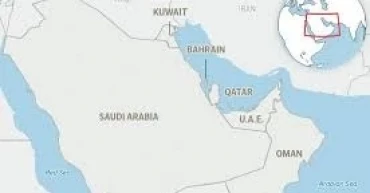
Kuwait reports interception of aerial threats
Kuwait said its air defence forces opened fire early Monday to intercept incoming drones and missiles. Iran’s Revolutionary Guard, quoted by state media IRNA, claimed US forces had struck a telecommunications tower.
The Guard also said it had launched a counterattack, without providing details, likely referring to the reported strike involving Kuwait. Kuwait hosts US Army Central, the forward headquarters of US forces in the Middle East.
Iranian state television later aired footage of missile launches, including one showing a message aimed at the United States and President Donald Trump, stating: “Until the last American soldier leaves the region.”
Ceasefire talks under strain
The latest attacks come despite continued diplomatic efforts to maintain the ceasefire, particularly discussions over Iran’s stockpile of highly enriched uranium. Over the weekend, US forces also targeted a Gambia-flagged cargo ship attempting to break a blockade of Iranian ports.
Although some ships have managed to pass through the Strait of Hormuz, tensions continue to threaten global energy and fertilizer supplies, raising concerns over potential shortages. The Gulf region accounts for around 30% of globally traded chemical fertilizers.
US President Donald Trump met advisers on Friday but has not yet decided on extending the ceasefire and reopening the strait. Iran has said no final agreement has been reached.
In a post on Truth Social, Trump said Iran was interested in a deal, adding: “It will be a good one for the U.S.A. and those that are with us.”
4 months ago
Did Trump need Congress approval to attack Iran?
US President Donald Trump announced the launch of what he called “major combat operations” against Iran, raising renewed debate in Washington over whether the White House needed approval from Congress before carrying out the attacks.
The United States, acting alongside Israel, began large-scale air operations early Saturday under an operation named “Epic Fury”, while Israel has referred to its campaign as “Lion’s Roar”. The strikes came two days after US-Iran talks on Tehran’s nuclear programme ended without agreement and were followed by Iranian retaliatory attacks across the Middle East.
Under the US Constitution, Congress holds the power to formally declare war, but it has not done so in this case. At the same time, constitutional provisions grant the president broad authority to order military action, creating a long-standing grey area that has repeatedly fuelled political and legal debate.
Reactions on Capitol Hill have largely split along party lines. Republicans, who currently control both chambers of Congress, have mostly backed the strikes. House Speaker Mike Johnson said the administration had briefed the so-called “Gang of Eight”, a bipartisan group of senior congressional leaders, ahead of the operation.
Democrats, however, criticised the decision, accusing Trump of launching a war without congressional authorisation. They renewed calls for a war powers resolution that could restrict the president’s ability to use force without explicit approval from Congress, although such a measure is seen as unlikely to pass given limited Republican support.
According to US Central Command, three US service members have been killed in action and five seriously injured during the conflict. Iranian authorities say more than 200 people have been killed and over 700 wounded in air strikes across Iran, including at least 165 people, many of them children, in an explosion at a school in the south of the country.
Iranian missiles have also struck Israel, killing at least nine people in the central town of Beit Shemesh and causing casualties in Tel Aviv, Israeli media reported. Iran has also targeted US-linked facilities and allies in Bahrain, Kuwait, Qatar and the United Arab Emirates, where casualties were reported at airports in Abu Dhabi and Dubai.
Trump has defended the strikes by accusing Tehran of pursuing nuclear weapons, developing long-range missiles and orchestrating attacks through regional proxies. He has also cited past incidents, including the 1979 seizure of the US embassy in Tehran and the 1983 bombing of a US Marine barracks in Beirut, as justification for military action.
The conflict has already claimed senior Iranian leaders. Trump announced that Supreme Leader Ali Khamenei was killed in the strikes, a claim later confirmed by Iranian state media, which declared 40 days of mourning. Trump has said dozens of senior Iranian figures were eliminated in the operation.
US officials have said there are no plans to deploy ground troops in Iran. Instead, the campaign is expected to rely on sustained air and naval operations. The US currently has tens of thousands of troops stationed across the Middle East and has deployed two aircraft carriers to the region.
While Iran denies seeking nuclear weapons, international concern remains high. US and Israeli officials say the operation is aimed at eliminating what they describe as an urgent threat, as lawmakers in Washington continue to debate the limits of presidential war powers and the role of Congress in authorising military action.
With inputs from BBC
7 months ago