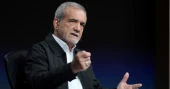
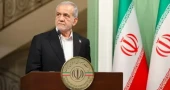
Iranian President Masoud Pezeshkian
PM discusses Middle East tensions, safety of Bangladeshi workers with Iran President
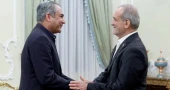
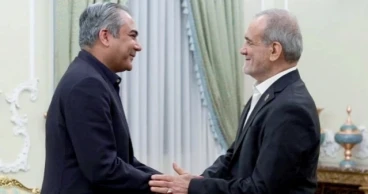
Prime Minister Tarique Rahman has met Iranian President Masoud Pezeshkian and discussed the Middle East conflict and the safety of Bangladeshi workers, while seeking Iran’s cooperation in facilitating the movement of Bangladeshi vessels and containers through the Strait of Hormuz.
The meeting was held on the sidelines of the 81st UN General Assembly in New York on Wednesday.
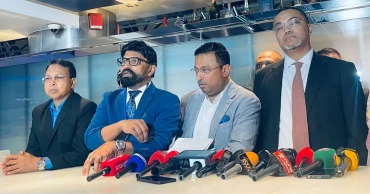
State Minister for Foreign Affairs Humaiun Kobir and Prime Minister’s Adviser Mahdi Amin briefed journalists on the meeting at a press briefing later in the day at the Hyatt Grand Central New York hotel.
Kobir said the Prime Minister called for an early resolution of the conflict through diplomacy, stressing its potential impact on Bangladesh, particularly on Bangladeshi expatriate workers and the country’s energy security.
Bangladesh has a significant number of workers and professionals in the Middle East, and any prolonged conflict in the region could have an impact on the country, he said.
The state minister also said Bangladesh raised the issue of containers and vessels being held up amid the tensions around the Strait of Hormuz and sought Iran’s cooperation in facilitating their safe movement once the situation improves.
“We called for a quick resolution through diplomacy,” he said, adding that the Iranian President listened to Bangladesh’s concerns and took note of them.
Kobir said Bangladesh maintains a neutral position and is prepared to play a constructive role in promoting peace and stability if there is an opportunity.
“Bangladesh can become a soft-medium influence for good, for peace and stability in the world,” he said.
The state minister said Bangladesh has important partners across the Middle East, and some of them have encouraged Bangladesh to use its neutral position to communicate with parties involved in the conflict.
He said Bangladesh does not necessarily need to take a visible mediation role, but can engage as a friend of the region and contribute to peace and stability through diplomatic channels.
“The UN is a neutral venue,” Kobir said, referring to the meeting with the Iranian President at the UN Headquarters.
He said the Prime Minister used the opportunity to discuss both the conflict and Bangladesh’s national interests, including the possible impact of the situation around the Strait of Hormuz on the country’s energy supply and trade.
The state minister said Bangladesh wants an early and peaceful resolution to the conflict through diplomacy, as a prolonged crisis could have wider regional and international consequences.
Mahdi said the meeting also focused on regional stability, the safety of Bangladeshi workers in the broader Middle East and issues related to regional and international peace.
He said the Prime Minister emphasised Bangladesh’s national interests, particularly the safety and well-being of its expatriate population.
The meeting took place as part of Prime Minister Tarique Rahman’s engagements on the sidelines of the 81st UN General Assembly.
17 days ago
Iran ready to deepen cooperation with Pakistan: President
Iranian President Masoud Pezeshkian on Tuesday said Tehran is ready to expand and deepen cooperation with Pakistan in various fields.
He made the remarks during a meeting with visiting Pakistani Interior Minister Mohsin Naqvi, highlighting the “excellent relations and deep bonds” between the two countries, according to a statement on the Iranian president’s official website.
Pezeshkian said Iran and Pakistan share strong historical, cultural and people-to-people ties. He also welcomed Pakistani officials’ efforts to strengthen solidarity and relations with Iran.
The Iranian president said Tehran is willing to further expand ties with Pakistan in areas of mutual interest and create opportunities for joint cooperation.
He added that stronger bilateral ties and closer cooperation would help protect the interests of both countries and contribute to regional peace, stability and security.
Naqvi said his visit to Tehran was aimed at following up on agreements reached during a recent visit to Pakistan by Iranian Interior Minister Eskandar Momeni.
Describing Pakistan-Iran ties as “strong, age-old and unbreakable,” Naqvi said Islamabad is committed to further expanding relations with Tehran.
The Pakistani minister arrived in Tehran earlier Tuesday and was received by his Iranian counterpart. Later, he met Iranian Foreign Minister Seyed Abbas Araghchi and discussed diplomatic and bilateral issues, Iran’s official news agency IRNA reported.
In recent months, Pakistan has played a mediating role between Iran and the United States, helping the two sides exchange messages and pursue peace efforts.
With Islamabad’s mediation, Tehran and Washington signed a memorandum of understanding in June aimed at ending their conflict.
1 month ago
Tehran threatens ‘strong’ response if key infrastructure or economy targeted
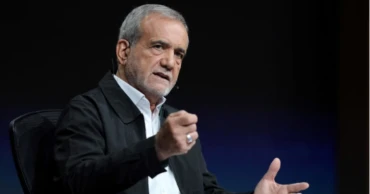
Iranian President Masoud Pezeshkian has warned that Tehran will respond “strongly” if its infrastructure or key economic centres are targeted.
He also echoed a message repeatedly voiced by Iranian military and political leaders, urging regional countries not to allow hostile forces to use their territory. “If you want development and security, don’t let our enemies run the war from your lands,” he said.
Iran maintains that its operations in the region are aimed solely at U.S. interests. However, officials from Gulf nations have consistently rejected that claim, alleging that Iranian strikes have also hit civilian infrastructure, including hotels, airports and residential areas.
Source- Al Jazeera
Russia is sending upgraded drones used in the Ukraine war to Iran, officials say
6 months ago
Iran sets conditions to end war with US, Israel
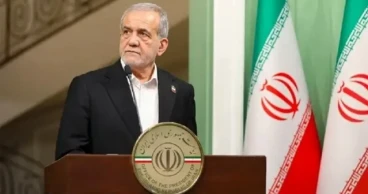
Iranian President Masoud Pezeshkian on Wednesday outlined several conditions for ending the ongoing conflict with the United States and Israel, saying Tehran is committed to regional peace but expects its rights to be recognised.
In a post on social media platform X, Pezeshkian said the conflict could only end if Iran’s “legitimate rights” are acknowledged, compensation is paid for damages and strong international guarantees are provided to prevent future attacks.
Earlier, Iran’s armed forces warned of a major retaliation if the United States carried out strikes on Iranian ports.
Abolfazl Shekarchi, spokesperson for Iran’s armed forces, told state-run IRIB TV that no port, economic centre or location in the Persian Gulf would be beyond Iran’s reach if Washington attacked Iranian port facilities.
His comments came after the US Central Command posted a warning on its Persian-language account on X urging civilians in Iran to stay away from port areas where Iranian naval operations were taking place.
The latest escalation follows joint US-Israeli attacks launched on Feb 28 targeting Tehran and several other Iranian cities. The strikes killed Iran’s then Supreme Leader Ali Khamenei, along with senior military commanders and civilians.
Iran later retaliated by launching multiple missile and drone attacks on Israeli and US-linked targets across the Middle East.
6 months ago