Education reform
Indian police hospitalize activist after health worsens during hunger strike over education reform
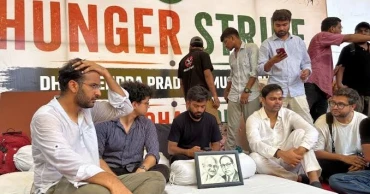
Indian police on Saturday shifted prominent activist Sonam Wangchuk to a hospital after his health deteriorated during a 20-day hunger strike demanding education reforms.
Security was tightened around Jantar Mantar in New Delhi, the city's designated protest site, where Wangchuk had been staging the hunger strike with students and activists from the Cockroach Janta Party.
The protesters are demanding the resignation of Education Minister Dharmendra Pradhan following allegations that examination papers were leaked before tests. They are also calling for major reforms to the country's examination system and compensation for families of students who died by suicide following the alleged leaks or exam results.
Wangchuk, a 59-year-old engineer and education reform campaigner, has become the face of the movement, which emerged in May after Supreme Court Chief Justice Surya Kant compared some unemployed young people to "cockroaches" during a court hearing on an unrelated matter.
Supporters later adopted the term as a symbol of resilience, launching a satirical political movement that quickly gained more than 21 million followers on Instagram.
Delhi Police said Wangchuk was taken to hospital on medical advice and under a court directive after his condition worsened due to the prolonged hunger strike.
Police said a brief scuffle broke out when some protesters tried to stop the authorities from moving him to hospital.
However, the Cockroach Janta Party claimed in a social media post that Wangchuk had been "forcefully abducted" by the government without his or his family's consent.
Authorities deployed additional police and paramilitary personnel and set up extra barricades around the protest site. Police said the increased security was a precautionary measure and urged protesters to cooperate with law enforcement.
3 months ago
Education reform needed to build merit-based Bangladesh: Mahdi Amin
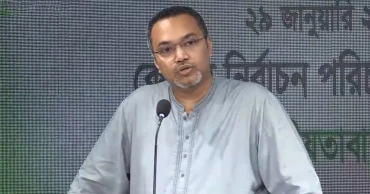
Prime Minister’s Adviser on Education, Overseas Employment and ICT Mahdi Amin on Monday stressed the need for major reforms in the country’s education system to build a merit-based Bangladesh, saying the current structure still contains deep inequalities.Speaking at a discussion on education sector reforms based on election pledges, organised by the Citizens’ Platform in Gulshan, Mahdi said the admission system in schools should gradually return to an exam-based process instead of the current lottery system.“Many schools have said they do not like the lottery system. It is a black box,” Mahdi said, adding that policymakers have already discussed moving back to an exam-based admission process.
BNP set to secure two-thirds majority, says Mahdi AminHe said efforts are underway to revise the education curriculum before January next year.“The curriculum has been politicised. We want to develop it in a modern way, redesigning where necessary,” he said, urging civil society to maintain pressure so the reform process remains free from political influence.Mahdi said the main objective of education should not be limited to obtaining certificates but should also focus on building capacity, technical skills and entrepreneurial ability. “We want an education system that enables young people to become entrepreneurs through self-employment and to qualify for jobs at home and abroad.”He also said Prime Minister Tarique Rahman has emphasised expanding technical and vocational education. Under the proposed plan, technical and vocational elements would gradually be introduced from Class Six theoretically and from Class Eight with practical components, making at least one technical or vocational subject mandatory alongside science, arts or commerce streams.Mahdi said the government is also planning to introduce third-language learning in schools to enhance overseas employment opportunities. Countries including Japan, China, South Korea, Italy, France and Germany have shown interest in supporting the initiative, possibly by sending teachers or providing technical assistance through their embassies.Initially, specific foreign languages may be introduced in selected districts before integrating them across the national education system, he added.At the event, State Minister for Primary and Mass Education Bobby Hajjaj said the government plans to gradually introduce a midday meal programme in all schools across the country. “The programme will begin with government primary schools at the upazila level and will then be expanded step by step to cover all schools nationwide.”He also said the government is working towards introducing a single curriculum framework to ensure that students from Bangla, English and Ebtedayee streams achieve comparable competencies after completing 12 years of education.The state minister added that steps are being taken to incorporate culture and sports into the national curriculum, with work on the initiative expected to begin after June and implementation targeted within two to three years.Earlier in the discussion, a study presented by Towfiqul Islam Khan, Additional Director (Research) at the Centre for Policy Dialogue (CPD), warned that Bangladesh is falling behind in ensuring universal access to quality primary and secondary education despite progress in enrolment.The analysis showed that boys’ primary school enrolment fell from 98 percent in 2023 to 91 percent in 2024, marking the sharpest one-year decline on record.At the secondary level, girls increasingly outnumber boys, while the transition rate from primary to secondary education has also declined.According to the study, the share of students moving from primary completion to secondary school dropped from about 95 percent in 2010 to 84.2 percent in 2024.The transition rate from Grade 5 to Grade 6 fell sharply to 74.99 percent in 2022, meaning roughly one in four students did not continue to secondary education.The presentation also highlighted a rise in child labour, which increased from 6.8 percent in 2019 to 9.2 percent in 2025, suggesting that growing household economic pressure may be pushing many boys out of school.The study further warned that many students complete primary education without acquiring basic learning skills, making it difficult for them to succeed in secondary education.It called for a renewed education agenda focusing on stronger learning outcomes, skills development and better alignment between education and labour market demands.
7 months ago