Adviser Titumir
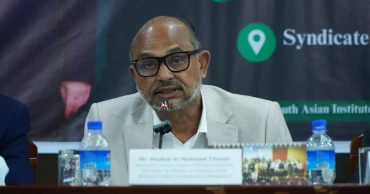
Partnerships should reinforce Bangladesh's national priorities: Adviser Titumir
Prime Minister’s Finance and Planning Adviser Dr Rashed Al Mahmud Titumir on Sunday said partnerships are most meaningful when they reinforce national priorities, placing Bangladesh's development and people's welfare at the centre of every collaboration.
Referring to the principle of “Bangladesh First”, he emphasised that Bangladesh must pursue its own self-reliant development journey while engaging with China on the basis of mutual respect, national interest, and economic sovereignty.
He was speaking as the chief guest at a seminar organised by the South Asian Institute of Policy and Governance (SIPG) at North South University (NSU).
The seminar, titled “Bangladesh-China Relations: Enhanced Trust and New Direction”, brought together policymakers, diplomats, scholars, China experts, media representatives, faculty members, and students to discuss how Bangladesh could transform the renewed momentum from Prime Minister Tarique Rahman’s recent Beijing visit into concrete gains in diplomacy, trade, connectivity, education, technology, and regional cooperation.
Dr Titumir welcomed Chinese partnerships in multimodal transportation, the Chinese Economic Zone in Chattogram, Mongla Port expansion, and the proposed Kunming-Chattogram connection, while calling for deeper society-to-society cultural exchanges.
Foreign Secretary Asad Alam Siam reflected on the positive trajectory of Bangladesh-China relations and highlighted recent milestones, including agreements, protocols, media cooperation, and collaboration in agriculture, water security, supply chains, technology, and multilateral forums.
He stressed that the real task ahead was to convert commitments and investments into high-impact projects backed by strong institutional accountability and aligned with Bangladesh’s national interest.
The seminar also discussed the proposed Bangladesh-China-Myanmar connectivity framework, BCM+I, the Teesta and northern river management issues, the Rohingya crisis, Myanmar’s instability, Bay of Bengal geopolitics, Indo-Pacific competition, and Bangladesh’s need to avoid overdependence on any single partner.
2 months ago

Titumir for three-tier revenue reform, warns of ADP operational spending imbalance
Prime Minister’s Adviser on Finance and Planning Rashed Al Mahmud Titumir on Wednesday said three major reform initiatives have been launched in the country’s revenue system, asserting that reducing tax evasion, tax exemptions and tax fraud will automatically boost revenue collection.
He made the remarks while addressing a dialogue on the proposed national budget for fiscal year 2026-27, jointly organised by the Metropolitan Chamber of Commerce and Industry (MCCI) and the Policy Research Institute (PRI) at the MCCI headquarters in Gulshan.
PRI Director Ahmad Ahsan presented the keynote paper titled "Macroeconomic Outlook and Budget Priorities: Stability as the Foundation for Restoring Growth" at the event. MCCI President Kamran T Rahman delivered the welcome address, while PRI Chairman Dr Zaidi Sattar and MCCI Vice President Habibullah N Karim also spoke.
Outlining the government's economic strategy, Titumir said Bangladesh is pursuing a three-phase recovery plan: Recovery, Restoration, and Reconstruction for Acceleration, with emphasis on consumption, investment, public expenditure and export diversification.
On fiscal reform, he said separate task forces are now operating in the income tax, customs and VAT sectors, each guided by monthly work plans and milestone targets, with progress reviewed every month.
The adviser acknowledged that revenue data presented in the past often did not reflect ground realities, and said efforts are underway to bring greater transparency to fiscal reporting.
He warned against the growing imbalance between operational and development spending, noting that while recurrent expenditure has been rising rapidly, the ADP or capital expenditure has not kept pace, a trend he described as a long-term challenge.
Criticising the slow pace of project implementation, Titumir said the country currently has around 1,300 projects at various stages of execution, some running for 12 to 14 years with multiple revisions.
He announced plans to introduce a dashboard-based real-time monitoring system for development projects and also emphasised implementing an open data policy, saying making BBS data and other institutional data publicly accessible will improve transparency in policymaking.
In his keynote presentation, Ahmad Ahsan described the FY27 budget as “ambitious, imaginative, and broadly inclusive”, essentially a budget for everybody, but raised significant concerns about the macroeconomic framework underpinning it.
He noted that the domestic economy is exhibiting stagflationary signs, with private investment growth turning sharply negative for the first time in decades, and warned that the current slowdown is not a one-year dip but “the latest, sharpest leg of a longer downturn.”
Ahmad Ahsan said the budget's revenue projections appear “out of norm,” noting that while the budget introduces several innovative tax policy measures, including mandatory TINs and BINs, turnover taxes for small businesses, quarterly e-VAT submissions and duty reductions on solar, EVs and semiconductors, it lacks high-impact reforms such as a unified VAT rate or a reduction in tax expenditures that could significantly improve compliance.
On foreign financing, he said the budget targets a gross external inflow of Tk 1,558 billion, some 89 percent above what FY26 actually delivered, calling the projection overly optimistic given fiscal stress in high-income countries and the FY26 pattern of significant underperformance against targets.
The PRI director urged the government to prepare a credible “Plan B”, a mid-term revised budget, with a clearly prioritised core expenditure package to be protected if revenues and foreign financing fall short.
The PRI paper flagged major unrecognised contingent liabilities in the energy and banking sectors. Ahmad Ahsan said the off-budget fuel import exposure through BPC and Petrobangla, estimated at around US$ 12 billion annually, remains entirely outside the fiscal framework.
On banking, he said the 2026 asset quality reviews put the true contingent liability at Tk 7.40 lakh crore, roughly 13.7 percent of GDP and about 18 times the Tk 40,000 crore allocated for bank recapitalisation this year, with no costed multi-year resolution framework in the budget.
Ahmad Ahsan also called for addressing Bangladesh’s persistent anti-export bias, particularly in light engineering, agro-processing, pharmaceuticals and leather goods, noting that the bias is worst exactly where diversification is most needed.
He drew comparisons with Vietnam's success in attracting export-oriented FDI as a model Bangladesh should emulate.
On public spending, the PRI director stressed the need to strengthen expenditure monitoring institutions, including giving the Implementation Monitoring and Evaluation Division (IMED) real enforcement powers, modernising BBS data systems, and cutting the roughly eight-month lag in monthly fiscal reporting to enable mid-year course correction.
He also proposed a public works programme targeting light infrastructure, upazila and rural roads, canal cleaning and sewage clearance to generate productive employment for several hundred thousand workdays while yielding strong economic returns.
4 months ago
Bangladesh now most suitable for US investment: Adviser Titumir
Prime Minister’s Adviser on Finance and Planning Dr Rashed Al Mahmud Titumir has described Bangladesh as the most effective and suitable destination for US investors.
He made the remarks while addressing a round-table discussion organised by the Business Council for International Understanding (BCIU) in Washington, DC, on Thursday as the chief guest.
State Minister for Power, Energy and Mineral Resources Aninda Islam Amit attended the programme as a special guest, according to the Press Wing of the Bangladesh Embassy in Washington.
The discussion provided an opportunity for US business leaders to engage directly with a senior member of the government of Bangladesh on the country's economic outlook, reform priorities, investment climate, and efforts to strengthen trade and investment ties with the US, according to the BCIU.
In his speech, Titumir said Bangladesh is now governed by a democratic administration, led by Prime Minister Tarique Rahman.
He added that citizens have placed their trust in the BNP, continuing the legacy of Shaheed President Ziaur Rahman and former Prime Minister Begum Khaleda Zia.
“Prime Minister Tarique Rahman is working responsibly to fulfil public trust. Bangladesh is now a very effective and suitable country for US investors,” the adviser said.
State Minister Amit said Bangladesh has a large workforce and the government is taking initiatives to ensure energy security.
He also said efforts are underway to import LPG from the US, adding that energy stability is being ensured for investors.
4 months ago
Govt eyes investment-driven growth to boost jobs, public financing: Adviser Titumir
Prime Minister’s Adviser on Finance and Planning Prof Rashed Al Mahmud Titumir on Monday said the government aims to ensure that investment translates into production, production into employment, and employment into a stronger tax base capable of financing public goods.
“We would like to see improvement in terms of Japanese average investment per country. If you really look at, there is a scope for improvement in case of Bangladesh,” he said, noting that official development assistance (ODA) has increasingly become intertwined with geopolitics.
The economist said they have seen evolving strategy around ODA. “Our government wants to see a change in the model. That's where Japan can play an active role,” he said, adding that they want to see that Japan is moving from ODA.
Govt to tackle crisis by boosting revenue, not borrowing: Adviser Titumir
The Adviser made the remarks while speaking at a commemorative event for Economic Partnership Agreement (EPA) with Bangladesh.
Executive Chairman of the Bangladesh Investment Development Authority (BIDA) Ashik Chowdhury, Japanese Ambassador to Bangladesh Saida Shinichi, Head of the Economic Section at the Embassy of Japan in Bangladesh Yutaro Mochida, Deputy Director-General (Ambassador), the Ministry of Foreign Affairs of Japan Izuru Kobayashi (online) also spoke at the event.
The event was hosted by the Embassy of Japan in Bangladesh and Japan External Trade Organization Dhaka Office (JETRO Dhaka) while it was supported by Japanese Commerce and Industry Association in Dhaka (JCIAD/Shoo-Koo-Kai) and Japan Bangladesh Chamber of Commerce & Industry (JBCCI).
Prof Titumir said they need collaboration and cooperation from the private sector joint venture companies and the government officials.
“I am expecting that in the future summit meeting between the Japanese Prime Minister and the Prime Minister of Bangladesh, we would see an epoch-making doable but future oriented steps,” he said.
The Adviser said they have seen Japan helping South Korea, Singapore, China and that collaboration is unique. “That's what we really want to have beside the official development assistance.”
He said they would like to increase the trade between the two countries but they would really like to see that Japan is investing in manufacturing.
The Adviser said everything has become geo-economics and geopolitics and there are discussions and there are narratives and Japan could lead Bangladesh in that area where they can see that risk are shared.
Ashik Chowdhury said they feel very confident that the implementation of the Economic Partnership Agreement (EPA) between Bangladesh and Japan will still become a benchmark for the country.
“At the same time, now we will be able to negotiate multiple EPAs in the next three to five years. But for the Japanese investors, I hope that the EPA really shows our intent that we are open to business and we really believe in the Japanese investment story,” he said.
Ashik said they really need to move away from the aid story to investment story. “We've always been talking about the aid story but now it's about investment and we generally want to show our intent that we are open to business to our Japanese friends.”
Japanese Ambassador Saida appreciated the new government’s ‘well-conceived plan’ which, in his interpretation, consists of a reconciliation to break the old time cycle, restoration of law and order, and economic growth through enhanced investment.
“All these will positively affect investors' minds and the prerequisite of accelerating economic growth through more FDIs,” he said, reiterating Japan’s ‘true appreciation’ for the peaceful elections which Bangladesh has achieved February this year and new administration's well-conceived plan.
The Ambassador said Bangladesh and Japan have shared a long-standing friendship since your independence. “As your faithful and dedicated development partner, Japan has consistently supported Bangladesh as a nation irrespective of its ruling party.”
He said this cooperation has evolved into today's strategic partnership founded on trust and shared values.
The Ambassador recalled that before signing the EPA, some critics were seen in the Bangladesh press. “I thought in my mind at the time that they might be looking at as long as three years, maybe a little bit short cycle.”
6 months ago