Institute for Energy Economics and Financial Analysis
Bangladesh’s energy import dependence jumps to 62.5%, power costs rise 83%: IEEFA
Bangladesh’s primary energy imports rose from 47.7% to 62.5% in four years, exposing its vulnerability to the volatile international fossil fuel market and raising the power generation cost by 83%, according to a new report by the Institute for Energy Economics and Financial Analysis (IEEFA).
Apart from expensive fossil fuels and depreciation of the Bangladeshi Taka (BDT) against the United States Dollar (USD), large capacity payments from low demand growth significantly influenced the rising power costs, according to ‘Fostering Bangladesh’s energy transition’, it said.
Analysing data from FY2020-21to FY2024-25, the report finds that a surge in the average coal price by 290% between FY2020-21 and FY2022-23, along with an expensive oil price for a brief period and a sharp currency depreciation increased Bangladesh’s power generation cost drastically.
However, despite 59.7% fall in coal prices as compared to FY2022-23, and oil prices remaining low during the time, generation cost did not reduce in FY2024-25.
“The average capacity payments of approximately BDT9.5/Kilowatt hour (kWh) (USD0.077/kWh) and BDT5.9/kWh (USD0.048/kWh) paid to private oil- and coal-fired plants, respectively, in FY2024-25 raised overall generation costs,” said Shafiqul Alam, the report’s author and lead energy analyst at IEEFA.
“Further, gas supply shortage increased cost—plants with load factor under 25% generated power at BDT16.85/kWh (USD0.137/kWh) while plants operating at around 75% load factor did so at a cost of BDT6/kWh (USD0.049/kWh).”
In addition, declining domestic gas production means that Bangladesh needs to import expensive liquefied natural gas (LNG).
The report estimates that the country could pay a subsidy of USD1.07 billion (BDT131.34 billion) on account of LNG imports from April to June 2026. This estimate is based on the import trend from April to June 2025 and the current import price of about USD20 per million British thermal units (MMBtu), excluding regasification and terminal costs.
Additionally, the share of renewable energy remains just 2.3% of grid-based power generation, far below the global average of around 33.8%, limiting its ability to hedge against the volatile prices in international fossil fuel markets.
Currently, however, high import duties are levied on distributed renewable energy (DRE) systems. The report estimates that a combined rooftop solar capacity of 100 megawatts (MW) will save more than 30 times the one-off import duties by reducing furnace oil imports over the lifecycle. Hence, it calls on the government to offer a duty waiver.
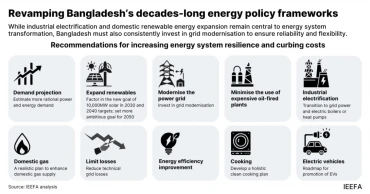
“The solutions to Bangladesh’s persistent problems lie closer to home, such as in expanding domestic renewable energy at scale while limiting fossil fuel-based plants to contain overcapacity. Given the requirement of spinning reserve and grid balancing, the government may consider retaining part of the operational oil-fired plants in its ownership to avoid the hefty capacity payments once their contracts expire,” said Alam.
To reduce its gas demand, Bangladesh could tap into the cost-competitive hydropower potential of the Bangladesh-Bhutan-India-Nepal (BBIN) framework.
A combined hydropower capacity of 6,000MW from Nepal and Bhutan for the high-demand March-September period will likely help the country reduce annual gas consumption by up to 257 billion cubic feet (Bcf) post 2030.
The report also seeks to draw policymakers’ attention towards the need to keep the open access cost of renewable energy projects under Corporate Power Purchase Agreements (CPPAs) at a minimum.
This would enable the apparel sector and corporates to decarbonise their operations as part of their environmental, social, and governance (ESG) targets.
While power utilities fear loss of revenue due to such projects under the CPPA, the analysis by IEEFA shows that electricity consumption in industries increased by 4.8% in FY2024-25.
“BPDB recorded revenue shortfalls of BDT556.6 billion (USD4.53 billion) in FY2024-25.
The West Asia conflict will likely add to the financial stress of other key energy sector utilities. Ultimately, the pathway to energy transition hinges on prudent policy decisions about implementing realistic targets on the ground supported by a favourable ecosystem, thereby minimising the country’s continued reliance on imported fossil fuels and high subsidies,” said Alam.
5 months ago