Thucydides’s trap
Explainer: What is the Thucydides trap, and how does it apply to the US-China relationship?
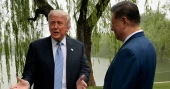
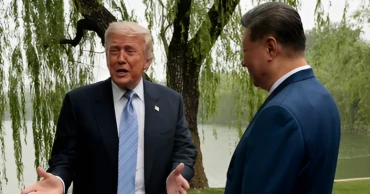
As Xi Jinping and Donald Trump began their much-talked about summit in Beijing on Thursday, the Chinese president announced, in his opening remarks: “The world has come to another crossroads.”
He then posed the question: “Can China and the United States transcend the so-called ‘Thucydides’s trap’, and forge a new paradigm for major-power relations?”
Thucydides was an ancient Athenian historian and military commander, who wrote a history of the Peloponnesian War in ancient Greece, a decades long conflict that erupted between Athens and Sparta in 431BC.
Trump says looking forward to hosting Xi in Washington, D.C.
In foreign policy commentary, the ‘Thucydides’s trap’ (or simply Thucydides trap) refers to the idea that when a rising power threatens to displace an established one, the result is often, indeed ‘inevitably’ war.
“It was the rise of Athens and the fear that this instilled in Sparta that made war inevitable,” Thucydides wrote in his book, “The History of the Peloponnesian War.”
Writing for the Financial Times in 2012, the American political scientist Graham Allison said that “the defining question about global order in the decades ahead will be: can China and the US escape Thucydides’s trap?”
Allison expanded on the idea further in his 2017 book “Destined for War: Can America and China Escape Thucydides’s Trap?” which argued that the two countries were on a collision course for war.
Xi was an early adopter of the idea, and records exist of him referencing Thucydides’s trap as far back as 2013 - just a year on from Allison’s formulation, which cast China as Athens, challenging the US as a contemporary Sparta.
“We need to work together to avoid Thucydides’s trap, which is a destructive tension between emerging powers and existing powers, or between two existing powers,” Xi told a meeting of international leaders, according to TIME.
The Chinese leader is on record referencing the same in 2015, 2023, and 2024. Chinese diplomats have similarly echoed him numerous times.
Writing in Dhaka Courier in 2020, ex-adviser on foreign affairs Dr Iftekhar Ahmed Chowdhury, one of Bangladesh's most accomplished diplomats, said that "Chinese leaders often cite Thucydides, but their reading of him is that the 'Thucydides Syndrome' was one that warned against war as a result of miscalculations between powers."
Xi at one point of the summit warned Trump that any missteps on the issue of Taiwan could push their two countries into “conflict”.
“The Taiwan question is the most important issue in China-US relations,” Xi said, of the self-governing island that China claims as its own.
“If mishandled, the two nations could collide or even come into conflict, pushing the entire China-US relationship into a highly perilous situation,” he added.
The so-called “trap” in the concept is to give in to the inevitability of war. In order to avoid a destructive outcome, great (and maybe declining) powers must work to settle their disputes in other ways, and so “avoid” or “overcome” or “transcend” Thucydides’s trap.
Responding on social media to Xi’s remarks, Trump recognised that his Chinese counterpart had “very elegantly referred to the United States as perhaps being a declining nation”.
True to form though, the US president refused to acknowledge Xi could’ve meant the US under his watch.
“Two years ago, we were, in fact, a Nation in decline,” Trump posted on social media early on Friday.
“Now, the United States is the hottest Nation anywhere in the world, and hopefully our relationship with China will be stronger and better than ever before!”
4 months ago