study by Centre for Policy Dialogue
Fossil fuels swallow 80% of Bangladesh's power budget, renewables lag far behind: CPD
Renewable energy (RE) accounts for only 5 percent of Bangladesh's revised development budget allocation for the power and energy sector in the current fiscal year, while fossil fuel-based infrastructure continues to absorb nearly 80 percent of the allocation, according to a new study by the Centre for Policy Dialogue (CPD).
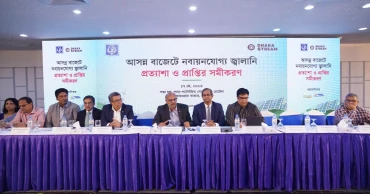
The findings were presented Sunday at a city hotel during a CPD programme titled "Renewable Energy in the Upcoming Budget: Expectations and Reality."
Prime Minister's Adviser on Finance and Planning Rashed Al Mahmud Titumir attended as chief guest. The session was moderated by CPD Research Director Khondaker Golam Moazzem, and the paper was presented by Programme Associate Md. Khalid Mahmud.
The study, titled "Renewable Energy in the National Budget 2026-27: Overshadowed by Fossil Fuels?", found that renewable energy projects account for only 3 percent of the total power and energy project budget and receive a mere 5 percent of the revised FY2026 allocation, amounting to BDT 795 crore, while fossil fuel-based projects command 87 percent of the total project budget and 79 percent of actual allocation.
Bangladesh has spent over BDT 1,474 billion subsidising fossil fuel-based power generation between FY2020-21 and FY2024-25, the study noted. The subsidy burden surged to BDT 620 billion in the revised FY2024-25 estimate, against an expected BDT 350-370 billion for the current year.
Bangladesh provides the highest energy subsidy as a share of the sector budget, around 34 percent, among selected Asian countries, the paper said.
The study also flagged that the FY2025-26 budget omitted a BDT 100 crore renewable energy allocation that had been included in the previous fiscal year, and introduced no new incentives for solar or other clean energy technologies.
Bangladesh's total installed renewable energy capacity currently stands at approximately 1,745 MW, with solar photovoltaic dominating at 83 percent of the total. The share of renewables in the country's total installed capacity remains at just 5.39 percent. The compound annual growth rate of renewable capacity from 2016 to May 2026 was recorded at 15.78 percent.
On the private sector front, the study noted that while 168 MW of solar projects were completed in FY2024-25, some 321 MW are currently under construction and over 5,254 MW remain in the tendering or planning phase, raising concerns about the pace of the procurement process.
Bangladesh floated four tender packages for a combined 5,238 MW of renewable capacity between December 2024 and March 2025, but the rounds drew limited investor interest, requiring repeated deadline extensions. The government has also cancelled 31 letters of intent covering 3,287 MW of capacity, projects worth around USD 6 billion in foreign investment, triggering 11 High Court petitions.
The CPD study identified high import duties as a key barrier, with lithium-ion batteries facing a total tax incidence of 61.80 percent and solar inverters facing 28.73 percent. It called on the National Board of Revenue (NBR) to adopt a full-chain duty waiver across the entire solar value chain rather than selective relief on individual components.
Among its recommendations, the study urged the government to establish a standalone Renewable Energy Development Fund with ring-fenced allocations, create a dedicated Ministry of Renewable Energy, restructure SREDA into a statutory regulatory body with enforcement authority, and adopt a rolling three-year RE budget commitment to give investors long-term fiscal visibility.
The paper also recommended a phased, legislated reduction in fossil fuel subsidies tied to verified renewable capacity additions, introduction of a direct RE promotion subsidy, and a dedicated budget allocation for the National Rooftop Solar Programme launched in July 2025. The country has an estimated rooftop solar potential exceeding 100 GWp and a gross wind energy potential of over 30 GW.
To meet the government's target of generating 10,000 MW from solar by 2030, the study said Bangladesh would need to install approximately 1,662 MW annually from January 2026 onward, a pace that would require a substantially different budgetary posture than currently on offer.
4 months ago