Armenia heads to election
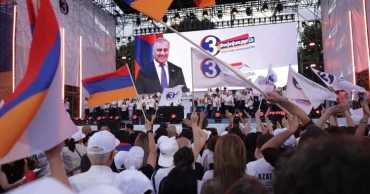
Armenia heads to crucial election amid tug-of-war between Russia and the West
Armenia goes to the polls on Sunday in a high-stakes parliamentary election widely seen as a decision on the country’s geopolitical direction, as Prime Minister Nikol Pashinyan pushes for closer ties with the European Union and the United States despite long-standing links with Russia.
Analysts say Pashinyan’s Civil Contract party is still the frontrunner to retain control of parliament. However, several opposition groups campaigning on pro-Russia platforms have turned the vote into a broader contest over Armenia’s international alignment.
In the run-up to the election, Russian President Vladimir Putin and other officials have warned that deeper cooperation with the EU could severely damage Armenia’s economy by disrupting trade with Moscow and its allies.
“This is the first time in Armenia’s history where geopolitical orientation has become a decisive issue,” said analyst and former MP Mikayel Zolyan, speaking from Yerevan. “Armenia was long assumed to be within Russia’s sphere of influence. Now that is being questioned.”
Strained ties after Karabakh conflict
Relations between Yerevan and Moscow deteriorated sharply after Azerbaijan took full control of the Karabakh region in 2023. Armenia had supported ethnic Armenian forces there for decades in a long-running conflict.
Armenian officials accused Russian peacekeepers of failing to prevent the Azerbaijani advance. Russia rejected the claim, saying its forces had no mandate to intervene, as it was preoccupied with the war in Ukraine.
“The idea of Russia as Armenia’s security guarantor collapsed after the Karabakh war,” said Alexander Iskandaryan, director of the Caucasus Institute in Yerevan.
Since then, Pashinyan has taken cautious steps away from Moscow, including joining the International Criminal Court in 2023 and suspending participation in the Russia-led Collective Security Treaty Organization in 2024.
Armenia has also announced its intention to pursue EU membership and hosted the European Political Community summit in Yerevan in May.
A strong electoral mandate for Pashinyan would allow him to continue this Western shift and advance a potential peace deal with Azerbaijan.
Western support and incentives
Western countries have highlighted potential benefits of closer cooperation.
In August, US President Donald Trump hosted Pashinyan and Azerbaijani President Ilham Aliyev for an agreement aimed at ending decades of conflict, including plans for a new transit corridor linking Azerbaijan to its Nakhchivan exclave. A separate February agreement could allow a US firm to build a new nuclear reactor in Armenia.
European Commission President Ursula von der Leyen has also pledged EU support for Armenia’s energy sector and growing digital industry.
Trump has publicly backed Pashinyan, calling him a “great friend” and praising his leadership in making Armenia “strong, wealthy, and very secure.”
Opposition favors closer Russia ties
Armenia’s opposition remains largely pro-Russia and critical of normalizing relations with Azerbaijan. Several leaders have called for Pashinyan’s resignation over the loss of Karabakh.
A total of 19 political forces, including two blocs and 17 parties, are contesting the election.
Pashinyan’s main challenger is the Strong Armenia Party, which advocates closer economic ties with Russia and accuses the prime minister of risking conflict with Moscow. It is led by Armenian-Russian billionaire Samvel Karapetyan, who is currently on trial over alleged calls to overthrow the government. He denies the charges.
Former President Robert Kocharyan also leads the Hayastan bloc, which accuses Pashinyan of damaging ties with Russia.
Moscow’s economic pressure
Russia, which maintains a military base in Armenia, has warned that a Western pivot could carry serious political and economic consequences.
Putin has compared Armenia’s path to Ukraine’s, suggesting EU aspirations could trigger instability. Russian officials have also tightened import rules on Armenian goods, including flowers, wine, cognac, vegetables and dried fruits.
Armenia’s membership in the Russian-led Eurasian Economic Union has also come under review, with discussions of possible suspension.
At a recent meeting in Kazakhstan, Russia and its allies even called for Armenia to hold a referendum on whether it should remain in the bloc or pursue EU membership. Pashinyan has rejected the idea.
Government data shows 38% of Armenia’s exports in 2025 went to Eurasian Economic Union countries, mostly Russia, while only 8% went to the EU.
In response to Moscow’s measures, the EU announced a 50 million euro support package for Armenia, with von der Leyen accusing Russia of “weaponizing” economic ties.
Growing uncertainty and interference concerns
Russia’s influence remains strong, particularly through energy supplies and infrastructure control, including discounted gas exports.
“Armenia cannot realistically escape Russian influence in the short term,” analyst Zolyan said.
Meanwhile, civil society groups have raised concerns about Russian-backed disinformation campaigns ahead of the vote. Moscow denies any interference.
Daniel Ionnisyan of the Union of Informed Citizens told the Associated Press that monitoring groups have documented suspected Russian-linked activity, including social media manipulation, cyberattacks, vote buying and pressure on journalists.
Similar concerns were raised by a delegation from the Parliamentary Assembly of the Council of Europe, which reported evidence of foreign interference aimed at influencing Armenia’s political process.
“These hybrid tactics aim not only to shape public opinion but to secure long-term geopolitical leverage over Armenia,” the delegation said.
2 months ago