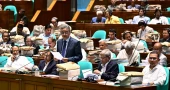
BNP govt's first budget
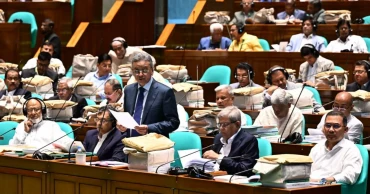
Tarique-led BNP govt's first budget resumes expansionary streak; reforms, investment-led growth, and national unity stressed
Finance Minister Amir Khosru Mahmud Chowdhury on Thursday placed the budget for the 2026-27 fiscal with a call for national unity, inclusive development, and continued reform-driven progress, emphasising the collective role of citizens from all walks of life in building a prosperous Bangladesh.
This is the first budget of the BNP government after winning the February 2026 election. Amir Khosru Mahmud Chowdhury as the Finance Minister delivered his maiden budget speech under the theme ‘Journey Towards a Democratic, Humane and Inclusive Economy’.
In the course of his nearly 4-hour budget speech, Amir Khosru, dressed in a dark grey suit paired with dark blue tie, repeatedly urged lawmakers and citizens including farmers, workers, students, women, youth, and expatriates to strengthen cooperation in achieving the country’s development aspirations. The finance minister took just two short breaks - that too for the Asr and Maghrib prayers.
He disclosed the government's vision to reduce inflation to 7.5 percent and raise GDP growth to 6.5 percent in the coming fiscal (2026-27).
For this, Khosru said he wants to rely on inclusive development, quality education and healthcare for all, universal social protection, an economy driven by investment, employment, and production.
He said he wants to step up deregulation and present a cost-effective, simplified business environment, financial sector stability, energy security, digital transformation and ICT development, management of life, nature, environment, and water resources and transparent, efficient, and accountable institutions and administrative systems.
The address highlighted that Bangladesh’s progress depends on the sustained implementation of electoral commitments, bold reform initiatives, and a united national effort.
“We firmly believe that through continued implementation of our electoral commitments, bold reform initiatives, and a united national effort, Bangladesh will advance steadily toward its development aspirations,” the Finance Minister said.
He said that it underscored the vision of building a society where equal opportunities are accessible to all, enterprise and innovation are encouraged, and the rewards of hard work are ensured, with the benefits of economic growth shared broadly among citizens.
“Our commitment is to build a Bangladesh where equal opportunities are available to all… through economic democratisation, deregulation, and the empowerment of the people, we shall build a prosperous and confident Bangladesh, InshaAllah,” he added.
Highlighting the importance of human capital, he said the strength, creativity, and entrepreneurial spirit of people remain the nation’s greatest asset.
The proposed national budget for the 2026–27 fiscal year has been framed with a strong emphasis on economic stability, investment, production, employment generation and building a more equitable society.
The government has set out an ambitious long-term vision of transforming the economy into a USD 1 trillion economy by 2034 through sustained and stable economic growth, driven by what it describes as “economic democratisation”, aimed at ensuring financial recovery and welfare for all citizens.
The budget claims to prioritise a shift away from debt-dependent growth towards a production- and private investment-led economic model.
In the medium term, efforts will be made to increase revenue collection, maintain budget deficits at sustainable levels, and restore discipline in debt management, with the aim of improving the country’s credit rating from moderate to low risk.
The budget deficit has been targeted at 3.6 percent of GDP, which will help keep borrowing risks at a manageable level.To encourage private sector investment, government borrowing from the banking sector will be gradually reduced.
At the same time, the government planned to diversify and strengthen the bond market through the introduction and expansion of corporate bonds and municipal bonds, thereby easing pressure on the banking system.
For the 2026–27 fiscal year, total revenue collection has been projected at Tk 6,95,000 crore, equivalent to 10.2 percent of GDP.
Of this, Tk 6,04,000 crore is expected to come from the National Board of Revenue (NBR), i.e. tax collection.
The tax-to-GDP ratio fell below 7 percent in FY2024–25, and the government said efforts will be made to significantly increase it in the coming years.
The total outlay proposed, or budget size, clocks a hefty Tk 9,38,000 crore, covering both operational and development spending - signaling a return to the expansionary fiscal policy that characterised much of the deposed Awami League government's tenure from 2009-24.
The interim government led by Dr Muhammad Yunus bucked that trend, as Finance Adviser Dr. Salehuddin Ahmed unveiled a Tk 7,90,000 crore national budget for the 2025–26 fiscal, marking a rare contraction of about 1% from the previous year's outlay.
If Khosru's proposed budget is passed without any major changes, it would mark an 18% jump over the current year's budget. One of the most significant points of departure between the two is the return to a much larger Annual Development Programme.
Operational expenditure includes subsidies, interest payments on public debt, procurement of capital equipment, food accounts, and administrative costs including advances to employees and state-owned enterprises.
The development budget, which is mainly made up of the ADP but includes some non-ADP schemes as well, stands at Tk 3,16,075 crore - nearly a third of the total outlay.
Priority has been given to investment-led and sustainable development initiatives.
In line with the party's promises on the campaign trail, the allocations for education and health have been significantly ramped up with a view to improve human capital development.
Education sector has been allocated around 2 percent of GDP, amounting to Tk 1,36,606 crore, compared to Tk 87,206 crore in the current fiscal year (1.39 percent of GDP).
The allocation spans multiple ministries beyond education including technical and vocational institutions under different sectors such as textiles, railways, defence, agriculture, fisheries, and ICT.
Similarly, the health sector's allocation has been increased to Tk 69,409 crore, equivalent to 1.01 percent of GDP, up from 0.58 percent in the current fiscal year.
The allocation includes spending by various ministries and agencies, including local government bodies, the Islamic Foundation, police-run hospitals, and social welfare institutions. The government has indicated a plan to gradually raise combined education and health spending to 5 percent of GDP in the future.
4 months ago