US, Canada
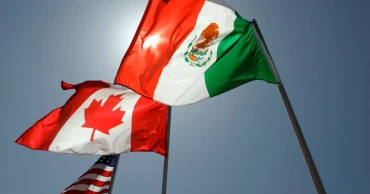
US, Canada and Mexico begin difficult talks on renewing North American trade deal
The United States, Canada and Mexico have begun negotiations to renew their regional trade agreement, a process expected to take months and possibly longer as major disagreements threaten to complicate the talks.
The three countries trade about $1.9 trillion worth of goods and services every year, or roughly $5 billion a day. Canada and Mexico have now overtaken China as the United States' two largest trading partners, making the outcome of the negotiations highly important for businesses across North America.
Many companies are hoping the talks will bring greater certainty after a year of changing tariff policies under President Donald Trump. However, analysts say the negotiations are likely to be difficult.
The U.S.-Mexico-Canada Agreement (USMCA), negotiated during Trump's first term, officially came up for review on Wednesday under a provision requiring the pact to be reconsidered every six years.
"There’s going to be a lot of drama this summer," said Diego Marroquín Bitar, a fellow at the Center for Strategic and International Studies, during a recent trade forum.
One of the biggest sticking points is the U.S. proposal to shift more manufacturing, particularly vehicle production, to the United States.
Washington wants stricter rules requiring a larger share of products to be made in North America, and specifically in the United States. Officials are also pushing for a new rule that would require at least 50% of every vehicle covered by the agreement to be produced in the United States.
Canada and Mexico strongly oppose the proposal, saying it goes against the principles of regional economic integration.
Analysts warn that tougher production requirements could disrupt established supply chains and increase vehicle prices in the United States, where the average new car already costs nearly $50,000.
The USMCA replaced the North American Free Trade Agreement (NAFTA) in 2020. While it largely preserved NAFTA's framework, it introduced stricter rules on regional content and higher wage requirements for some manufacturing sectors, particularly the auto industry.
The agreement currently requires that 75% of a vehicle's content originate in North America to qualify for duty-free treatment, up from 62.5% under NAFTA. The United States now wants that threshold raised further.
Trade experts say automakers have spent years restructuring supply chains to meet the existing requirement, making further changes costly and time-consuming.
Although Wednesday marks the start of the review process, experts do not expect an immediate agreement.
Oscar Ocampo, director of economic development at the Mexican Institute for Competitiveness, said negotiations are likely to continue for years if necessary. Under the agreement, the three countries have until 2036 to reach a new deal before the current pact expires.
At the same time, any member country can withdraw from the agreement by giving six months' notice, raising concerns in Canada and Mexico after Trump recently said he was "not looking to renew" the pact.
Ocampo believes the president is using the uncertainty as leverage to pressure Mexico on border security and immigration rather than preparing to abandon the agreement altogether.
Canada has so far played a limited role in the discussions, while the United States and Mexico have already held talks.
Patrick Childress, a former U.S. trade negotiator, warned that Canada risks being presented with a deal negotiated mainly between Washington and Mexico and being left with little room to negotiate.
Canadian Prime Minister Mark Carney said the three countries plan to hold a virtual meeting on Wednesday and stressed that his priority is to modernize the agreement.
Businesses across North America say their biggest concern is not necessarily new trade rules but uncertainty.
Shawn Miller, co-founder of Michigan-based importer PKGD Group, said companies need stable policies to plan ahead.
"If the rules change, the rules change. But we'd really like to know what they're going to be and have them stay that way for a while," he said.
PKGD imports tequila, mezcal and other agave-based spirits from Mexico. Earlier this year, three of its shipments were unexpectedly hit with a 25% tariff before qualifying products under the USMCA were later exempted, leaving the company with an additional cost of about $105,000.
Miller said smaller businesses do not have the legal teams or trade specialists available to large multinational companies, making sudden policy changes especially difficult to manage.
1 month ago