drones hit
Ukraine uses midrange drones to hit Russian supply lines and slow advances
Ukraine is increasingly using midrange drones to strike Russian supply routes far behind the front lines, a strategy military commanders say is disrupting logistics, slowing Russian advances and helping Ukrainian forces regain ground.
From an underground command centre in Ukraine's Kharkiv region, drone operators monitor live thermal images of roads in Russian-held territory. Once they spot a military vehicle, they guide the drone toward its target, aiming to destroy fuel, ammunition and troop supplies before they reach the battlefield.
"Our mission is to cut logistics," said Kat, commander of Ukraine's K-2 Brigade. "If we stop their supply lines, frontline troops are left without food, ammunition, batteries and night-vision equipment. That's how we weaken them."
The soldiers interviewed by The Associated Press used only their military call signs, following Ukrainian military rules.
By repeatedly targeting roads used to transport fuel, ammunition and reinforcements, Ukrainian commanders say they have made Russia's supply operations slower, more expensive and less reliable. They believe this has helped slow Russian offensives while allowing Ukraine to launch counterattacks and carry out strikes in Russian-occupied Crimea.
Until recently, this area was difficult for Ukraine to reach. Frontline drones lacked the necessary range, while long-range drones were reserved for strategic targets hundreds of kilometres away. That left a large area where Russian forces could move supplies with little threat.
Now, fixed-wing midrange drones equipped with Starlink satellite communications have filled that gap, turning Russian supply routes into active targets.
"They are putting constant pressure on Russian logistics and making it harder for Russia to keep some parts of the front supplied," said Samuel Bendett, a researcher at the Center for Naval Analyses.
Bendett said Ukraine will need to maintain this pressure while Russia develops ways to counter the drones. Although he expects Moscow to adapt over time, he said Russia's larger military can absorb greater losses for now.
"The key question is whether Ukraine can keep up this pressure in the coming weeks and months," he said.
The K-2 Brigade operates from what looks like an ordinary office, while drones are assembled in workshops and launched from hidden locations near the front.
Inside the command room, drone pilots dressed in civilian clothes work at desks covered with coffee cups, energy drink cans and electronic devices. Their computer screens display satellite maps and target locations rather than office documents.
In May alone, the brigade launched 800 midrange drones, successfully hitting their intended targets with 650 of them.
The drones are launched more than 200 kilometres away, after which pilots in Kharkiv take control. They can guide the aircraft for up to four hours and more than 100 kilometres behind Russian lines.
Some operators are flying drones over towns they once called home before Russia's invasion forced them to leave. They now search those same streets for Russian troops, military vehicles and ammunition depots.
The brigade even keeps a scoreboard tracking the performance of its 10 drone teams. The current record stands at 17 successful strikes in a row.
One of the unit's top drone operators, 20-year-old Pharaon, said his gaming experience helped prepare him for the job.
"When I was younger, I spent a lot of time playing Counter-Strike," he said. "It's similar in some ways because you're competing to destroy enemy targets."
Military experts say Ukraine's campaign gained momentum earlier this year after SpaceX blocked Russian forces from using Starlink satellite services without authorisation. The move disrupted Russian drone operations while giving Ukraine a technological advantage.
Rob Lee, a senior fellow at the Foreign Policy Research Institute's Eurasia Program, described the Starlink restriction as one of the year's most significant developments on the battlefield.
Pharaon said the improvement has been dramatic.
"Now, eight out of every 10 missions are successful," he said. "A few months ago, it was the opposite."
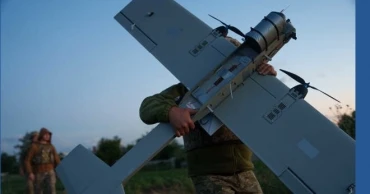
The K-2 Brigade mainly uses the Dart drone, an inexpensive aircraft made from lightweight materials including wood, polystyrene and 3D-printed parts. It is mainly used to attack Russian supply convoys. Larger drones, such as the Hornet, carry heavier explosives and are used against bridges and other infrastructure.
Before every mission, crews inspect batteries, cameras, flight controls and the Starlink communication system to ensure the drone remains connected throughout the flight.
The drones are then taken to concealed launch sites near the front line, where soldiers prepare them for takeoff using catapult launchers.
Russia was initially caught off guard when Ukraine expanded the campaign about three months ago. It has since increased mobile air defence teams, machine-gun positions and drone interception units, but Ukrainian commanders say the speed and scale of the attacks have allowed them to stay ahead.
Bendett said Russia also faces coordination problems between military units, making it harder to respond quickly when drones are detected.
Ukraine has focused many of its attacks on key highways linking the occupied cities of Mariupol, Berdyansk, Melitopol and Crimea, which are major supply routes for Russian forces in southern and eastern Ukraine.
According to Ukraine's military intelligence, repeated drone attacks have made parts of the land corridor connecting Russia to Crimea increasingly dangerous, disrupting the movement of fuel, ammunition and reinforcements.
Pharaon said Russia is now expanding its anti-aircraft defences and deploying more interception teams near major cities.
In response, Ukrainian drone operators plan routes that avoid known Russian air defence positions. During flights, they sometimes see anti-aircraft fire below as the drones continue toward their targets.
Lee said Russia has also been testing electronic warfare systems designed to interfere with Starlink since 2024, but so far those efforts have had only limited success.
"I think they have achieved some success, but we'll have to wait and see how effective it becomes," he said.
3 months ago