South Korean stock
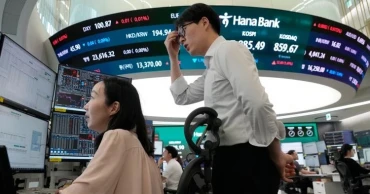
Asian markets fall as South Korean stocks tumble despite Wall Street's AI-driven rally
Asian stock markets closed lower on Tuesday, led by a sharp fall in South Korean shares, even as AI-related stocks helped lift major US indexes overnight.
Oil prices edged higher, while US stock futures showed mixed performance.
South Korea's Kospi briefly plunged as much as 8% before recovering some ground to end the day down 4.9% at 7,656.31.
Shares of Samsung Electronics dropped 7.7%, despite the company reporting a 19-fold jump in quarterly operating profit to 89.4 trillion won (about $58.7 billion) and more than doubling its revenue. Chipmaker SK Hynix also fell 6.7%.
Kim Seok-hwan, an analyst at Mirae Asset Securities, said Samsung's decline was mainly due to foreign investors taking profits after recent gains and adjusting their investment portfolios.
Technology stocks linked to artificial intelligence have seen sharp swings in recent weeks as investors question whether the massive spending on AI chips and data centres will generate enough profits to justify the investments.
Stephen Innes of SPI Asset Management said the market reaction to Samsung's strong earnings suggested investors were becoming more cautious about AI-related stocks.
Investor sentiment will face another test this week as SK Hynix plans to raise $28 billion through a Nasdaq share offering in the United States. If successful, it would rank among the largest US stock offerings, following SpaceX's $75 billion IPO last month.
Despite recent losses, SK Hynix shares have more than tripled this year on strong optimism over AI demand.
Elsewhere in Asia, Japan's Nikkei 225 fell 2.1% to 68,256.96. Tokyo Electron lost 3.9%, while Kioxia Holdings dropped 11.3%.
Hong Kong's Hang Seng Index slipped 0.7% to 23,444.20, while China's Shanghai Composite Index declined 1.3% to 3,990.25. Taiwan's Taiex lost 2.3%.
Australia's S&P/ASX 200 edged down 0.3%, while India's Sensex gained 0.5%.
On Wall Street, the S&P 500 rose 0.7% on Monday to 7,537.54, moving within 1% of its record high despite most of its listed stocks ending lower.
The Nasdaq Composite climbed 1.1% to 26,121.16, driven by gains in AI-related technology companies, while the Dow Jones Industrial Average added 0.3% to close at a record 53,055.91.
Broadcom was among the biggest contributors to the S&P 500's gains after rising 3.7% on news of long-term agreements to supply silicon products to Apple.
SpaceX fell 1% in its final trading session before joining the Nasdaq-100 index, a move expected to trigger buying by funds that track the benchmark.
AI infrastructure company TeraWulf gained 4.9% after announcing a 20-year agreement with Anthropic to use its Kentucky data centre. The company expects the deal to generate about $19 billion in revenue as it shifts its business from bitcoin mining to high-performance computing.
In energy markets, Brent crude, the international benchmark, rose 84 cents to $72.83 a barrel, while US benchmark crude increased 73 cents to $69.28.
Oil supply concerns resurfaced after the British military reported that a liquefied natural gas tanker caught fire off the coast of Oman in the Strait of Hormuz after being struck by a projectile early Tuesday.
The latest attack highlighted continuing security risks in the strategic waterway, through which about one-fifth of the world's oil and natural gas trade once passed during peacetime. Iranian state television reported that the tanker was attacked after ignoring warnings but stopped short of claiming responsibility.
In currency trading, the US dollar slipped to 162.01 Japanese yen from 162.09 yen, while the euro eased to $1.1431 from $1.1442.
3 months ago