Maijbari
Maijbari: the village that builds the haor’s lifeline, yet struggles to stay afloat
In Bangladesh’s haor region where monsoon waters transform roads into waterways for nearly half the year, boats are not merely a means of transport—they are a lifeline and for decades, Maijbari, a village in Sadar upazila, has quietly kept that lifeline afloat.
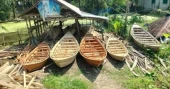
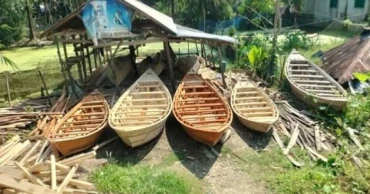
Located just three to four kilometres from Sunamganj town, the village has earned a reputation as the district’s “boat village,” where generations of artisans have preserved the craft of wooden boat building.
More than 3,000 residents depend directly on the trade, producing a wide range of traditional boats, including barki, khilua and dingi.
Boatbuilding continues throughout the year, although demand peaks during the rainy season when the haor landscape becomes a vast expanse of water.
According to local sources, around 400 small and large boats leave Maijbari every month.
The annual market value of the industry is estimated at nearly Tk 22 crore, with buyers travelling from Sylhet, Habiganj, Moulvibazar, Netrokona, Kishoreganj and other districts.
The boats serve multiple purposes—from carrying passengers across flooded villages to transporting fish, feeding fish in ponds and navigating rivers, canals and wetlands.
Depending on their size and design, prices range from Tk 12,000 to Tk 150,000.
Yet behind this thriving business lies a difficult reality.
Despite producing boats worth crores of taka every year, most craftsmen struggle to make ends meet.
Rising timber prices have become one of their biggest challenges, said the boatmakers .
With quality wood becoming increasingly scarce locally, artisans now have to source timber from distant districts, pushing production costs sharply higher.
Lack of capital presents another obstacle. Many craftsmen rely on advance payments from moneylenders or traders to finance production.
In return, a significant portion of the proceeds from each sale goes to these financiers, leaving the builders with only a modest share despite months of labour.
“We’ve been in this business since the time of our forefathers,” said veteran boatmaker Tajud Ali.
“But profits are shrinking as costs continue to rise. Somehow we’re managing to survive. We cannot abandon a tradition that has been passed down through generations. If the government provided loans on easy terms, it would help us greatly.”
Another craftsman, who has spent around 45 years building boats, said financial security has remained elusive despite a lifetime devoted to the trade.
“From sunrise to sunset, we work with wood. Boat building is the only source of income for my family,” he said, expressing hope for greater government support.
The craftsmen believe the industry has significant untapped potential.
They said easier access to institutional credit, modern technical training and better marketing support could help preserve the traditional craft while improving the livelihoods of thousands of families who depend on it.
M.N.M. Asif, deputy general manager of the Bangladesh Small and Cottage Industries Corporation (BSCIC) in Sunamganj, said the organisation has introduced programmes to support artisans involved in the boat industry.
“BSCIC is providing training programmes, and small loans are also available under certain conditions,” he said. “We will continue taking necessary initiatives to further develop this traditional sector.”
3 months ago